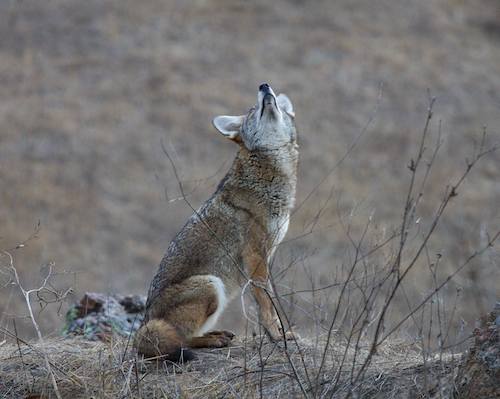
Here are photos of coyotes in their full winter coats. The wind blowing through the coat of one of the coyotes reveals for us not only how long and thick the winter coat is, but also how the coloring works throughout the length of the fur shaft.
Lush Winter Coat Revealed In The Wind
15 Oct 2010 Leave a comment
in coyote physical appearance, coyote's coat
Buddies Still
15 Oct 2010 Leave a comment
in coyote behavior, family interactions, group activity


In spite of the bullying and shows of dominance by one coyote sibling towards another, I still see the two walking together at times. Maybe not as lovingly as before, but nonetheless, together.
Bullying And Dominance
14 Oct 2010 Leave a comment
in communication, coyote behavior, dominant vs. submissive, family interactions, hierarchy


Here is another instance of bullying and dominance between two 18-month old male coyote siblings: it has to do with coyote family dynamics. The dominant one rushes at the other with his hackles up and then pursues him aggressively. The other one runs off, crouches low, holds his ears back, and hits the ground. This trend continues on a stronger level than previously. Notice that at the end, the dominant coyote licks his chops: I’ve seen this before in this type of interaction and wonder what it means.
Tail Spots
14 Oct 2010 Leave a comment
in coyote physical appearance, coyote's coat


Very often, the spot which is about one-third of the way down a coyote’s tail, can be used to distinguish one coyote from another, at least from the back! Here are three different coyote tail markings. Notice especially the middle fellow: his marking is almost lightning shaped — the same as Harry Potter’s scar! During the summer, because the fur is shed, the marking are less distinguishing than when the coyotes have their full winter coats.
Found: Another Toy Treasure
12 Oct 2010 Leave a comment


Coyotes love to play, either with each other, or alone with a toy they have found. A toy is anything that has the potential for fun. In this case it was a child’s lost lady-bug doll. Although our human eyes might be drawn to the toy’s bright red color, as far as I’ve been able to find out, canine’s can’t really see red. A red ball tossed onto a lawn is much more difficult for a dog to find than a yellow one.
Toys are pulled, tossed and torn apart. They are rolled on and urinated on. Sometimes they appear to be lovingly caressed. More often than not, a young coyote will eventually leave his toy to return to it later, but I’ve also seen a coyote carry his toy several hundred feet before dropping it in a very unconcerned way and then continuing on himself without the toy. The day after I took these photos I found parts of this toy strewn over some distance: plastic, cloth, cotton stuffing. This is no different from the way a dog would play with a toy. The main difference I have seen is that a coyote will very often “mark” his found treasure — he definitely wants to claim it as his own. I don’t know if this “claim” is for the benefit of dogs visiting the park, or for his own family members.
Intimidated Into The Bushes
12 Oct 2010 Leave a comment
in coyote behavior, dominant vs. submissive, family interactions, hierarchy


Here is another instance of intimidation by one coyote over its sibling. I was watching the dominant coyote sibling when he spotted his sibling and approached hackles up. The less dominant coyote retreated into the bushes for protection. The dominant coyote went no further, but licked his chops and moved on, and that was the end of the spat. Both coyotes then continued their meanderings, but at a distance from each other.
Happiness Descending A Hill
12 Oct 2010 Leave a comment
in coyote behavior, feelings & emotions


Coyotes very often are extremely joyful: you can see this in their faces and in their body movements. This coyote seemed to be infused with happiness as he descended the hill.
“Thoughts on Dogs and Coyotes” by Charles Wood
11 Oct 2010 5 Comments
in communication, competition for resources, coyote behavior, coyote reactions to dogs, coyotes and dogs, coyotes and dogs are different, coyotes defending themselves, dog reactions to coyotes Tags: coyotes and dogs
Over the last year the encounters between my dog and “my” coyotes have escalated into confrontations. A year ago I could unleash my sixty pound dog in their field and successfully manage their infrequent interactions. I’ve come to understand that my past success was influenced by chance and happenstance to a greater degree than I previously thought. Today I consider my entering their field as potentially unsafe and provocative. In contrast, other people use that field at times and have told me they have not seen coyotes there. Young boys use a part of the field for bicycling, having built earthworks for that purpose. Transients at times sleep there. Groundskeepers make their appointed rounds. Teenagers party. Towards these other field users, the coyotes have remained a “ghost species”, perhaps because they don’t bring dogs with them. My dog and I have caused the coyotes to single us out for increasingly confrontational treatment. It took a year for those changes to develop, a testament to the coyotes’ natural tendency to avoid people.
By chance and happenstance I mean factors that influence coyote behavior. At root their behavior is about food and reproduction. Coyotes live mostly in family groups. Consequently, if you see one coyote there is a good chance there is at least one more present nearby. It doesn’t seem likely that one coyote and an equally or greater sized unleashed dog will seriously injure each other. My opinion is that mature breeding coyote pairs together are smarter and stronger than one dog of their size or larger and that coyotes don’t play by the rules that a typical pet dog expects. The encounters between a larger unleashed dog and such pairs seem to me to be advantaged to the coyotes. The proximity of a human and the degree of human control exercised over the dog become critical to the outcome of such an encounter.
An unleashed larger dog appears to a coyote as an interloper, and intruder. Coyotes are known to be intolerant of interloper coyotes. Coyotes will defend their food sources and their young. Their options in so doing are legion and their choice of tactics is perhaps situational. My situation is that my dog foraged, he did not simply walk through the area and/or chase my coyotes. Also, my dog interacted with a mated pair. My observations of my coyotes and my interloper dog took place over the last year or so. The contact with the coyotes began with them simply showing themselves. They seemed to be saying, hey, you’ve smelled me and my markings, why are you still here? After a time of being in view, they would withdraw into the brush. At some point later Dad would attempt to sneak up behind my dog, presumably to deliver a nip to his haunches, nips I could prevent by yelling. As time passed and I ignored these messages, Dad escalated to warning bark sessions after which he would return to the brush. Barking sessions were later replaced by more aggressive displays of marking, scraping and mock charging followed by partial withdrawals where he remained in full view. If we didn’t leave, he would begin those aggressive displays again. Later, to those types of aggressive displays, Dad at times seemed purposed to separate me from my dog where I read his intent as to engage my dog in combat. Mom recently temporarily separated me from my dog although we were on opposites sides of a chain link fence.
These behaviors developed over about a year, and about a month ago, Mom also began mock charges, marking and scraping without retreating from view. I should mention that the zone of intolerance increased beyond their field and into other areas where my dog and I had never had problems with them. My read of my dog is that he would not visit those coyotes of his own accord and that he has felt that way for some time. Also, much of the time when we walk along the river bank or go to the bridge, we don’t see any coyotes. When we do, many times my coyotes don’t behave aggressively. I can’t predict when they will or when they won’t. When I do see them, it is for an insignificant fraction of their day and I never know what kind of day they had.
Several years ago in a different area, at dusk, two coyotes followed my dog and me as we were leaving. On the crest of a hill, one of the coyotes ran out in view of my dog while the other remained behind crouching. My dog stupidly chased the moving coyote down the hill out of my sight. The crouching coyote did not follow my dog, perhaps because I was present. Perhaps the coyotes were practicing, but clearly my dog was at risk of being defeated in a frontal and rear attack. I hadn’t visited that other area very often, yet those other coyotes engaged my dog at a level it has taken a year for my usual coyotes to approach. Once, in that other area, my dog was off leash and out of my view. I called him and he didn’t come. I began to look for him and soon saw him running full speed towards the exit which is located about a mile from where we were. I called him, he momentarily paused, missed one step in his galloping gate and looked me in the eye. His look and body language said to me, “Forget it, I’m outta here buddy!” It took me a while to catch up to him near the exit. I believe he was responding to some wildness directed towards him by a coyote, again, one of my first visits to that other area. Here again I am speaking to the unpredictability of coyote behavior, the reason the experts advise us, upon seeing a coyote, to go the other way. We can choose to do so. An unleashed dog may decide to chase the coyote and the outcome may or may not be consequential to the chasing dog.
Part of the unpredictability of coyote behavior could be attributable to the fact that the circumstances in which coyotes find themselves change over time. Food may be plentiful one year and scarce the next. A female may lack a mate one year and acquire one the next. One year there may be no puppies and the next there may be several that survive for months or longer. I have no idea why the coyote I call Mom recently became aggressive when for the longest time she was timid and obsequious.
I want to reiterate that the behaviors of escalating aggression I observed over a year were behaviors that I elicited by ignoring the messages the coyotes were giving me. My behaviors caused the increasingly aggressive behaviors I observed. From the point of view of the coyotes, my behavior was that of a perpetual repeat offender. I continually brought my dog, whom they perceive as an intruding competitor, into their home. I had decided to give my 60 pound dog a little space with coyotes in order to find out for myself what would happen. I don’t like what happened. My behavior was to repeatedly intrude into their home range and seek contact and take pictures. My unwise dog used the space I gave him to seek food and to disturb the coyote family. The coyotes’ home range contains their children and their food, the two things coyotes care most about. They responded accordingly. After all, coyote behavior is rooted in food and reproduction.
I’ve wondered, considering how little territory my coyotes occupy, how it was that rabbits were always present. Why weren’t the rabbits depleted and why hadn’t the coyotes moved on? One reason is rabbits reproduce rapidly. Another is that other rabbits nearby come in and take over the space formerly occupied by rabbits that the coyotes ate. The same kind of habitat seeking applies to coyotes. Removal or extermination creates empty habitat for other coyotes to find and occupy. The idea that “something must be done” about coyotes is simply an idea that is obsolete. Coyote survival in urban and suburban areas doesn’t depend at all on how many are removed or killed. Their ability to find and use habitat in urban and suburban areas depends on how we behave towards and think about coyotes. Understanding the nature of coyotes helps us to manage our lives in ways that minimize unwanted contacts with them. Coyote presence requires us to change a little.
Dried Gum Nuts
11 Oct 2010 1 Comment


Coyotes have been foraging in the dried leaves along the paths, eating something which, until now, I hadn’t really concentrated on. Then, as I spoke to the owner of a Rhodesian Ridgeback, the dog began foraging and crunching the same stuff as the coyotes. It was gum nuts from the Eucalyptus trees! This dog was picky about her gum nuts — some were crunched and then spat out. But some of them were crunched and swallowed.
Gum nuts are the hard woody fruit — the hardened seed container — of the Eucalyptus.
The gum nuts, which contain seed and chaff, remain on the tree after it has flowered. When they ripen, they fall off. Once on the ground, they dry out as they age. The valves in the top of the nut open and release the seed and chaff. Even before this happens, the woody seed container becomes dry and brittle and much easier to crunch open by a foraging animal. Seeds, it would seem, are nutritious, and maybe even tasty?
More Ears And Facial Expressions
11 Oct 2010 Leave a comment
in communication, coyote behavior, family interactions, feelings & emotions


I posted several of these photos a couple of months ago when I took them. The little guy was sitting in the same spot for just a few short moments, during which time he displayed a wide range of ear movements and facial expressions. He was “dealing” with a sibling to our left who was pressuring him to “come along”. This coyote reacted to the sibling’s pressure by sitting firmly in one spot, and for the most part, looking away. However, the ear movements and facial expressions show that along with the defiance there is a bit of inner conflict going on, too! Notice that the ears move from up and forward, up and to the side, down and to the side, down and back, head cocked to the side, eyes narrowed. Twice he glances over his shoulder at the sibling. I wrote about this incident from the perspective of the other sibling on July 4 when I took these shots: Aren’tcha Coming???
“Youngster And Mom”, by Charles Wood
10 Oct 2010 Leave a comment
-

- PupNorth
-

- PupSouth
-

- MomAdvice
-

- MomAvert
-

- MomWatch
The week ending Saturday, October 10 included a twilight sighting of one youngster on October 7. I stood looking east from the river bank accompanied by my leashed dog. We saw the larger of the two youngsters, probably female, move briskly north along a dirt road. She stopped at the rendezvous site where the north-south dirt road is met by a dirt road that runs east. Her demeanor was of a coyote with an important and agitating concern. She did not look towards us. Nor did she linger at the rendezvous site. She turned back and even more quickly arrived at the dense brush that contains the family den. Before entering the brush she gazed south a few times. An unknown had prompted her to venture out into the open, investigate, and withdraw. Perhaps her behavior was prompted by what in her mind was a known unknown. Apparently her behavior confirmed the known unknown as yet unknown and she had the presence of mind to know she still didn’t know and she withdrew.
Late dusk Saturday was Mom’s day. Again I stood looking east from the river bank with my leashed dog. I had difficulty seeing any motion in the dimming light. Then my dog alerted by standing up with a whimper. I used my camera to spot Mom advancing on us from the north. It took me about half a minute to focus on her after my dog stood. My first picture of Mom shows her advancing and making eye contact with the camera. The second shot shows Mom averting her gaze. She then evaded and I lost sight of her. It took me four minutes to find her watching us from a point further south. I found her by aiming my camera along my dog’s line of sight. He had not lost track of her. The impression I am left with is of Mom having it in her mind to challenge my dog. I favor that view because Mom didn’t halt her advance or avert her stare until she noticed I had spotted her. Until that moment she was most probably giving my dog the eye as she approached, causing him to stand and vocalize his concern to me.
Mom, Dad and perhaps the larger youngster (in an inexperienced way) object to my dog’s presence in their territory. My proximity to my dog has so far worked in his favor. Over a year ago Dad wasn’t carrying the battle scars he currently displays on his upper nose. I am inclined to view Mom’s drooping ear as from battle as opposed to being a congenital defect. Mom and Dad have occupied and held their territory for at least a year. There are other coyotes in the immediate vicinity, presumably each breeding pair dispersing youngsters. Dispersed males and females must eventually be drawn to each other by scent to then find and hold territory of their own. Coyotes are both drawn together and in opposition to each other. Coyotes are at times drawn to dogs and at times are in opposition to dogs. Dogs are domesticated, coyotes are wild. To be safe near wild coyotes, a dog needs proximity to its owner, secured by a leash.
I sentimentally refer to my breeding pair as Mom and Dad. Actually, they aren’t mine and they aren’t sentimental about me. I recognize them as battle hardened by conflicts with their coyote neighbors and with coyote interlopers. Together Mom and Dad are capable of severely injuring my dog, perhaps fatally, despite his weight advantage over either of them alone. Were he not at my side and leashed, or, if leashed, were he twenty feet from me instead of six, I would have significantly less influence over an encounter’s outcome.
The character and outcome of encounters between dogs and coyotes are not predictable to a certainty. It is certain that experts advise a dog be leashed when walked in areas where coyotes are known or suspected to be present. In considering that advice, substitute cars for coyotes. Unleashed, a dog may run into a street where the outcome can’t be predicted with certainty. Cars are known or suspected to be present in streets. Yet cars may either be present or not, may hit a dog or not and if hit, may injure or may kill. With a dog off leash near a street, an event may unfold that either ends well or doesn’t. Consider that with either cars or coyotes, one just doesn’t know what is going to happen once a dog gets in the wrong place. A leashed dog is far less likely to get in the wrong place. A leash provides a dog owner with some power over events.
Posting written by Charles Wood. Visit Charles Wood’s website for these and more coyote photos: Charles Wood. His work is copyrighted and may only be used with his explicit permission.
Snapping: Growing Discord Between Coyote Siblings?
10 Oct 2010 Leave a comment
in communication, coyote behavior, dominant vs. submissive, family interactions, group activity
-

- less dominant coyote #2 sitting close to a path
-

- dominating coyote #1 to our right approaches coyote #2
-

- dominating coyote #1 sits as less dominant coyote #2 moves off
-

- less dominant coyote #2 moving off
-

- less dominant coyote #2 sniffs a spot, then urinates on it & moves on
-

- dominating coyote #1 comes to the same spot to mark it
-

- after marking, dominating coyote #1 looks in direction of coyote #2
-

- dominating coyote #1 approaches & attempts to mount coyote #2
-

- less dominant coyote #2 snaps at coyote #1 who has come over to him
-

- dominating coyote #1 retreats back
-

- less dominant coyote #2 moves off as dominating coyote #1 stands with hackles raised
-

- less dominant coyote #2 sits and looks away while dominating coyote #1 seems to accept the rebuff
-

- dominating coyote #1 turns around and marks a spot
-

- after marking, dominating coyote #1 moves away
-

- less dominant coyote #2 decides to move on
-

- dominating coyote #2 again follows, seemingly to take over
-

- less dominant coyote #2 moves off again and sits down
-

- dominating coyote #1 again walks towards less dominant coyote #2 who keeps his gaze diverted from the first one
Although these 18-month old male coyotes continue to spend time together, I’ve been noting a growing dissonance between them, and growing separation. The angry snapping in self-defence by the less dominant coyote #2, has become more routine. The dominant coyote #1 persists in attempting to dominate, while the less dominant #2 tends to move off or look away to avoid the first one. At this point I would not call coyote #2 submissive, after all, he snaps in self-defence. However, coyote #1 is definitely dominating in his behavior. Coyote #2 deals with the hounding by moving away and averting his gaze. His patience is wearing thin: “If you want to boss me around, go fly a kite.” I’ve labeled what went on today in the sequence of photos above.
Fleet Week
10 Oct 2010 2 Comments

Not everyone appreciates the horrendous and scary sound created by the Blue Angels as they zoom through the skies overhead.
Observing, Responding, and Rest — Hinge On The Human Factor
09 Oct 2010 Leave a comment
in barking, care for the young, coyote barking, coyote behavior, coyote reactions to dogs, coyotes defending themselves, dog reactions to coyotes, family interactions, monitoring, resting Tags: coyote behavior: the human factor
-

- Mom, sees something in the distance which puts her on alert
-

- Mom, off like a bullet (blurred)
-

- Mom, shooting across the park
-

- encountering a youngster who follows her
-

- Mom, barking and upset
-

- young coyote watching as Mom barks nearby
-

- Calmed down, Mom heads to another area
-

- Mom gives a last lookout to make sure German Shepherd is gone
-

- Mom spends the rest of the morning asleep and resting
This story hinges on human conduct, which is always the cause behind coyote “incidents”, and also the route through which misinformation is turned into nasty rumors. The only way we can control coyote behavior is through our own behavior. Leave them alone, and they will leave you alone.
So, the day began peacefully, as usual. Very often, when coyotes are out early resting on a hillside, a group of unleashed dogs will aggressively run up to their remote location and chase them. It is always the same group of dogs with the same set of owners who have never taken responsibility for keeping their dogs away from the coyotes — this group is one of the few who are not fond of having coyotes around. Ninety-nine percent of dog owners, however, are respectful and want to do what they can for the urban coyotes. They are totally responsible, keeping their dogs leashed or under voice control when coyotes are out. Repeated “incidents” always occur with the same few dogs. Fortunately, today the coyotes were not out when these dogs went by.
However, not long after they passed, a coyote did appear up on a hilltop, observing her surroundings. We know it was the mother coyote because of the behavior which followed. Several groups of walkers stopped to admire her presence in the park as she sat so calmly looking around: this was magical urban wildness. It was all so peaceful. Then the coyote jolted to a sitting up high position: her attention became riveted into the distance. She ignored the walkers below her. And then, as suddenly as she had sat up, she darted off like a bullet at full speed with hackles raised.
I’ve seen her do this before, so I knew what it was about. She sped to the spot which she had been so keenly observing. On the way she encountered one of her full-grown pups — but this is not the one she was worried about. She had the aim of heading-off a dog which was pursuing her other year-old pup. I didn’t even have to be there to know this. We then began hearing this mother coyote’s distressed and upset barking — barking she only engages in if she or one of her pups have been pursued by a dog. The barking is an indication of her distress, but also imparts a message: “Keep your distance.”
A few of us who just a few moments earlier had been watching her peacefulness, headed off to where the distressed barking sound was coming from. On the way we passed the angry owner of the dog which had chased the coyote — she now had her dog leashed. This huge dog continually chases the coyotes — it is a game for the dog who is about four times larger than any coyote. The owner wouldn’t even look at us: for her, the incident was the coyote’s fault for being there — not hers for not having leashed her dog.
We walked a little further until we spotted the mother coyote: she was rearing up on her hind legs and barking. The young coyote which had been pursued had taken cover in the bushes, but the second young coyote sat on the hillside nearby watching as its mother continued her barking for about 20 minutes.
The reactions to this incident were various: these are the reactions which get reported to our Animal Control Department. Some people were furious that a dog walker had allowed her dog to chase a coyote again — and that dogs are not kept leashed in this “leash-law” area. Some were just fascinated by the barking, and fascinated that a mother coyote would run such a long distance to defend one of her year-old pups from a dog. Some twisted the information to fit their own image of coyotes, saying the coyote had not been chased at all, that she was aggressive and bold and a danger to humanity. And finally there was the individual who points to observers or photographers so as not to have to address his own reasons for not leashing his dog.
It was nice having the witnesses who saw the young coyote chased by the German Shepherd. More and more people are willing to give their names to defend the coyotes and I want to thank them all. When a coyote defends itself or its pack members, it is not an act of aggression or an attack. In fact everyone needs to become more aware of nuances in terminology so that they may be able to describe what they see more accurately. Lynsey White and Stanley Gehrt of Ohio State University point out that the phrase “coyote attack” is sensationalistic and fear-mongering. We need a better choice of words and consistency to better understand how coyotes actually interact with humans. People often conflate words like “aggressive”, “assertive”, “bold”, “curious”, “defensive” and “investigating”. Details of the behavior of people, dogs and coyotes prior to and during any coyote incident are needed to really understand what is going on.
Our mother coyote finally calmed down. I watched her slowly head down a hill and into the bushes and finally up to one of her remote lookout posts, where she gave one last glance around to make sure the German Shepherd was gone. Then she lay down and napped. A couple of hours later I returned to the park to find her still in that same spot resting. Coyotes just want to be left alone. If you leave them alone, they will leave you alone. Please keep your dogs leashed around coyotes.
Jaws And Teeth
07 Oct 2010 9 Comments
in coyote physical appearance Tags: coyote jaws and teeth


My first impression upon seeing a coyote skull was of how small in size it was. I’m used to seeing coyotes in real life: the skull appeared so much smaller than life. Coyotes are known for their long snouts. The palate length/width ratio for a coyote is more than 2; whereas that for wolves and dogs is less than 2. The entire jaw length is 5.5 inches; the line of teeth is just under 4 inches. Of particular interest is the very narrow lower jaw.
Like dogs, coyotes have four canine teeth, two upper and two lower, for grabbing and holding prey. These canine teeth are not as sharp as those of a cat. The premolars — teeth behind the canine teeth — are used for tearing chunks of meat from larger prey. Coyotes also have molars for chewing, but these teeth don’t get much use except in crunching bones or eating hard objects such as nuts. Coyotes are very versatile in their eating habits: consuming fruits and insects, as well as carrion and rodents.
How sensitive is a coyote’s mouth, and how finely can a coyote manipulate its teeth? I’ve seen a coyote dismember a cricket before eating it, and I’ve seen a coyote remove a thorn from its paw: things most dogs cannot do. I’ve seen a coyote pick a tick off of another coyote’s back. So a coyote’s control of its mouth is VERY fine. My own dog’s very uncanny ability to finely manipulate with her teeth may be indicative of a coyote’s ability to do so. My little dog had an instinct for what was healthy and what was not. Cinder did not like the bandaid on my finger — I’m sure she could sense the small wound underneath which needed only air to heal. As I sat with her she caringly began to take the bandaid off of me. I let her do it and watched. The gentleness and precision involved were absolutely astonishing — she barely touched the finger itself at all. The reason I allowed her to do this was because of a previous incident involving her own health.
Cinder was born with fragile coronoid processes which broke and got into her elbow joint. The bone chips had to be removed. The operation involved an incision down the front part of a foreleg. And she had 11 stitches. The amazing thing is that four days before the stitches were to come out, she took her health into her own hands. Stitches left in too long can become infected. She may have sensed infection beginning or maybe she sensed that they were no longer needed. I saw her take out her own stitches, one at a time, ever so gently so as not to hurt anything else. Using her teeth, she actually unknotted a few of the stitches, and she cut through the rest. Once she began this, I allowed her to continue because it was obvious that she knew what she was doing. I trusted her innate knowledge, even more so as I continued to watch. The doctor’s timeline for the same stitch removal was only four days away. This story is to show how extremely finely specific dogs can manipulate their teeth and mouths. For a coyote, the control would be even more precise.