Great Blue Heron – Cormorants – Running Away From Home

the eucalyptus tree

the eucalyptus tree

Here is more wildlife, aside from the coyotes.

I went to see the Great Blue Heron nest in the Eucalyptus tree on Lake Merced. The “nativists” will have you believe that the Eucalyptus are useless for wildlife and that “they are fire hazards which must be removed.” These folks seem to have their “eyes wide shut”. We have found hawks, owls, cormorants, Great Blue Herons, monarch butterflies, bees, hummingbirds, bats and countless songbirds live in these trees. And as for fire, the Eucalyptus were planted as a windbreak which serves to *prevent* fires! We’ve had no forest fires in San Francisco, but we have had grass and brush fires — and the surrounding Eucalyptus did not burn! Nativists want to replace trees with grasses.

There were about 12 cormorant nests in the Eucalyptus tree — yes, all in ONE tree — with chicks in various stages of development, including a mom sitting on her unhatched eggs, so I watched them as well as the Great Blue Heron nest.

The Great Blue Heron nest had three large nestlings. They sat low, stood up, groomed, stretched their wings, stretched their necks, looked at me, pooped, yawned, made a strange sound which I can’t even begin to describe, picked bugs off one another and grabbed each other’s beaks. They were pretty calm and subdued. No adults were in sight. Where was Mom?

the active cormorants

the active cormorants

The cormorant parents, on the other hand, were omnipresent and extremely busy. When new nesting material and food were brought home by one cormorant parent, the other took off to gather the same stuff, and while the one parent was out collecting supplies, the other parent stayed home. It went like clockwork.

A few sunbathed and a few spread their wings to dry — they don’t have the oils on their feathers that other waterbirds have, so they must allow their wings to dry out and they do so by holding them out parallel to their bodies. There was an entire cormorant village active up there in that tree.

neck stretched up

neck stretched up

After a full hour of my watching the chicks, Mom Blue Heron finally made an appearance. The chicks had not seen her approach, but their energy picked up and the excitement began when they saw her finally arrive — her return marked the beginning of a feeding frenzy. She stood on the edge of the nest and extended her head and her long neck up. She just stood there like this, seemingly inactive.  I wondered why she didn’t get busy and feed the kids.

biggest nestling goes for it

biggest nestling goes for it

Then the biggest of the three chicks also stretched up high, next to Mom — he was impatient. The other two remained crouched low with beaks up, in the “feed me” position. But the one now standing next to Mom grabbed her beak as best he could with his own long and seemingly clunky beak — the beak worked like clumsy chop sticks. The chick seemed to be trying to pull Mom’s bill down. And soon, he seemed to succeed — Mom, too, bent over.

the huddle

the huddle

I don’t know if the stretching fellow actually pulled her down, or simply directed Mom’s bill into his, and I couldn’t tell if he was successful in getting the fish. I know there was a large fish because I saw the tail fin. It’s when all four herons were all huddled down — forming a football huddle — that most of the feeding occurred. I could not see the feeding.

feeding

feeding

This scene was repeated over and over, so I’m assuming Mom had carried at least 3 large fish in her belly for them. In fact, when she was doing nothing but stretching her neck up in the air, when she first arrived, she may have been attempting to regurgitate the fish to feed the youngsters. When her supply was gone, she turned around and flew off.

The chicks began to groom again, but soon they settled down to wait . . . and yawn, and stretch their wings, and look at me . . . .

active cormorants

active cormorants

The cormorants continued their activity, with food being brought every few minutes to both youngsters and to mothers sitting atop eggs. Also, nesting material was constantly brought in. The cormorants were consistently on the move, except those drying themselves in the sun.

It appeared to me — in my imagination — that the herons became disgruntled and discouraged — or, maybe it was me.  After waiting almost another hour, they had huddled together on the opposite side from the spot where Mom had landed and departed. I imagined them plotting their flight from the coop to find a more attentive Mom. The thought occurred to me only because the cormorants were omnipresent and giving full attention to the youngsters.  Then, though, I thought of the time my siblings and I plotted our own getaway . . .

waiting

waiting

We had been ousted from the house — I have no idea why — probably we were being too noisy — but it was drizzling and cold outside . . . So, did this constitute child abuse — at least mistreatment? We hung on the yard gym and talked and discussed it. My older brother suddenly announced he was going to run away from home. It sounded brave, daring and exciting. “But where would you go?”  I asked him. He sounded so definite, like he really might know what he was talking about. He said he would go to Barney’s — that was our grandfather. I wondered how on earth he knew how to get there — he was 8, I was 6 and my sister was 5. I didn’t want to be left out of such a plan, even though I knew I didn’t have the capacity to carry it out.  So I said, “Yes, I’m going too.”  ”NO”, he answered in a very definite tone. I couldn’t come with him. He was going alone. OK. I still didn’t want to be left out. I tried thinking of a place I could go. Oh, yes. I’ll go to Uncle Clyde’s . . . Younger sister Debby, too, tried to think of where she could go. She knew that if I couldn’t go with Robby, neither could she, and neither could she come with me. The rule had been set by my brother, as the eldest. Ah, yes. Debby decided on Wright Kirk’s place — this was her godfather. I think these were all the *relatives* in the world that we possessed.

waiting while cormorants leave & return with food

waiting while cormorants leave & return with food

My brother took punishment much harder than the rest of us. He was the eldest and often the leader, but may have felt he had done nothing to deserve this. He was really hurt/incensed by this *mistreatment*, whereas I accepted what came. We were often punished together as the “gang of three” instead of as individuals. My mother had a short fuse and I had come to accept that. So for me, I was following Robby’s lead, not out of a feeling of having been abused, but for the thrill of it and to keep up. I had heard about running away before — isn’t that what the little Lost Boys did in Peter Pan? Of course the plan was utterly impossible, but the magic of the moment stuck with me because I’ve always remembered our planning as a positive event.

My mother got over her mad and we were allowed back into the house. None of us had any intention of running away. We were whiling away the time — and also angry ourselves — secretly spinning a sort of imaginary retribution which would never be fulfilled. It was much too scary and anxiety-provoking for little kids. Nonetheless it brought us kids closer together to cope with parents, and for me it had turned a *punishment* into a fond and memorable event.

I digress. . .  I looked up at the herons: *I* was the one waiting for Mom Heron to return to the nest — it had been an hour since the last feeding. Suddenly all three chicks hurried to the side of the nest from which Mom had departed. They looked excited, attentive, with their beaks agape. This time they saw her coming. I had my camera ready. “Mom, Mom, MOM . . . ” I could hear them yelling in my imagination. Actually, they were totally quiet. And then, there she was, and the frenzy-feeding repeated itself.

Mommmmm!!!

Mommmmm!!!

Solitary Hunters – Subtle Communication Maintains Harmony

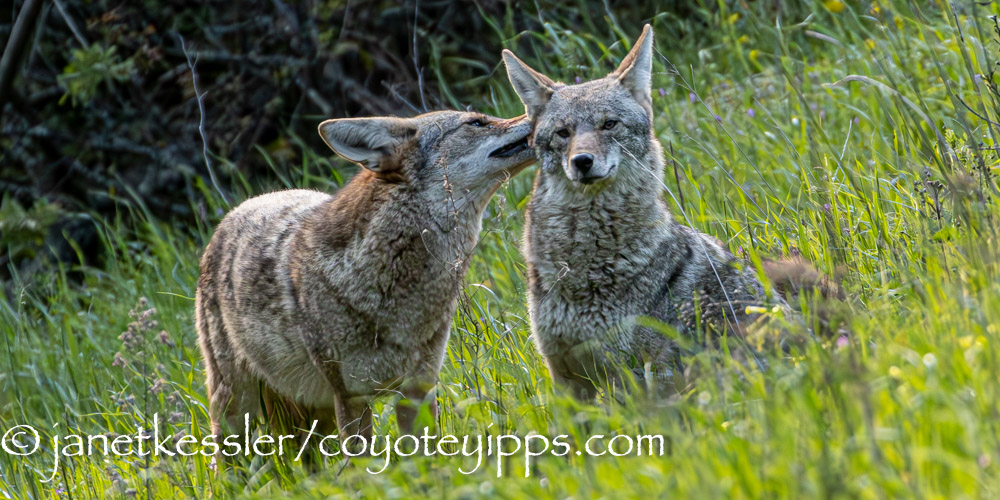
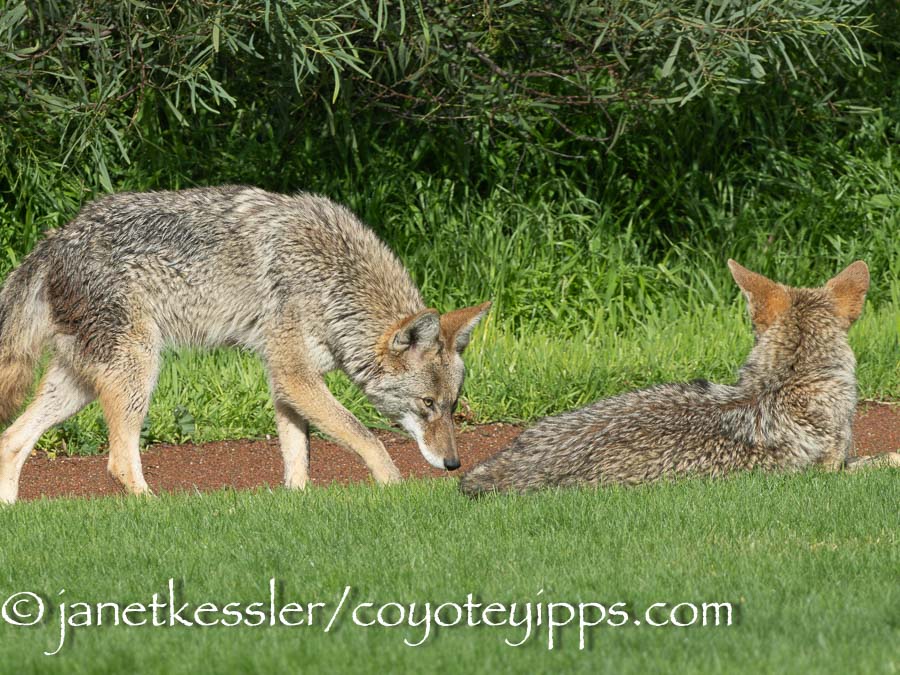
Coyotes are usually solitary hunters. This is due to their main food source being small rodents — mice, voles, gophers — which can’t really be divided up between several coyotes. However, coyotes will engage in teamwork when hunting a larger animal, such as anything bigger than a raccoon.

The above sequence of photos shows two coyotes who are together as they hunt. They both head for the same spot when they hear a rodent underground. The female is the alpha — she digs more energetically than the male. Maybe she was hungrier than he was.  The male must have sensed this because he stopped digging but kept his gaze on the spot where she was digging. So she glared at him: “Hey man, give me space!” He moved off to the side to wait patiently, feigning no interest in the meal she had just claimed as hers. She continued digging ferociously and reaped the reward of her labors: it was a huge gopher.  He watched, seemingly disinterested. When she finished her meal, he got up to walk on with her.

Trek, Far and Away, Beginning At Dusk

A few days ago, I was able to keep up with one of the coyotes I know as she began trekked at dusk.

caught a gopher

caught a gopher

She started out in a park where she found a gopher as she lingered, waiting for the day to fade. Then she headed out into a neighborhood street, with plenty of parked cars but no moving traffic. She picked up a couple of mice at the edges of driveways. She didn’t have to search for them — they were just “there”. She couldn’t have seen them. Did she hear them or smell them?  They were small and eaten quickly.

through a neighborhood

through a neighborhood

She then headed, decisively, to wherever she was going. She walked at a fast pace and kept her body high and tall — she was on high alert. She was amazingly tuned-in to her surroundings and the human world she entered as twilight set in. I’ve been told that pet dogs know their owners better than the owners know themselves. This is because they watch you all day! Well, coyotes don’t watch you all day, but they do watch us — from behind the scenes — and they learn our patterns.

middle of street

middle of street

She seemed to know where human perception lay, and that it wasn’t as keen as hers, especially at night. She knew when to stand still, when to duck down or simply walk behind a tree so that only part of her was visible — not enough to make her recognizable. Only one person saw her — amazed — “is that a coyote!” She stuck to the side of the road where she could duck into high grasses or shrubbery if she needed to — and she needed to three times, when three different cars went by. But she also wandered into the middle of the road several times, zigzagging right down the middle of it.

gopher in open space

gopher in open space

Her next stop was way down the street at an abandoned field where she hunted and caught another gopher. It took her only a short time to eat this, crushing the bones so the gopher could be consumed whole. Then she trotted assuredly onto a long church driveway. She seemed to know where she was headed. She moved along the driveway fairly quickly, stopping to sniff and “mark” in a couple of places, before climbing a hill at the edge of the church property. Here she hunted a little, but didn’t find anything.

dashing through a break in the traffic

dashing through a break in the traffic

She was now at the edge of a 6-lane thoroughfare. I thought she would turn back and descend the hill — but she waited there as the traffic whizzed by — she was hidden by the fading daylight and the darkness under dense trees. Then she took off – resolutely — across the street! “Oh, no,” I thought, “I’m going to have to watch her die”. But, as she crossed, the traffic magically parted for her. In fact, I was able to cross during the same brief break in the traffic. Her judgement and timing were excellent.  She got to the other side of the street and climbed the steep grassy embankment and was off down the next winding two-lane road. Please note that it’s much darker than the photos show — the headlights of the cars are on because they need them.

up an embankment through dense brush

up an embankment through dense brush

I exerted myself  to keep up but lagged behind because of the steep hill. When I got to the road she was now on, she was way way ahead — almost invisible in the dusk. I decided to give catching-up a try. I was able to do so because she stopped to examine and pick up some road kill — I think it was part of a squirrel. She carried it off to the side of the road where she was somewhat hidden in the tall grasses. This is when I caught my breath. She spent several minutes eating her find. She then descended from her hiding place and continued on her way, up the two lane road.  Her trajectory as I followed was in a single direction — far and away from where she began.  I wondered where she was ultimately headed. I would have needed night vision goggles to follow any further.

car headlights help me focus

car headlights help me focus

what you can see with night vision goggles

what you can see with night vision goggles

I actually tried on a pair of night vision goggles from my son’s lab. Wow! In a totally blackened room, you can SEE! What you see is a very clear and sharp black and green. I wondered how close these are to coyote night vision. Most of the daytime treks I’ve kept up with lasted anywhere from one to three hours. I’ve always assumed that nighttime trekking was a more substantial endeavor, maybe lasting all night. I wasn’t able to find out how long this one lasted because of my own inability to see. I turned around and went back.

How Much Food Does a Coyote Eat In A Day?

the menu at a wildlife rehabilitation center

the menu at a wildlife rehabilitation center

Coyotes are opportunistic eaters: they eat what they can find when they need to. However they’ll concentrate on obtaining their favorite foods, when available, which include freshly caught gophers, voles, squirrels, mice, rats, opossums. They eat roadkill and other carrion. In areas where there are deer, they scavenge for deer hit by cars and they can take down the infirm and younger ungulates. And, yes, the occasional cat has been eaten when their regular food sources are scarce.  They eat birds as big as chickens and as small as sparrows. But they are not totally carnivores. They eat fruit, nuts and bugs, including crickets, peanuts and watermelon. And they will nibble at human leftovers from picnic areas or the street, though this is clearly not a big part of their diet as shown by coyote scat analysis. Sandwich baggies have even been found in their scat!

Although they find and kill snakes and lizards, I have not seen them eat these. They prefer rolling on them to absorb their acrid odors, but might eat them when other food is scarce.

They’ll expend a lot of effort digging up what turns out to be a mole, only to reject it. There must be something about the flavor they don’t like. They roll on them, as they do with reptiles, to absorb the odors, and, again, when no other food is around to satisfy their hunger, they will eat them as a last resort.

I’ve wondered how *much* a coyote eats in a day, or over several days.  I’ve seen three full gophers caught, chomped and gulped down, all in a row. I thought that was a lot of food. I’ve seen coyotes eat a raccoon carcass, but only part way at any one time. They returned on successive days to finish it off. It appears that they stopped eating each day when they had had their fill.

The image above is the coyote — and juvenile coyote — menu offered to injured coyotes at an animal rehabilitation center. This amount of food is obviously enough to sustain a coyote comfortably when it is not active. An active coyote would need much more than this, I would think, as would a female during gestation and while nursing young pups. The menu above looks scrumptious! There’s more variety than most dogs get. Maybe when times are tough coyotes should learn to check into their local wildlife rehabilitation center for a gourmet meal!!

Nesting Season: Finding and Testing Building Materials

Sometimes I like posting about something different than coyotes. I found a tiny little Bushtit — 3.5 inches from tip of the beak to tip of the tail — searching for, finding, and testing building materials for it’s nest.  The materials did not pass muster, and were abandoned. Birds have very high standards for their young.

Mary Lactating, by Charles Wood

MaryApril

Mary April

For several years I’ve visited a nearby field to watch two coyote parents whom I named Mom and Dad. In November 2012 I found that a new coyote couple had replaced Mom and Dad as the field’s resident coyotes. I named them Rufous and Mary.

Mary didn’t look pregnant to me over the last two months. Then on Monday, Rufous and Mary were out and about together at dusk and the picture I took of her shows she is lactating.

OctoberMarycrop-1

Mary October

Mary on Monday was finally close enough for me to take a good photograph for identification. The October photograph for comparison was taken when Mom and Dad were still in control of the territory that Rufous with Mary now call home. The October photograph was taken from more than twice the distance as Monday’s. Still, I think it is the same coyote, think that Mary is Mom and Dad’s daughter from their 2011 two pup litter. There is a resemblance, I think it fairly strong. Also, Mary has eyes that remind me of Mom and she has Dad’s fleshy lower lip. I can’t seem to help softening a bit toward Rufous.

Posting written by Charles Wood. Visit Charles Wood’s website for more coyote photos: Charles Wood. His work is copyrighted and may only be used with his explicit permission.

Nursing Coyote Mothers

a lactating mother coyote

a lactating mother coyote

I had been told that nursing mother coyotes stay in the dens, or fairly close to them, during the 5 weeks following birth when they are being nursed. Guess what? They don’t!

A nursing mom’s need for nourishment skyrockets during this timeframe in order to keep up with the growing nutritional needs of her pups for which she is the sole supplier through nursing. Nevertheless, moms appear to keep themselves pretty secluded and out of sight. New moms are even more secretive and evasive than normal because the lives of pups now depend on them — it’s a safety measure.

This new mom was in a field only a moment or so. The rest of the time she moved slowly under bushes and next to “edges” of taller growth, where she could easily slip away from view. When she saw anyone coming, she slowly stepped behind something, be it a tree, tall grasses, bushes or a stump, where she would not be noticed, and she wasn’t.  She headed “in” for the day when a man and his dog came around a bend and saw her. He stopped and observed. She calmly slithered out of sight. The dog was leashed and well behaved. It all happened so quick and smoothly!

It’s much too early for pups to be out and about. Pups are kept secluded in their dens until about the fifth week of birth, and even after that, their introduction into the bigger world will be a gradual one, and as secret as possible to begin with!

HISTORY for the Record: How Coyotes Arrived in San Francisco

10714 on a horizon 

It has been almost five years since I first learned about this from a good friend and neighbor who who would not divulge his source since he had promised not to, and about six months since it was confirmed with this report to me, from someone also requesting anonymity. It’s time to publicize it.

The DNA of San Francisco coyotes matches that of coyotes north of the city — not south, as one might expect. San Francisco is a peninsula with no way to get to it from the north except over Golden Gate Bridge. So it has been theorized that coyotes walked across Golden Gate Bridge. Sounds exciting, but . . . whoa!

The following information on how coyotes really came to San Francisco was supplied to me by an individual who has been peripherally associated with what happened, actually observed it, and knows the person involved very well.

Yes, coyotes did come over the Golden Gate Bridge, but not on their own four legs. They were brought in from northern Mendocino County by a trapper.

These coyote releases occurred in and around 2002. They didn’t occur just once, they occurred several times, and at least 6 coyotes were involved — probably more. The fellow who brought them into the Presidio — that is where they were left — felt that they had a good chance of survival because of all the rodents and feral cats in the city — he wanted the coyotes to thrive.

Why did he bring them in?  He did so out of retribution for the 1998 ban on leg-hold traps which he had fought against! Interesting twist! He wanted these coyotes to be a problem for the residents. “Darn those liberal voters in San Francisco who voted against leg-hold traps.”  SF was on the route he took to visit relatives further south. It is on his way to visit the relatives that he transported and dropped the coyotes at the Presidio.

The U.S. government routinely shoots, poisons, traps and kills about 90,000 coyotes each year – mostly in rural areas. It’s brutal. California voters passed Proposition 4 on November 3, 1998, enacting California Fish & Game Code § 3003.13 and § 3003.2, which, broadly speaking, ban the use of certain traps and poisons to capture or kill wildlife in the state. Proposition 4 also authorizes criminal prosecution for violation of these subsections, punishable by fines and/or imprisonment. Unfortunately, not all permutations of Proposition 4 were studied before it was passed. Now the more vicious and insidious collarrum snares are being used. 

What did he use to capture these coyotes? He used what was allowed: collarum snares, setting them on *low* hold so that they would not choke the animal to death. Collarum snares normally inflict a particularly horrifying death and are tricky to use, but this man knew how to set them to allow the coyotes to survive. Many were wounded by the snares in the process, but this fellow treated any infections before transporting them to the city and releasing them.

So — coyotes came to San Francisco as a result of the ban on leg-hold traps! Really interesting! The truth is more interesting than the fiction!

And, by the way, most San Francisco residents are thrilled to have this urban wildlife in the area, so no harm done. It’s nice to know how it happened. In fact, it turns out that these coyotes have a better chance for survival in their urban setting where guns, snares and traps are not allowed. But it still is heartbreaking to think of the cruelty inflicted on them to get them here: excruciating physical pain and terrifying fear. Also, these animals were torn away from their very strong family units, creating additional distress. We are lucky those we have survived, and have formed new family units. Moving coyotes can be tantamount to killing them, which is why the state does not allow it. We have about 20 coyotes in San Francisco now. They live in city parks and city golf courses.

Some of the San Francisco Coyotes I’ve Known

Coyotes Are Thriving In San Francisco

Scratching

She kept scratching and scratching. She’d get up to move on, and then immediately again be on her haunches, scratching.

She kept it up for over 20 minutes, with that leg boing, boinging up and down for that length of time. The scratching has been particularly intense over the last few days. I’m hoping that it’s just a bug that she hasn’t been able to get, or maybe it’s just that there are a lot of them: ticks or fleas.

I don’t know if she’s trying to ease an itch or an irritation. Her coat is extremely thick, which impedes the claws from reaching whatever it is that is bothering her. Shedding has begun and will continue through June, so maybe the scratching is helping to remove some of the loose fur.

My one worry with constant scratching of this sort is the possibility of mange — a killer. Mange results from a mite that buries itself into the skin, causing severe discomfort which the coyote attempts to relieve through such intense scratching that the fur is slowly removed, leaving the skin exposed with lesions. This is a prime killer of coyotes. Apparently all canines, including domestic dogs, carry the mites which are transferred from mother to pups via cuddling during the first few days of life. Most canines live in harmony with their mites — but things could get out of balance when the immune system is compromised or if there are other underlying health issues.

There are no bare patches of skin, so, I’m hoping it’s just fleas or ticks. I’m monitoring this one.

Coyotes As Neighbors, Let’s Get To Know Them!

Here’s a full 20 minute presentation I created for my/our new site: CoyoteCoexistence.Com. I began the site with a couple of friends in order to stop the trapping and killing of coyotes in Atlanta last fall.

It’s through Yipps that we connected for this project. We organized and flew to Atlanta to present the case against trapping at a town meeting. We printed a large packet of flyers and helped publicize the event. In the end, money that had been collected to hire a trapper was returned — the trapper was not hired!  This was a clear sign that we should proceed with our efforts!

Presentation Title Page

Presentation Title Page

This video is an aid for future presentations. It is cutting-edge in its unique approach, concentrating on coyote himself! A muted version will also be available for presentation by others at meetings, and so will shorter clips of specific sub-topics, such as “shooing-off”. Contact CoyoteCoexistence.Com at our email on that site for further information.

Papas Have Work To Do!

Pop&Rat20130331If you see a male coyote trekking along with a rodent in its mouth, it’s probably because a new family has arrived, or is about to arrive! The new papa, along with other members of the pack/family have a big job!! They will bring home the bacon while Mom holds up in her den nursing the newly born pups and keeping them warm. That’s the biggest job! The important point is that the family works together from day one to raise the pups!  It’s altruistic and very exciting!

For six weeks, Moms will keep their pups in the dens. Papa and any remaining pups — now adults — from previous litters will bring food to supplement her hunting, which will be more limited during this time because of the pups.  After six weeks, food will continue to be brought back to the pups, but it will have been eaten and partly digested — then regurgitated for the young ones. This will be their first solid food — pablum, or baby food! As time moves along, entire rodents — dead ones — will be brought for the youngsters to feast on, then live ones, and eventually they’ll be taken out to do their own hunting.

I have often seen dads and yearlings bringing in prey like this well before any pups were born. Could they be helping a female who is having trouble hunting? Or could they be practicing for when this activity becomes mandatory? Possibly some of these rodents are buried by the den area, creating a cache of readily available food in case of hard times? Growing youngsters need daily nutrients to develop properly — good parents will prepare for hard times.

I have seen a coyote yearling transporting a rat, like this, to its home base, even though there happened to be no pups in its pack that year. I’ve wondered if, in this case, no pups were even born, or if no pups survived, or if they all died.  I have only seen this “transportation of food” during the breeding season, which is why I wonder about what was going on in the case where there were no pups. Maybe food was too plentiful and too readily available. If you are full, you may want to take it to a special place to bury it — saving it for a rainy day?

News: Happy Ending!

lucky little gal

lucky little gal

Story sent from Canada:

I received a call from Animal Care and Control today.  They had picked up a coyote that had been caught in a leg-hold trap.

The guy at ACC said that he just couldn’t put her down.  So, I met him out at the rehabilitation center where the coyote is now in one of our outdoor enclosures.

Although the coyote would rather be free, at least she is still alive.  She doesn’t look as though she was hurt by the leg hold trap and she appears to be healthy.

I gave her a nice dinner for her stressful day.  Since she doesn’t appear hurt, we’ll release her soon as soon as we find a good place for her.  The bad news is that we can’t release her back to where she came from.

————–

How nice that they called you! It gives me hope to know that there are good people out there. I wonder what the story was and why the trapper didn’t get her.

I hope there is a good place for her to be released.

—————–

Of course it is her home which she is tied to: her family and territory. The ones released by Stan Gehrt tried to make it back to their homes. They all died in the process. If released too far from home, there are more obstacles — people and cars — that the coyote has to deal with.

Not only that – in her desperate search for food she could get into trouble with people and their pets!!!

——————

Someone called ACC to say that they had seen her in the leg-hold trap.  So there is another good person out there.

We do have places to release coyotes.  Unfortunately it won’t be with her family or in her own territory.  And, they don’t all make it when they are released in a new place.  I hate this, but at least we are giving her a chance.

——————

Couldn’t it be done at night – who would know?  The whole experience will be aversive enough to keep her from going into the area where she was trapped.

——————

Unfortunately, I do not know where she was found.  They don’t want me putting her back in the same area.

——————

The attached is not a good photo, but a photo none the less of our latest visitor at the rehabilitation center.  She is curled up in front of a heat lamp on a drizzly day.  She ate all of her kibble last night but neither of the rats that I left for her.  I guess she doesn’t like them if they are not alive and running from her.  She will get more kibble, rats, insects and other goodies tonight.

I am still working on getting the location of the spot where she was found.  It may take me a few more days.  Once I find out where she was found, I’ll get her released close by.

I know that she is not keen on where she is and she is afraid.  However, she is warm, has food and shelter and it is temporary.  We will get her back where she belongs soon.

——————-

It’s a great picture! And you are an angel!!!

——————

I found out where the coyote was found.  I am working on a clandestine release within a couple of blocks.  Will keep you posted.

—————–

Yay!!!

—————–

Just wanted you to know that the coyote brought in for rehabilitation was returned to her neighborhood on Wednesday night about 11:30 pm.  I wasn’t there, but here is what was relayed to me.  She was at the back of the kennel during the drive until she got close to her neighborhood when she could tell that she was almost home.  Once the door was opened, she bolted out.  About halfway to the tree line, she turned around and looked at the person who released her.  Then she went on her way to find her family.

We all just love a happy ending.

Breeding Season: “With Pups”

Coyotes give birth at about this time of year — usually from March through April. A bulging belly might reveal that they are heavy with pups right now.

How do coyotes experience their pregnancies?

The extra weight slows them down and they get tired — much like humans. Climbing steep embankments takes greater and greater effort as their pregnancies come to full term.

They have trouble scratching themselves: that back leg is hampered from reaching the itch by the bulging abdomen.

Being a curious critter, they want to know what is going on, so they examine their bellies where the nipples are: they seem to feel the changes they are going through. When is it that they actually “know” they’ll be having pups? When does the rest of the pack become aware of this? At a certain point, dens are prepared: might this be the signal to the rest of the pack about what is in store? How does she know the time is right for building her den?

Behaviorally, during their gestation period, they become more secretive and withdrawn than ever. They try to not be seen, and they don’t wander far from home. This is how they protect themselves and keep out of harm’s way.

One big behavioral change is that they don’t howl so often at sirens. Might this be so as to not reveal their locations during this vulnerable time for them?

Timeline. When the young are born, they will remain secluded in the den for about 6 weeks.  Mom is required to be there to nurse the youngsters and to provide warmth for them. At the end of this time period, her pups will emerge from the den — and she will slowly wean them, first onto regurgitated food brought home by Dad and other adult family members, and then onto whole rodents which are killed first. The final step in this process will involve teaching them to hunt on their own.

Few people ever see coyotes. You have an even slimmer chance of ever seeing a pup. If you are one of the lucky few, it usually isn’t until about July that you’ll see them, though you may be able to spot one as early as June.

Rufous Howls, by Charles Wood

For several years I’ve visited a nearby field to watch two coyote parents whom I named Mom and Dad. In November 2012 I found that a new coyote couple had replaced Mom and Dad as the field’s resident coyotes. I named them Rufous and Mary.

One possible difference between Mom and Dad’s behavior compared to Rufous and Mary’s is that Mom and Dad did not seem to howl at emergency vehicle sirens. Consider my August 22, 2012 post:  A Brief Show.  The video included there showed Mom ignoring both the siren and her youngsters’ howls in reply. My general impression after many observations was that Mom and Dad just didn’t bother with howling back at sirens. I always thought that restraint showed how intelligent Mom and Dad are.

In contrast, the video included with this post shows Rufous howling at sirens. A little earlier, Rufous and Mary, both hidden, were howling at the sirens.

Coyote in a Secluded Forest

0602 We live right next to a Provincial forest with nothing behind us but forest and mountain, we have almost invisible neighbors each side, so generally we are very in a very secluded location.

Last Winter, we noticed a coyote sitting at the edge of the forest about 20 metres away, he looked very thin and it was very cold out there – now I know that people should not feed coyotes, but my wife just couldn’t stand to see this poor fellow, so she got two fresh chicken legs and a handfull of beef offcuts and took them out to where he had been (he moved off when she went outside)

Within a couple of minutes he came back and polished off the lot and disappeared (maybe he took some back for his mate), anyway this was repeated each day for quite some time, until he would literally follow her to the feeding area a mere 3 or 4 metres behind. She would always talk quietly to him and he would stand about 2 metres from her and seem quite relaxed. Needless to say he began to look very healthy with a lovely full coat, and sometimes he will go away for 3 – 4 days and then return.

0528One day I was sitting on a planter, when I realized he was sitting just behind me (see attached photo) luckily I had my camera so very slowly I took this photo while I kept talking to him very softly – he stayed right there. Anyway my question is this; my wife took some food to him yesterday and he came right toward her and stopped about 1 metre away, then almost playfully he did a few little bounces with his front feet, his head was low and his rear in the air, then he started to eat the food – was he playing ? and was this his show of freindship ?

Incidentally we never give him any ‘human’ food only raw chicken and pieces of raw beef, I guess we love all animals and they seem to respond so well to us, including Owls, Racoons, a skunk family, and of course about 12 red squirrels !

Sincerely,

Duncan and Rosalind

============

Thanks for writing and sharing your experience — and wonderful photos. Personally, there is nothing wrong with helping animals that are having a hard time in winter as long as it doesn’t create a nuisance for neighbors.  Think of it as “rehabilitating” wildlife in the wild.  The “don’t feed” is for misguided people that are feeding coyotes that don’t need any help – that, is “hurting” the coyote.

Obviously this coyote was there hoping to find some relief from starvation. The little bounce is happy anticipation, and gratefulness for the food – this is the behavior pups engage in, when parents bring food back for them.

The coyote is also keeping a respectful distance. It’s best if Rosalind puts the food down and  leaves quickly, as not to condition it to approach or follow humans – this is strictly for the coyote’s protection.

Continue to help this little animal get over the hump.  One day the coyote will leave, and may not return…until it needs help through another harsh winter or drought. Duncan and Rosalind will both share in the blessings of the merciful!  

Mary  Paglieri
Human Animal Conflict Consultant
LittleBlueSociety.Org

Previous Older Entries