Information and stories about San Francisco coyotes: behavior & personality, coexistence & outreach, by Janet Kessler: Unveiling first-hand just how savvy, social, sentient and singular coyotes really are!
Fall is coming along well. Lots of doings with the dogs patrolling properties as usual. We recently wrapped up a 3 week “investigation” into 4 coyote packs who were accused of livestock predation on sheep.
We worked with cooperating landowners, and some biologist students, as well as Ranchers.
This is progress, as historically the answer to sheep being killed is to hunt every coyote within 100 miles. This only leads to the surviving coyote booming in population, and never solves issues or give solutions.
I am proud of my dogs in helping clear accused coyote…though they don’t see it that way.
The sheep ranch sustaining losses is surrounded by a 5,000 acre Quail Hunting Preserve. Coyote have fairly large packs there. 4 distinct packs or family groups. They don’t affect Quail numbers. In fact, they removed feral cats that were affecting Quail introductions.
Proving coyote innocence takes time, skill, and impartiality. We WANT to be accurate and find the raider, who risks all local canids being suspect, ranch dogs, coyote, or wolves.
The Pack and I travel miles and miles and miles along tracks and trails. The dogs mark and leave scent as we travel, advertising our route. Of course, this greatly irritates coyote, but they come along after we move on. The marking insults between dogs and coyote are kept track of and studied.
Scat doesn’t lie. It is irrefutable proof of diet. All 4 packs of coyote, for 3 weeks, countered my pack with markings, scat, and vocalizations. Not a single wool encased scat.
Deer hair (deer hunter scraps or road kills) are in some, but overwhelmingly…all 4 packs show vole and gopher diet. And a few late berries and spawned salmon.
When we finally did locate wool encased scat, biologist students brought trail cams and liberally set up in that area.
Long story short, not a single coyote scat with wool for over 5,000 acres was ever found.
But it seems 3 pet dogs let loose in evenings are our proven suspects. Trail cam and scat proof literally from pastures to their country home.
It’s very easy to suspect coyote in pet or livestock raiding. And it does happen. But most people would be shocked…far more often…its unsupervised dogs killing livestock.
Summary: I’ve spent a lot of time filling in family details here, but the gist of what I’m saying is that we’ve had a single, long-term, nuclear family, owning one of the territories here in San Francisco, generationally now for four generations. At the beginning of this year, 2024, disruption was caused in the family’s tight hold of the territory when an alpha male, Scowl, left and the aging alpha female, Chert, headed into her twilight years, even contracting a severe case of mange at the end of her life. Another family came in and pupped here, but they did so without kicking out the resident offspring or weakened alpha female who had been here so long. Now, as winter 2024 approaches, that “intruder” family appears to have left, and it’s Chert’s offspring who again — without Chert — seem to have control over the territory: they are fourth-generation owners (and I’m not talking about 4th litter owners, I’m talking about a territory passed down from mother to son to his daughter and now to her daughter = four generations).This is the history of one territory over 20 years.
Our long-term alpha female, Chert, is no longer around, having reached the ripe old age of eleven and a half years. A daughter and son appear to be the new alphas in the territory — so we are stable again. But Chert’s last waning months led to a disorganized territorial situation!
Chert’s 2-year old son and daughter are behaving like the alphas now
A Little History: Chert’s story actually goes back to 2013 when she was born, and her family’s goes back to 2004 in this park. But it was in 2009 that I started focusing on the relationships of the individuals living on this territory at the time, and figuring out the extent of that territory. The territory is average in size for an urban territory. However, territories here in the city of San Francisco and most urban areas run less than half the size of rural ones, possibly due to a ready supply of food — it turns out that human refuse figures larger than thought [Tali Caspi, details TBP]. The territory covers four of what I call *pods* or *hubs* towards the center of the city — these are substantial parks — and only one family has owned it, generationally, for all that time: nuclear family members are the only ones ever seen throughout the extent of the territory, with the exception of very temporary suitors or dispersers. In San Francisco, we have approximately 20 territories — each about the size of the Presidio — each occupied by one family.
Above is the early genealogy I put together, showing how the family evolved: it shows that there has been plenty of inbreeding within this one territory. Dr. Ben Sacks, the geneticist at UC Davis assured me that inbreeding was not a problem as long as new blood eventually entered the scene, and it always has eventually.
In 2009, the territory was owned by a family that consisted of the Maeve, the alpha female, Toughy was the alpha male and there were two male pups — Silver and Bruno. Toughy’s life ended suddenly and brutally when he ingested rat poison before his offspring were weaned. A small dog suffered the same fate at the same location.
Maeve taught me a lot about coyotes, but mostly about the alphas total awareness and control of their territories: she knew every dog and their human, and she knew which dogs — most were off leash — were troublemakers. She would sit high on a knoll and watch the early morning activity, while at the same time keeping her eyes on something in the distance: it took me awhile to see that those were her pups over there hidden in the bushes.
Maeve with her two sons, Silver and Bruno in 2009
As these two pups grew older, they started their own little forays throughout the park. Over time, I watched these best buddies become arch enemies. It very obviously involved vying for the attention and affection of their mother. Bruno just wanted to get along, but Silver did not want him around and in the end drove him out with bites causing yelps of pain from Bruno. Silver then hung around and for two years romanced his mother who finally accepted him as her mate when he turned four. So for three years, we had no pups in the park, and a very young alpha male, yet this same family continued to own and control it.
In 2013, Silver and Maeve produced a litter of three pups. This was Silver’s first litter and Maeve’s second: Chert, Gumnut and Pinecone. Pinecone was not very social and kept to himself. I think he had a somewhat antagonistic personality because he was actually driven away by his father and Chert. I wondered if Chert might have been retaliating from some sort of mistreatment by him: yes, coyotes keep score!
Chert on the left and her long-time mate Silver. They were together for 7 years until he passed away.
So the two remaining pups, Gumnut and Chert, became inseparable best buddies. I thought they were going to disperse and find a new territory together, but it was not to be. Their father, Silver, had other plans. Silver began breaking up the bond between the two: he incessantly put Gumnut down and hovered between the two siblings to keep them apart, all the while showing great fondness for Chert and putting up with her teasing naughtiness which normally might have elicited harsh disciplinary action. At the same time, Gumnut became extremely submissive — he was doing everything he could to remain on the territory and close to Chert — he wasn’t allowed to show any dominance over Chert — or Silver would land on him by forcing him onto is back in submission. Of course, this caused Chert to value Gumnut even more.
In the Spring of 2015 a singleton pup was born to Chert. Gumnut was still around, hanging in there: his affection for Chert had not waned. But that summer was the last time we saw Gumnut — he had been driven out by his father. The family now consisted of Chert, Silver and the singleton pup I named Scout. Of high interest is how inordinately severe Silver was on Scout: it seemed whenever he saw her, he charged at her aggressively and forced her on her back. Chert would console her whenever Silver was not around, until one day in January of 2016, at just 9 months of age, Scout had had enough and left home. Another point of interest: I normally see Dads driving male youngsters off, and mothers dealing with the daughters — not so here.
This is the earliest I’ve seen a youngster disperse — most don’t do so until after their first birthday. Could Silver tell that Scout wasn’t his own offspring? [Monica Serrano, details TBP]
Although the relation was not mutual to begin with and had been forced, with Bruno gone, Chert and Silver remained committed long-term mates and owners of the territory through Silver’s old age. Chert stuck with him until his end, which was January 2021. They produced litters throughout the years with some of them dispersing to become alphas within the city: Sparks ended up as alpha male in the Presidio; Vida ended up as alpha female in the Buena Vista Area; Scout at Bernal, Gumnut ended up as alpha male in the Lake Merced area [Monica Serrano, details TBP].
After Silver, passed away, there was a vacancy: suddenly Rookie, an older male appeared on the territory in 2021. He was not liked by Chert or her yearlings, as could be seen by their their distressed vocalizations, and then over time, keeping their distance from him and not including him in their grooming sessions. Of consequence is that the six offspring produced that year had light colored eyes, just like Rookie’s. But Rookie knew he was not liked. He didn’t fit in and he ended up abruptly leaving and moving on to Golden Gate Park for one year (before leaving again — I’ve not seen other instances of this).
While Rookie was still with the family, Chert began grooming one of her yearlings as her next mate: this was a strong message to both: Rookie: “you, go”, and to the yearling: “you stay”. Scowl was one of seven pups born in 2019 to Chert and Silver. To get Scowl to stay she began lavishing constant attention on him. Indeed, he stayed, becoming the alpha male and father on that territory for two years, and producing two litters with his mother, Chert.
Chert (2013 to 2024) turned to her son Scowl as a mate a year after her long-term mate died, and right after her unhappy pairing with Rookie that lasted less than a year (2019- )
But after two years, and actually even before two years, he was feeling wanderlust. [I wrote a posting on changing mates which you can find HERE if you are interested.] Today’s posting is focused on the long-term ownership of a territory and its disruption when the strong hold by the alphas is in someway disrupted.
Scowl left Chert after raising two litters with her. He paired up with a two-year-old female only one mile away: here is one of the four pups they produced in 2024
Scowl left Chert and the territory at the beginning of 2024, this year. I’ve wondered if his instinct to disperse finally caught up with him, or possibly if Chert was losing her pull through diminished hormones: this last is a thought I had without any proof. He appeared in a territory only one mile away where he paired up with a daughter of the previous alphas from that territory, Vida and Cape at Buena Vista who had both been killed by cars in 2022 before their pups were grown. But interestingly, the Buena Vista territory remained in the family with their offspring, which is not always the case: I’ve seen territorial takeovers by absolute newcomers after an intense territorial battle when strong alphas aren’t around. But this did not happen here.
Falcon 10-2023ArcherIntruderRagsTawny
Above: Chert’s 2024 suitors — HERE is a posting I wrote about changes in mates — in fact, most coyotes — in spite of their famously being known for *mating for life* — appear to go through a number of mates in their lifetimes, some of them long-term and some less so.
Back to Chert and what happened to her territory: Chert must have had enough luring hormones because she attracted five suitors in early 2024 after Scowl left (actually, one before he left). The first three were quickly driven away. The next — Rags — had mange. He was accepted and hung around for several week. Unfortunately, months later we noticed that he had passed his mange on to the rest of the family — it’s highly contagious.
Screenshot
Bottom row: family after driving Rags out; top left: the steely stare for emphasis letting Rags know he can’t come back; middle above: rags hurrying away; top right: rags looking back, knowing he has to go.
Then, several weeks after accepting Rags into the family, yet another new suitor appeared: this was Tawny — a new fellow for that time frame, but he looked familiar to me and could have been a returned family member from way back in time who I had lost track of — familiarity would have caused her to choose him, Tawny, over Rags. I then watched as Tawny, Chert and her yearlings viciously drove Rags out. I’ve seen this before: the guy forced to leave looks back knowing that he must go, and he never returns. But even this new arrangement — Tawny and Chert — didn’t seem to last long as I’ve not seen Tawny since before any pups were born.
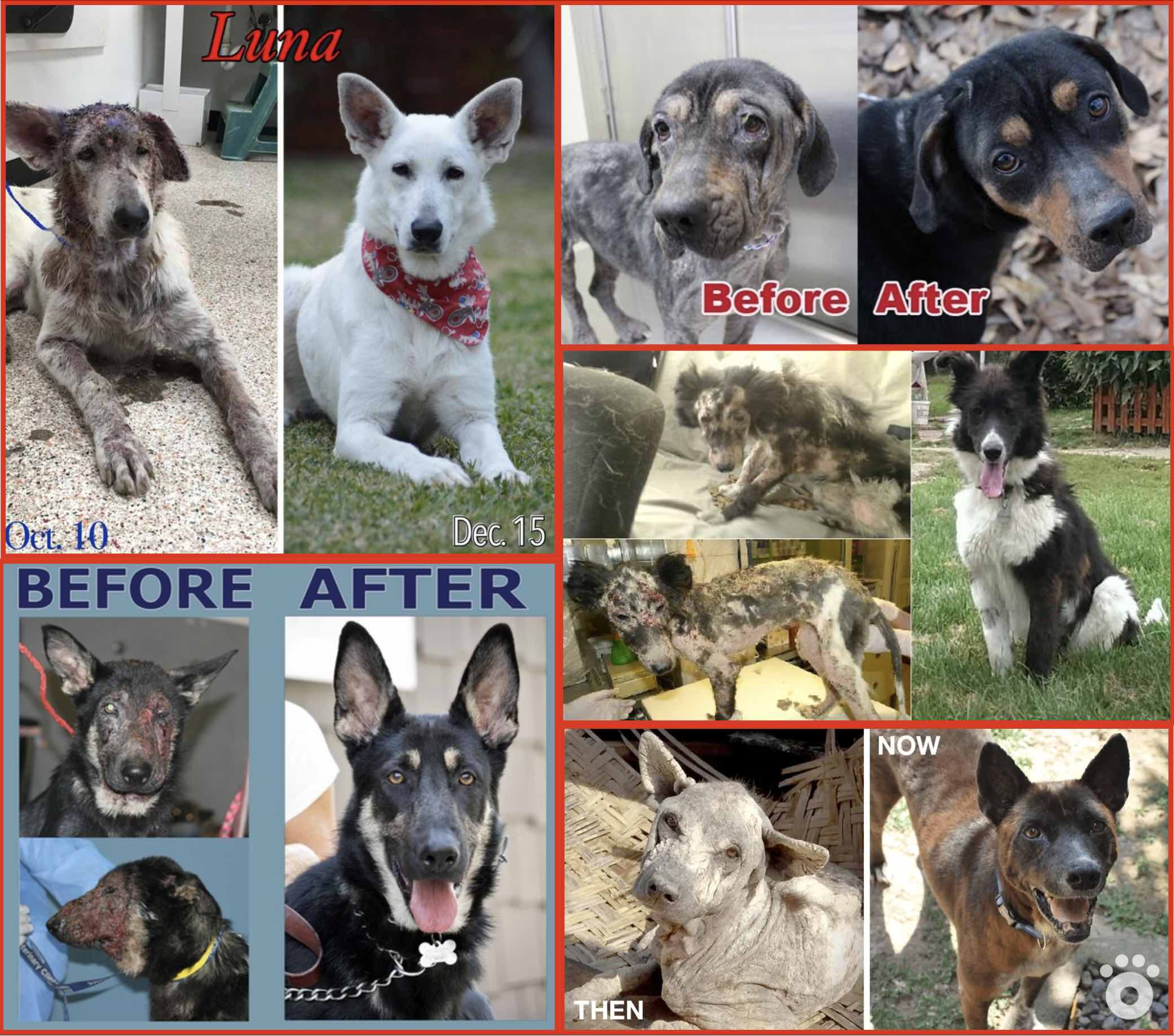
Chert, Bibs, Tug and Root all came down with mange. It probably led to Chert’s death. To show how disfiguring mange can be, I’m showing here images of Chert without (above) and with mange (directly below) — Chert’s case is one of the worst I’ve seen. In the center column, Bibs is seen without and then with mange: she recovered. Then Tug on the right: before and now with mange. [To see the drastic change in appearance in dogs from mange, click HERE]
Unfortunately, mange spread through the family. Come June, we saw in this territory, Bibs (Chert’s two-year-old daughter who now had mange) with another female who was so disfigured by mange that I could barely identify her except by some minor markers — her eyes and face were completely crusted over. This would be Chert — based on her behavior and sticking to her favorite hangouts — mange really changes their appearance. BOTH females — Chert at 11 years of age and Bibs, now two years old — were lactating. I’ve seen this double-lactating phenomenon before, suggesting the daughter was either a wet-nurse or, potentially, it was an actual double-denning situation. What appears to lead to this double-lactating condition is a disruption in the alphas: and indeed that happened here with Scowl leaving and Chert aging. Tawny, Rags AND Scowl had all been around during mating season, and NONE of them were around to raise the pups, so I don’t know who the father was, but both Chert and Bibs were definitely lactating. However, another thought occurred to me: I wonder if in their reproductive cycle, their teats might enlarge even when they haven’t produced pups and aren’t lactating. If anyone has information on this, I would love to learn about it!
The OTHER, intruder family: Amberson (Dad) on the left; Eyes (Mom above right seems to have recovered from mange); Two of their pups were found dead.
The alpha disruption appears also to have led to a weakening of Chert’s family’s hold on the territory: strong alphas have absolute control over their territory, but with aging and illness, and no alpha male around, this might not be possible. So yet another pair of non-related, foreign/intruder coyotes came in and took up residence in the main hub of the territory — within just several hundred feet of where Chert and Bibs were, where they had their litter of pups. Interestingly, Chert and her daughter and younger brother were not driven out by them, conceivably because the newcomers themselves were not a strong pair, and were not familiar with the situation: they had arrived shortly before their pups were born, perhaps having been driven out from another area and desperate for a denning site. The female of this pair also had mange. I don’t know how mange in parents affects their offspring, but two of their very young pups were seen with neurological disorders and eventually found dead.
So a sort of *coexistence* existed between these two families in the same hub that lasted through the early summer, with vocalizations between them confirming their presence to each other. And in another hub or pod of the territory — where I had only ever seen Chert and her family — an ADDITIONAL new litter surfaced, reported to me, but I didn’t have time to check them out,. This should tell us a lot about disruption of the alphas. As winter approaches in late November, I’m only seeing ONE pup occasionally, and frankly I don’t know whose it is.
Yearlings from Chert’s last two litters retain the territory. It looks like Chevy and Bibs, two year old littermates have formed a pair bond. Their littermate Root is still there. Tug is still there, but with a hefty mange condition.
Things seem to have returned to normal now that winter is fast approaching, with just Bibs and two littermate brothers — Chevy, who appears to have become her mate and one other, Root — along with a younger brother, Tug, now living on the main hub of that territory and one additional pup born this year whose parents I’ve not been able to yet identify. This could change quickly and I’ll update if it does.
Over the years I’ve been sent photos of coyotes on Angel Island, but I’ve never had the time to check them out. I was even brought some scat for my scat study, but, most people don’t know what *fresh* scat looks like, and what I was brought was definitely not fresh, so it was not included in my study.
I was told that possibly coyotes swam over, crossing the shortest part of the bay at what’s called the Raccoon Straight. I’ve always been skeptical of this, but, wow, there’s a photo in this article that shows a coyote swimming from Angel Island to Tiburon, so indeed it is possible. I’m including the article which appeared in Bay Nature, by Jillian Magtoto because I found it fascinating! Enjoy! And thank you Staci Hobbet for sharing this with me!
I’m writing this in the wake of all the dog/coyote incidents that have recently been in the newspapers. I want people to know that there is more to coyotes than just that, that coyotes are fascinating as individuals and as a species because of their intelligence, personalities, family structures, and land management, among other things. Here I dive into some of my observations of them and share some telling photos.
Dad bantering with his pups: many if not most coyotes mate for life and both parents raise the young.
Coyotes are our fellow citizens here in San Francisco — a *citizen* being someone who lives in the city — a denizen of the city. They are living in and sharing the same neighborhoods we do. We share this urban environment with lots of wildlife, even if we humans want to predominate and dominate the scene. According to Brandon Keim [in “Meet the Neighbors”, page 13], in this setting, “what makes us human is not what makes us different from other animals, but what we have in common.” Brandon writes about the “personhood” (his term) of animals and indeed, it’s knowing and appreciating them as individuals that helps break through some thinking barriers we’ve been handed down through the ages, including through science.
Raising the young is a lot of work: this mom moved her pups three times for safety reasons: here she is carrying one of six pups, 1/2 mile, through the streets of San Francisco, to a safer location.
In this vein, my own view of coyotes is anchored in my hours of *focused observation* which has led to my feeling of commonality and empathy with these critters, in spite of the obvious superficial differences that we usually focus on. Animals, as we, in fact are thinking and feeling in a much deeper way than most people have imagined.
Coyotes communicate constantly through eye-to-eye contact and body language: including intentions and moods.
Through hours of observing them, I’ve come to see coyotes as living parallel lives to our own, similar to the Hobbits who are *over there* in the shire, mostly invisible to us humans, but living very equivalent lives to our own, within their territories and family structures, and functionally doing what we humans are doing: trying to survive and eke out a living in an often inhospitable outer world, but also within a an often rich social context that constitutes their/our closer inner circle. When that social context is broken or missing, it affects them no less than it affects us.
Coyotes’ basic social unit is the nuclear family: both parents work for a living by hunting and defending their turf, and both parents raise, defend, and provide for the young, while yearlings pitch-in with all of these duties. They live on their exclusively family owned territories, keeping all outsider coyotes out. We have about 20 of these family-owned territories that cover the entirety of San Francisco (see map]
Litter mates become best buddies or sometimes bullies: every family is unique and different.
Coyotes are highly social, highly interactive, and highly communicative, and many if not most famously mate for life, and they also engage in individual activities — hey, not different from ourselves: they play, they hunt, they have parties (most evenings the family congregates for its rendezvous), they celebrate (yes, I’ve seen it!), they tease, they defend, they go exploring. Their relationships vary from simple companions and like-minded buddies, to bullies and rivals, to peacekeepers, caregiver and comforters. Mom and Dad are always at the top of the hierarchy, and just as in our own families, there often is sibling rivalry and vying for superiority within litters and even between litters.
They communicate vocally, with sounds that vary from yipps to growls, squeals, hisses, grunts, purrs, moans and screeches — these range from barely audible to overpoweringly loud! And they communicate silently through odors and pheromones — for example, scent marking their boundaries — and silently through body language and subtle eye-to-eye-contact and expressions. And from what I’ve seen, it’s every bit as nuanced as our most carefully chosen words and the entonations we use, if not more so.
They display the same full range of emotions that we display, from joy, enthusiasm, affection, excitement, to boredom, pain, rejection, sadness, jealousy, anger, oneupmanship and even deception (even though that’s not exactly an emotion). They love to tease each other.
This coyote is acting sad and rejected: she’s been taunted, shunned and excluded. Their emotions seem to be extremely intense, and are very obvious when watching them (which is why it’s so much fun to watch them, if they allow you to)
Their bodies respond to the environment no different than ours. There is physical pain from thorns and bugs, and from bigger injuries from lost eyes and tails and broken legs and crippling diseases such as mange. Some of these are accidents and illnesses that weaken and compromise their ability to live. This is all the stuff I’ve observed repeatedly through hours of first-hand observations and then written about on my blog, but besides observing this stuff, isn’t it just plain logical that this would be so?
Here one sibling is removing ticks from her brother: family members take care of each other through mutual grooming.
They deal with death and they deal with birth, their own and others’.
*Science* is only now agreeing more and more with the view that animals are much more intelligent and feeling than science admitted in the past. Brandon Keim’s book talks about the intelligence of bees, the friendship of snakes, puzzle-solving turtles, etc, and science is indeed confirming these. One has to wonder why *science* is just now *getting* this, when focused observations by anyone makes it all so obvious. Science upholds a hierarchical order of things passed down from ages past, putting humans at the top. We don’t like to see our characteristics shared with others.
Science is rooted in observation. Repeat observations allow us to form generalities. However, science itself has had to reverse some of its proclaimed truths. We drank milk when I was growing up because we needed calcium. Now we know that milk actually leeches out the calcium from your bones. Long established underlying scientific principles should always be questioned. I’ve approached studying coyote behavior not with the idea that *they aren’t like us until proven otherwise*, but rather with the idea that *they ARE like us until proven otherwise*.
Sometimes life can be as much fun while being alone as being together: here a good rubbing on something smelly — I call it a perfume bath — seemed to create overwhelming joy for this coyote!
Galileo applied mathematics to experimental physics. His mathematical methods were the standard ones of the day, but he was condemned for pointing out that the sun, and not the earth, was the center of the universe because that broke long established conventions about where man stood in the world: that we humans weren’t at the center of the universe with everything revolving around ourselves and our religion. This was anathema!! I think we’re still grappling with this hubrustic concept. I don’t see much difference between this and the idea of anthropomorphizing — a concept where we attribute human characteristics — including intelligence and emotion — to animals, as if humans were the only ones with such characteristics.
Coyotes tease and horse around all the time: here one slipped under another and lifted her on his back where he left her to dangle for a moment. They can indeed be very funny — and they themselves think this is funny!
In sum, having empathy for, and being able to relate to other animals, grows connections and understanding whereas dehumanizing or objectifying these animals [it has been argued that these are one and the same: https://blog.apaonline.org/2018/08/02/is-dehumanizing-animals-possible/] — makes it easier for us humans to dominate and persecute coyotes and other animals as dangerous or mindless/stupid enemies without feeling bad or guilty about it. What we don’t know engenders fears in us, and we destroy what we fear and what we relegate to a status below ourselves. People end up filling in what they don’t know with rumors, hearsay, unvetted conventional thinking, or a single experience from which they generalize. There’s more to learn about coyotes than simply the issues of dog/coyote encounters that have hit the newsstands.
More sharing of overwhelming fun and silliness, contact, and togetherness.
On an ending note, in THEIR contexts, in fact, they are smarter than we are: try sniffing out WHO passed through your turf yesterday, or simply REMEMBERING everything you need to without writing it down, like elephants do!
On the left, siblings who used to be best buddies have become arch-rivals. On the right, a father coyote uses scare tactics to get a dog to leave: these tactics can often be intense, insistent, and persistent, especially during the denning seasons, which is what makes them so scary. If it weren’t so intense, we would not listen. And herein lies a problem with humans and their dogs: humans want to always control situations, not be controlled by other species. We get around it by calling them aggressive, but they aren’t, they are simply demanding what they need.
About My Site and Me: This website reflects my almost 20 years of intense, careful, and dedicated field-work — empirical observations — all photo-documented without interfering or changing coyotes’ behaviors. Be welcome here, enjoy, and learn! I am a self-taught naturalist and independent coyote researcher.
Coyotes reappeared in San Francisco in 2002 after many years of absence, and people are still in the dark about them. This site is to help bring light to their behavior and offer simple guidelines for easy coexistence.
My information comes from my own first-hand observations of our very own coyotes here in San Francisco. What I’m presenting to you is the reality of their everyday individual lives. They have not been studied or observed so thoroughly by anyone else. Mine is not generic information, nor second-hand.
Note that none of the coyotes I document and photograph is “anonymous” to me: I know (or knew) each one of them, and can tell you about their personalities, histories, and their family situations. There have been over 100 of them, distributed among over twenty families, all in San Francisco. Images and true stories have the power to raise awareness and change perspective.