Update: This Gypsy/Divorced Coyote Has Found Himself YET Another Home!

This posting covers the end of territory #4, territory #5 and the beginning of Territory #6. Most coyotes I’ve known retain their locations for years and years — but not this guy!

Here he is, only a few days ago, in his new home.

I last wrote about this fella, who I will call Monte here (I always use pronounceable names instead of numbers — they are easier to remember and don’t dehumanize them), after things had settled down a bit from the tumultuous events of a year ago: mating-for-life might be the norm in the coyote world, but it’s not hard-and-fast: see  Till Death Do Us Part? 

To sum up briefly, his mate had left him for another guy. Coyotes generally guard their mates during mating season, keeping all other suitors at bay. BUT, this fella was more interested in the food he was being offered daily than in guarding his mate. This required him to be away from his mate as he traveled the distance and then hung around for hours-on-end where he was being fed. He simply was not around her when the other guy came by and claimed her. In other words, he managed to neglected her entirely. Just like in the human world, coyote females (and males) respond to kindness, time, and attention: read Walkaboutlou’s courtship story about Slim Jim and Chica.

His ex (Maam) and her new mate (Blue) retained that old far-off territory (#4) — it was at the other end of the city — whereas HE moved back to a previously owned territory of his (#5), following in the wake of a son, Cape, who could not stay in that territory with Blue’s takeover. Cape had remained with his parents ever since his birth and over the previous two years, and now he was displaced from that territorial home (#4). He returned to the only other home he had ever known, and Monte followed several weeks later. At about the same time that they moved back, a 9-month old dispersing female, Vida, from another family joined them on that previously owned territory (#5) — this happened almost exactly a year ago. The threesome formed their own unique “family” and they all could be seen chasing and playing with each other happily and regularly, hunting, trekking together, and howling at the sirens and sometimes at dogs that upset them. This family continued this way on this territory for about eight months.

Some photos of him and his family in his previous life in 2020

And here, human feeding popped up again as a driving factor in this story. There was a hand-feeder who actually interacted regularly with this coyote on this territory #5. Our coyote, Monte, had learned to wait for and expect food from this person as part of his daily routine, as he had in his previous territory, but in this case, over several years and even before Monte left for territory #5, there had developed an eye-popping bond between feeder and coyote which I have never witnessed before, and I’ll be writing about it in another posting soon. I’ve already written profusely about the detrimental effects of feeding coyotes, and this coyote was a victim of that. See: Abused, and the linked articles therein.

As fate would have it, in October, that prolific hand-feeder died of cancer, and right after her ashes were spread (as she had requested), interestingly, Monte left. I don’t think he left solely because the feeder was gone, but I think the feeder’s disappearance was a major factor. It was also time to start looking for a mate: he had been without one for 8 months.  Upon his departure, the territory he had returned to and was living on with Vida and Cape reverted to — or was ceded to — those two younger coyotes: his son and also to the little female who had joined them.

And so our fellow Monte moved on to a new park where he wandered for awhile as an interloper until he found a niche and settled down there. He has lived here now for the past three months, with . . .  his new girl!! He had fallen off of my radar for a couple of months, so you can imagine my thrill when I finally found him with the help of some photos and sightings from other people. I’m sure only Monte and I carry his fascinating and convoluted story with us as a first-hand memory. To everyone else who doesn’t know him, he’s just another coyote, unless you’ve read about him here on my blog.

Here he is with his new mate, and as you can see in the lower photo, he (and she) are very interested in all those hormones which are soaring right now: he sniffs and licks, and she’s happy to let him do so. Mating season is about to begin, so I guess he’ll have another family.

Note that my work is accomplished visually and without the use of tags or radio-collars. I identify each coyote by their unique faces.  I use DNA analysis from scat (which will be analyzed by Monica Serrano at Dr. Benjamin Sacks’ lab at UC Davis) to confirm what I see. Although I haven’t been able to pick up Monte’s scat from every location, I have collected enough in most places, and then photos elsewhere, as hard-evidence of what I’ve found. See my most recent presentation.

© All information and photos in my postings come from my own original and first-hand documentation work which I am happy to share, with permission and with properly displayed credit: ©janetkessler/coyoteyipps.com.

Mom Tells Off Her Son, and Dad Stands By

The family was out together, all four of them: Mom, Dad, Daughter and her brother. It’s not often that we see the young daughter: she’s just not comfortable at this point being out when people look at her. The minute she feels noticed, she hurries off and disappears into the surrounding foliage.

Her brother also dislikes being watched. This makes a lot of sense: in the wild, if any animal looks at another animal, it’s probably a predator sizing it up as prey. But brother has become more tolerant of humans eyeing him than his sister. He might leave an area if he feels the focus is on him, but he inevitably returns to the same spot, especially if his parents are out there.

So after Sis left today, only Mom and Dad and Son were out. They wandered around a little, and then Dad moved further away from the others. Suddenly Mom was beating up Son: he was on his back and she was standing over him with teeth bared. Yikes! She seems to have a short temper recently.  She got annoyed at Dad recently while I was watching: I think simply because he bumped into her, maybe brushed against her or stepped on her heels. She not only snarled at him, but she then acted on her “words” and let him know who was boss by raising herself above him: it was an instance of interpersonal coyote communication and interactions showing HER emotional response to him, and HIS tolerance and total deference to her.

What happened with the youngster today? I didn’t see it, it happened very quickly, but probably the same thing. I’ve seen dogs get pretty upset when they’ve been bumped — nothing else but a clumsy bump — by another dog, and maybe something like this happened today. It’s probably disrespectful. Anyway, here are the photos of Mom letting little guy have it with snarls and growls. Dad soon arrived and seemed to take sides with Mom. He may have had to — if you know what I mean. In fact, Mom in this family is the “top dog”.

Eventually, after making sure Son got the message, the two parents walked off. And the little guy stayed behind. He looked dumbfounded, like he had no clue why that had been so intense: “What did I do?” But he knew he was not invited to follow his parents. Parents proceeded to walk around the periphery of their park together, and Son stayed right where he was, searching for gophers, alone.

Maybe this was just a temper-tantrum on Mom’s part — maybe she just wanted a little more respect from him? Then again, maybe she’s setting the stage for dispersal. The earliest dispersal I’ve seen occurred when a pup was nine-months old, which is what this pup is now. We’ll have to see what happens next..

© All information and photos in my postings come from my own original and first-hand documentation work which I am happy to share, with permission and with properly displayed credit: ©janetkessler/coyoteyipps.com.


Family Interrupted: Update

Last October I wrote about a “family interrupted”. A coyote mom, Bonnie, suddenly disappeared from her family (I’ll call this family #3), leaving three five-month-old pups and a very shy dad, Clyde. Territories are best defended by an alpha pair, but there was no longer a pair here to work as a defending team. Within a few short weeks, intruders (family #4) came and took over the territory. It’s actually a very complicated story: nothing is as cut-and-dry as it seems in the coyote world, and unless you are actually there to catch the nuances, you might miss the essence of what is going on.

The intruder males from what has been family #4 — consisting of an alpha male, Blue, an alpha female, Maam, and the male’s younger brother, Buff — were actually related to the disappeared mom, Bonnie, and had lived on this territory with her for over a year (as family #2) during the previous year, having migrated over from a nearby territory which they had occupied long-term until that point and still visited fairly regularly. I’m not sure what sparked their move from that other territory, but it could have been that the old alphas passed away or simply left — I’ve seen the abandoning of territories by older alphas a number of times (due either to a territorial battle, or even without such provocation). What remained of that family #2 — three siblings consisting of two males and a female — were able to move here from that nearby territory when the long-term previous alphas on this territory left. (I hope I haven’t lost you yet). That was family #1 on this territory. The dad, Ivan, had been here at least 12 years — the alpha female, Maya, was a more recent arrival. They appeared to have ceded the land to their two-year old daughter, who, even with repeated beatings and body slams by her mother, would not leave/disperse. So they (the alphas, Ivan and Maya) left.

This daughter, Sissy, attempted wooing one of the newcomer males (the dominant male from family #2), but this didn’t work out — yes, even coyotes are fickle and choosy in picking their lifelong mates. This male eventually and somehow became hostile towards Sissy. Sissy became scared, nervous and flighty, and then one day she was gone for good: the family of the fella she was trying to woo, took over (this is family #2). We had only ever seen the two males, Blue and Buff here, but now, with no females around, their sister, Bonnie, joined them.

At the end of about a year, the two brothers left, leaving Bonnie and her new mate, Clyde to claim the territory and raise their litter of three. The departed older brother, Blue, found a mate, Maam, and another territory, and younger brother, Buff, stayed with them. I don’t know which happened first: that Bonnie found Clyde and then the brothers left, or the other way around. At any rate, as Bonnie raised her litter, only her nuclear family (family #3) lived here.

But then Bonnie suddenly disappeared, as I stated above. The vacancy (semi-vacancy of the territory) caused by her absence apparently attracted the intruders.

Anyway, even if you can’t keep track of all that — and I must say, even I hardly can — what we have here now on this territory is a reconfigured family which includes one of Bonnie’s pups.

I was fascinated to watch one of Bonnie’s pups, Bolder, begging to be included in this family. I saw it happen. I can only guess that the youngster knew she had a greater chance of survival by joining the intruders.

So now we have this unusual family. It consists of a mom, Maam, a dad, Blue, and dad’s younger brother, Buff, and one of Bonnie’s offspring who is now 9 months old, a female I call Bolder. I have not seen Maam and Blue’s pups, though I know they had them because I saw Maam lactating in April and May. And up through today, I’ve not seen any of their youngsters trekking with their parents, which is normal as far as I have seen for almost all pups at this stage. In the few cases where I have seen the pups venture further with their parents — and yes, there are such individuals — I think it is due to a less wary personality, along with picking up behavioral fearlessness towards humans from their mostly fed parents.

This reconfigured family #5, then, has a hierarchy which runs from alpha Maam who is top dog, to the alpha Blue who is her mate, then her mate’s younger brother, Buff who is very submissive towards his older brother, but rather bold in other respects, and finally the little squirt, Bolder, who, although she keeps out of the way a lot of the time, she nevertheless travels with them sometimes. There seems to be a kind of push-pull in her relationship with the rest of family #5, and I get the impression from the others in that family that she’s considered a nuisance by them, though allowed to stay and hang on. I see her with them, but also I see her run from them in fear.

Very sporadically — but enough so that I know they are still around — I see Bolder’s dad, Clyde, and a brother of Bolder’s, Shier, so I’m still trying to figure out this territorial situation and these families.

And here are a couple of recent photos of that reconfigured family.

younger brother, older brother and alpha male, Bonnie’s female pup, alpha female [photo: Janti Sommer]

From left to right: alpha male older brother, pup, younger brother, alpha female [photo: Janti Sommer]

Crossing the First Divide: One Milestone at a Time

The video depicts 11 week old pups at the end of June, two months ago. It covers the week before they abandoned their denning site entirely. 

This is a time-lapse video sequence taken over a week’s time, showing coyote pup and parent behavior at the entryway to their denning area. This is not a “video” but a “time lapse” sequence.  I’ve speeded it up to 2.5x — so please remember that the action actually was occurring at less than 1/2 the speed which you are seeing here. Time lapse at original speed is excruciatingly slow to watch. All of the activity occurred in the dead of night when it was safest for them — and with only a distant dim street lamp for lighting for the video: this should explain the jerkiness and the blurriness. But the story is captured! It turned out to be a milestone in their lives, i.e., practicing and first steps for moving out of the den. 

The camera was placed at the periphery of their denning area. The “outerworld” — dangerously full of people, traffic and dogs — is past the stake to the right. Before the video even begins, there was one wise little pup who had caught onto parental departures and returns. Hmmm. So, “Where were parents going? What’s out there? Why can’t I go? Looks scary!” Coyotes, even youngsters, are curious. Sneaking past the pups started not working. Mom or Dad had to turn around, turn them back and distract them, thwart them by carrying them and then leading them back to safety.  This is how they began to learn that “out there” was not safe. Boundaries seem to be understood early on, as they later are in territorial divisions between adult coyotes: coyotes firmly understand these.

The videoed part of the adventure, then, begins with the pups going to, and hovering around, this “exit” area. You can see that they are both apprehensive and excited, as they look around hesitantly. They repeat this approaching of the boundary line in the same way for several days — both fearing the outside world and at the same time drawn to it, encouraged now at this age and stage by their parents. Finally Mom or Dad begin leading them out a little way, but one pup is afraid and opts not to go, sitting down and looking back over his shoulder at Mom and siblings beyond the exit. The two beyond the exist see their brother and also get cold feet — decide to hold back too, and they hurry back. It takes a while to get the minds and bodies of the pups all moving in the same direction at the same time! This “sticking their toes out the door” happened once a day. They were getting used to the idea and any new stimulation right there close to home. It’s probably overwhelming to begin with.

By 1:50 in the video, the pups have now finally begun venturing out as a family and this is them returning. Mom anxiously makes sure everyone is in. You can almost hear her “Whew!” She lovingly mouths one of the youngsters (2:40 in the video) over and over: “Good job, Kids!”

The sequence after that, which is the next day, shows them now returning without too much fanfare — it’s old hat by now!

The move obviously required forethought, aim, intent, and direction on the part of the parents who were on the same wavelength with each other, working together and in unison on the project. They were able to communicate this to each other and then to the pups. Their communication isn’t something humans have a handle on — it’s too complicated for us!  I know that the ultimate goal and objective had been to prepare the pups for the move — the area was vacated the very next day. It took over a week of working on this project before it was actually carried out. Coyotes think ahead, plan, retain the plan in their minds, and communicate to each other about it!

Most “denning areas” I’ve observed remain “home” for months, but not in this case. After abandoning this site, the pups were moved every few days to at least four locations until they settled down in the safest spot, where they now have remained through 4 months of age.

Wild Plums, Eagles, Runt and Big Sis, by Walkaboutlou

“We are entering wild plum season, with blackberry, raspberry and blueberry fast approaching”

Hi Janet.

I hope you are well as summer flies. We are already entering wild plum season, with blackberry, raspberry, and blueberry also fast approaching.

Of course, this is appreciated by our local coyote. I was talking with one property owner who has been spying on some coyote pups the last 3 weeks. I enjoyed his observations and here are some.

“The pack consists of parents and a female yearling daughter with 5 pups. The pups were moved to a “rendezvous” area at around 6 weeks. Immediately, they changed dramatically. They started foraging for, and catching crickets, grasshoppers and mice/voles. There are also several plum trees in rendezvous area and the pups feast on plums daily. They are so full of fruit, bugs and mice, they sometimes ignore parents returning with food. They were at first scared of deer, but now playfully charge at them.

An incident occurred when it was noticed the “runt” pup had lacerations to his back and it seemed had trouble with back legs. Evidence indicates a golden eagle, as the pups hid for at least 2 days before being moved again. And an eagle kept returning to site and sitting in trees surrounding area. On 3rd day pup seemed listless, and then the older sister carried it a bit then groomed it some time, then slept with it. For several days she stayed with injured pup while parents fed pups AND older daughter while she cared for runt. The pup, though stunted and weak, is rallying again and hunting bugs and eating fruit, as well as being fed by parents.

No doubt it wouldn’t have survived without big sister’s week long special care. When the parents returned with venison (from scavenging road killed deer) the big sister guarded the runt while he ate a slice of meat as big as himself! He might be an undersized underdog, but he is grabbing the chances his big sister gave him. We see a coyote trotting along….but are almost never aware of the family bonds and life saving deeds they often share.”

Lou🐾🌾

“Most people don’t realize golden eagle are more than happy to take a young fox, coyote or wolf. This pup was very fortunate to escape, and have a big sis. ❤🐾

Frantic Concern for an Injured Sibling

I hadn’t seen one of the youngster I’ve been documenting for a couple of days and when I did, on February 12th, he held up a dangling front leg. That explained his absence. Leg injuries are the most common I see in coyotes, many of them are caused by dogs chasing them. As here, injury often causes coyotes to become more cautious and self-protective by withdrawing from where they might be seen. With dogs wanting to chase them, it was best to remain hidden most of the time.

A couple of days later, the injured male youngster returned to one of his hangout spots, but he kept close to bushes where he could seek refuge if needed. A day later I decided to get a video of the injury to send it to my wildlife veterinarian friend. While getting that video, I also documented the frantic anxiety of a sibling female who was worried about her injured brother. The above graphic video, which I’ve captioned with explanatory text, is what I observed.

Few people realize how intensely sentient and feeling these animals are. That they are family minded animals who have caring individual relationships. They have direction and purpose in their lives. They experience joy, sorrow, and most other feelings that you and I feel, including frantic anxiety and concern for a valued sibling. These are things I’ve seen repeatedly through hours of observing them. I don’t expect most people will have the time or opportunity to see directly what I see, but that’s why I’m posting about it: for everyone to become aware of. On this subject, here is a two-minute message from Jane Goodall which, although inspired by the coronavirus, contains words of wisdom that we all need to listen to.

By February 20th, which was ten days after the injury occurred, I was still seeing no improvement in the limp. The veterinarian gave me a general assessment from the video I took. She said, “It looks like he could have a radial nerve injury from the way he is dragging the leg but flexing his elbow. It could also be a fracture in the carpus or paw, but if so, I would expect it to look more painful and for him to be holding it off the ground rather than dragging it on the ground.”

The vet and I agreed that whatever course the injury was to take, it was best to leave the coyote alone and let nature run its course. Many people feel they need to “help” an injured animal. This is rarely so unless the animal is actually immobile or incapacitated. Nature is always the best healer for wildlife, even if the animal could end up as tri-pawed: coyotes are amazingly adaptable [see story of Peg Leg]. Trapping and confining are terrorizing for the animal, even if we humans might want to believe “it is for the animal’s own good”. In addition, removing an animal from its territory and social situation can inexorably alter their lives — they can’t simply be “put back” and be expected to carry on as before. We don’t really have a handle on all the infinite facets that are involved in interfering, even if our intentions are good ones. So if nature can heal, which it can in most cases, it should be left to do so. Mange is a different story, but there’s now a way of treating this in the field with no more interference than simply medication administered in some left-out food! — I’ll be writing about this soon.

This same type of frantic anxious concern displayed by this female sibling for her brother can be seen in another example, displayed by an older female for her younger male companion: Anxious and Scared for His Safety.

I kept monitoring and assessing the youngster’s leg situation. Almost a month after that injury, on March 8, I finally saw that some mending had taken place: nature had been working its magic! The coyote was finally putting weight on that leg. He did so ever so carefully and gingerly, but he was doing it.


And by March 15th, the leg looked recuperated and the fellow is walking normally, as videoed by my friend Eric Weaver!

I hope this posting serves as an example of how great a healer nature is [see another example here]. But also it should serve to show how incredibly feeling these animals are. By the way, sister is still keeping an eye on brother over her shoulder, and he’s also watching out for her, but there’s no more urgency or anxiety involved!

keeping an eye on him over her shoulder

Coyote Anger: Cat-like Growls or Screams

When coyotes communicate, there’s little room for misinterpretation. You already saw this in my last posting about “coyote insistence” through body language. If they are insistent towards humans and our dogs, you can be sure they are just as insistent towards each other. This short video clip, above, shows this. It was taken after a family howl session in response to a siren. The howling and yiping in response to the siren were sing-songy and upbeat as you can hear here:

The family howling then segues into the evening rendezvous, where the entire family excitedly meets and greets for the evening trekk and other family activities. But Mom is not so keen on having all that high-energy wiggly and excited youngster activity around her. Her vocalizations at this point, as seen in the above video, are of the “raspy” type I discuss in my posting on Coyote Voicings. These are anger, annoyed, and warning vocalizations directed at family members. She’s telling the rambunctious youngsters that she wants space and calm: “get away from me”. She also displays her frustration by complaining with a wide vocalized gape to Dad who happens to be standing beside her. These are sounds you may not have heard from a coyote: they are very cat-like — the kind of sounds a cat would make before swiping at something with its claws.

Remember that coyotes also “pounce” for prey in a very cat-like manner, they toy with their prey as cats do, they splay their toes as cats do, and they “warn” with that very familiar “Halloween Cat” stance which includes a hairpin arched back and often a gape and hiss. I have been asked if coyotes are cats or dogs: I can see why such a question might be asked. Of course, coyotes are neither: they are simply themselves. However, they can reproduce with dogs and have many dog-like qualities, but they also have several very cat-like behaviors which dogs don’t have.

Coyote Family Playtime for a 3-Month Old Singleton Pup


This tiny family responds to sirens!

She’s an “only pup” — she has no litter mates. An “only pup” is known as a “singleton” pup. But she is not an “only child” because she has an older brother: a yearling born the year before. He was part of a litter of five, and is the only youngster from that litter to remain part of the family. That yearling plays with the pup, as do Mom and Dad, as you’ll see in the video.

Nighttime is when coyote families engage in most of their family activities: the whole family plays together on and off — when adults aren’t off hunting — during the length of the evening. And then they rest or sleep in different locations during the daytime.

The video above is a composite from one of my rarer daylight captures of family play. Note that, after the intense and fun play session above, the “adults”, trickle off, one at a time, in the end leaving the pup alone for the rest of the day. At night, too, they leave her for long extended periods of time when they go off hunting. She knows she must stay home and keep hidden.

After watching them leave, the pup wanders sadly, slowly, and unenthusiastically back — you can tell this by the lack of energy in her pace — to her hiding place. And that’s how the days go by as she is growing up.

Cuddling, Teasing and Play


Of course pups cuddle, tease and play with each other. And parents do the same with their pups. But in the coyote world, these inter-personal activities are prevalent throughout adulthood between mated pairs: coyotes really like each other (unless they really don’t, which is a different story). They are social, meaning they spend a lot of time together interacting with each other, be it simply through visual communication or more emphatically through physical contact. Their involvement with each other is constant and can be intense.

In this video you’ll see some of that activity between a bonded pair. You’ll see affectionate nudges and teasing, fond provocations, tender mouth clasps or little “kisses” and cuddling. This is what goes on between them when they’re left alone and not having to constantly watch over their shoulders for danger — mostly from dogs. The activity occurs throughout the year, not just during the reproductive season.

Pestering and Taunting: Sibling Rivalry


Sibling rivalry and discord are part-and-parcel of coyote families, just as are the formation of tight and everlasting bonds and friendships.

Here a younger sibling continues to harasses his sister (see Yearling Taunts) through body blows/bangs/punches or smacks. He seems to have a need to egg-her-on, whereas she just wants to be left alone atop the mound. This younger brother followed her there explicitly to taunt her and dives into his activity the minute she tries lying down. This is now an established behavior between these two.

No other coyote in this family engages in the type of body blows he performs at the beginning of this video except his mother. Mom is an expert at this, and this 8-month old pup watched and learned from her, and now uses his sister as his punching bag to practice his technique. Coyotes are keen observers: they learn by watching and copying. It’s fascinating to watch.

After the body bangs, the younger sibling continues to be “in his sister’s face” by yanking up dried sticks disruptively right next to her. He’s purposefully making himself into an utter nuisance and is probably hoping for a rise from her.

Eventually, a third older sibling comes to check out the activity, but he soon leaves because the disruptive behavior is not enough to warrant interference. This older sibling is very mild, peace-loving, and generally aloof from the first two, but he has occasionally been a disciplinarian when their behavior became too disruptive, and he also has approached the female to comfort her after some of the youngster’s harassment sessions, which lately are growing in number and intensity.

Coyote families are orderly, so growing disruptive behavior is not tolerated for long. This behavior will eventually lead to someone’s dispersal.

Sibling Best Friends Become Arch Enemies

I missed capturing the first skirmish in this battle, and when I finally turned on the video camera, the three coyotes were in a standoff — standing absolutely still, facing each other, tense, waiting, daring an interaction, prepared for the other’s next move. There was no physical activity during this time; the activity was all psychological and internal. They held this stance for many minutes. I cut out that long section from the video, but know that for several minutes before this video begins, that was going on. The video actually begins right before a snarl that leads to more fighting.

On reflection and with hindsight, all the activity of that early morning was headed in the direction of this showdown. Instead of their normally exuberant playing, exploring and hunting, the two coyotes I was observing in the video remained fairly immobile, with their eyes fixated on a far-off object which I could not see. That they remained this way for more than 15 minutes, with just slight movements, should have been a dead giveaway as to what was going on. These two were waiting for any false move or “moving in” from the coyote they were watching. And that coyote, no doubt, was watching them just as intently, assessing what his own next moves would be, and what theirs would be, possibly daring the situation into a showdown.

Finally the two rushed up apparently to head off the third coyote who decided to enter this area, and that’s when the first skirmish occurred.

The fighting here includes snarling, teeth displays, raised hackles, intense biting and punching, jumping on, charging and slamming against, and brutal tail-pulling by two siblings, a brother and a sister who joins him, against a third brother who cries out in pain (about :44) and fights back, but who ends up running off after the showdown. The sister’s behavior is interesting and I’ve seen this before: a subordinate coyote joins in the fray led by an aggressor in ferociously attacking a third. In a couple of cases it made sense because there had been a bit of antagonism between the two subordinates, but I’m not sure this is always the case. Maybe the sister was primed instinctually to team up with the would-be-winner as a population control mechanism? I’m speculating because I don’t totally understand this why a third would join in.

This fighting is not a simple family spat to resolve who gets what or who sits where: those issues are worked out by hierarchical behavior which is less intense. This fighting here, in its consequences, will decide fates and destinies that will be monumental for the lives involved. It will decide who gets to live a privileged continuance of patterns and routines he has known all his life and within a territory which he knows every inch of, and who will be put at risk for hardship, survival and even death by traveling away from the familiar and into the unknown through hostile territory (with unfamiliar routes, cars, other territorial coyotes, people), where food and water also will be scarce and hard to find.

That’s the physical side of what’s going on, but there’s also an emotional side: that of finding oneself all alone and self-dependent after a life of intense family interactions, companionship, and mutual care. Dispersal can be a trying time, and it is often initiated like in this video. This rivalry here hasn’t been going on for too long — these fellas were still buddies less than a month ago. The rivalry has reached a crescendo now. Hopefully the underdog is resilient and lucky and will survive and become a stronger individual through his uncharted trials.

Already the siblings in this family are down to three from seven. One was killed by a car when under a year old. Two were found dehydrated and beyond help (I’m told by ACC), probably poisoned by some human element — possibly car coolant left out in the open. A fourth female recently picked up and left amicably of her own accord. She was the one who had always held back and was not totally a part of the fun of the others.

And now it appears that this brother has to go: there’s no room in one territory for the two males, and the remaining sister has taken sides. Eventually these last two siblings will also leave, and I wonder if they will go off as a pair: I’ve seen that inbreeding is not so uncommon in coyotes. Because of dispersion, we are not overpopulated with coyotes. At this point, these particular yearlings are 16 months old.

Coyote Dominance Is Not About Brawn

I’m reposting a video I took several years ago showing dominance behavior between two coyote family members. What happens in the video is that the underdog did not like being bumped by the dominant coyote and reacts — he’s annoyed. But the dominant one does not allow him to get away with his disrespectful reaction, and she literally puts him in his place. This is how ranks are confirmed in the animal world. You’ll see there is a slight struggle here, but that it is minimal is the point.

The underdog struggles a little, but the dominant one is much more adept, smarter and wiser. The physical hold is finally let go when the underdog calms down. But not until the underdog reveals that he accepts his place does the top dog actually let go of the psychological hold over the underdog. When the less dominant coyote bows, keeping his head low, and stays that way for a few seconds, he has shown his submissiveness and the little display is over. The ending includes a little playful skip on the part of the dominant coyote. Both then continue grooming themselves and hunting, best friends as ever before.

This particular female was much smaller than the fellow trying to gain the upper hand: dominance is about personality and intelligence, not brawn. This coyote’s control always made me smile. There is literal truth to the phrase “top dog”.  These coyotes get along really well, but it is obvious that the existing hierarchy needed reconfirmation now and then. [see the original posting: Dominance Display]

There is a lot of *order* out there in the animal kingdom — and it’s all there to prevent fighting that could get out of hand — even though that too exists: no different from in our human world, in spite of our systems of order. However, they work for the most part..


I’m including below some interesting dominance observations from Kathy Lally who is in charge of the coyotes at St. Augustine Wildlife Reserve. These coyotes are where they are because they can no longer survive on their own in the wild. These coyotes are no longer truly wild, but their behaviors, of course, are the same as coyotes anywhere:

Sundance

“Janet, your email made me laugh last night.  Sundance, our friendliest female coyote, flipped her mate Yosemite on his back a few weeks ago.  She then stood on him.  His yelping could be heard everywhere.  I was at the next enclosure when it happened so was able to see her standing on him.  She will normally chase him into a den box when she’s had enough of him – this was quite impressive stuff!  Attached a picture of Sundance.  You will notice a large piece of plywood in back of her.  We’ve had to do that to keep the pairs from fighting with their next door neighbors.”[NOTE: Why would they fight? Since coyotes are territorial, they are compelled by their innate territoriality to keep other coyotes out of and away from their territories.]

Yosemite

“Janet, again I was thinking of you and your observations of dominance with your urban coyotes.Of the 3 pairs of coyotes (male/female pairings) which I look after,  two of the females are definitely in charge.  They are friendlier & will put the males in their place in a heart beat. I stuck around a few minutes when I was delivering diets to the coyotes yesterday morning. Sundance, the little rascal, displayed some amusing behavior: After I put the meals down, she immediately went over, sniffed both of them, peed on one, and took meat from the other. Poor Yosemite [her mate].  He just waited until she was out of the way & went over & grabbed what he wanted.”

Pups Are Left While Parents Rendezvous and Play

“Catch me if you can!” You can see the fun and happiness in their faces.

Dancing around her and inciting her with his twists and turns

Affectionate poking and grabbing while running together

Full grown coyote family members tend to sleep and rest during the day, usually not all together as might be expected, but apart — and usually within the distance of a football field — from each other. They rendezvous after their day-long rest. The get together is the most exciting part of the day for them: it includes greetings with squealing, wiggles and hugs; playing all kinds of games such a chase, wrestling, play attacks, etc.; there are confirmations of ranks, and there is mutual grooming, and finally they all head off trekking together further afield, which is when they hunt and mark their territories, and also explore and investigate. As pups mature and become more secure, they, too, will gradually join in this important daily event.

But while pups are very young during their first several months, they stick close to “home” because it’s familiar and they feel safest here. Of course, the whole family plays together in this area: there’s chasing and wrestling, tumbling and bumbling, play attacking and jumping on each other, and lots of grooming from parents. But afterwards the adults of the family head off for more adult, rougher and farther-ranging fun, and the youngsters are tucked away in a safe spot, or sometimes not so safe spot, as I’ve discovered.

So here are photos of a  rendezvous: they are all blurry because they were taken as daylight faded (remember that photography is about light — the better the lighting, the better the photo), but I wanted to give you a glimpse into coyote life that you might not otherwise see. I’ve attempted to tease out some of the distinct elements/activities involved in the play and name them for you. These two coyotes are seasoned parents, having produced at least two previous litters, yet they themselves are so puppy-like in their all-out, exuberant and trusting play. The adoration between these two is particularly heart-warming among the coyotes I know — it melts my heart every time I see it. Their rendezvous seldom seems to include the greetings, grooming, or rank confirmations — it’s as though their bond is above needing these rituals — and concentrates almost exclusively on the play I show here.

At their rendezvous, from their first eye-to-eye contact, you can actually see their *guard* let down as the happiness envelops them and they start running and jumping all over each other — it’s no different now than it was two years ago: they didn’t grow up out of this. What normally happens first is that they excitedly and joyfully race towards each other to be together. They engage in chase, catch-me, tease-shoving, tease leg biting: all joyful fun showing how bonded this pair is. This same scenario without the offspring, with variations in play methods and without quite this degree of affection, occurs in every family I know.

Meantime, what about the pups who are supposed to be tucked away safely? The pups are three-months old and recently I found them not so safely tucked away, but out in the open, exploring on their own, while parents were having their own fun in an open field hundreds of yards away and totally absorbed in each other. These pups didn’t even see me until I had been watching for several minutes.

The pups were close to some bushes which could provide an escape route from the dangers of dogs, raccoons, and even humans. They ran off after spending a few moment examining me from the distance, so their self-protective instincts are there, though not necessarily keen. I’m sure that if a quick dog had wanted to grab one of them, it could have. Dogs frequent the area.

Pups are absorbed in their own investigations

That parents devote this daily time strengthening and confirming their devotion to and affection for each other, over and above their “duties” as parents, is revealing of just how strong and important that bond is, and also attests to their amazing fun-loving natures.


Know that concern for youngsters is indeed there: these are very responsible parents, and leaving them for periods of time is what all coyote parents do. A few days later, a piercing explosion nearby showed how quick these coyotes’ reactions were to possible danger to their pups. I surmised this explosion might have been a remainder firework from the 4th of July only a few days before. The sound provoked the immediate appearance and investigation by both parents who approached from different directions, one right after the other, close to the pup area. Obviously, neither parent had been with their pups when the noise sounded.

But it also showed, again, how important the paired parent relationship is. First, Dad appeared. The direction of his gaze revealed that his concern alternated between two different points: where the hidden pups were, and away from them. It became apparent within a minute that his gaze away from them was in the direction of his all-important mate. This fellow is always watching out for her which always makes me think of some human catch-phrases: “She’s the love of his life”, and “She’s his raison d’etre”.  When she appeared, he relaxed. She looked around and assessed the situation, and then went to check on the kids. He soon followed


These Yearlings: Still Being Brought Food By Dad

Dad expels food for yearling youngsters — Dad is to the left in all these photos

Coyote pups were born at the end of March and the beginning of April this year here in San Francisco, so they are now four to six weeks old. To begin with, all pups are fed with their mother’s milk. Depending on the mother coyote and her age, this is either obvious or not so much so, as you can see in these photos.

Lactating mothers

As the pups grow, soft food is introduced into the youngsters’ diet. Regurgitated food is what young coyotes are fed as they are weaned off of their early milk diet. Eventually more solid forms of food are introduced: first, parts of and then whole dead rodents, then incapacitated prey, and finally live prey is brought home for the youngsters to learn to deal with and eat.

The youngsters depicted in these photos here were born last year. They appear to still be enjoying an extended puppyhood, even as their mother has gone off to give birth to a new litter. Uninhibited play and fun are still the order of the day for them. Interestingly, they are still receiving presents in the way of food from Dad.

A yearling youngster elicits the regurgitation reflex in his father before a sibling joins him as Dad watches

Upon seeing Dad, the most exuberant and active youngster of the litter runs to greet Dad and thrusts his snout into Dad’s mouth which elicits a regurgitation response. I don’t know if the regurgitation is actually voluntary or an involuntary response. This sort of feeding and being fed keeps everyone in their same states of dependence (for the youngsters) or leadership (for Dad), and is a strong solidifier of bonds and affection.

This particular family was a large one, with seven youngsters being born last year. This is the largest litter I have ever seen here in the city, with most litters being one, two, or three youngsters. But this litter is now down to four. One youngster was killed by a car, and two more were found dead. Although I haven’t found out what those two died of, I can pretty safely assume it was rat-poison or less likely, a natural disease. Coyote pup survival rate is only 20-30%, which, by the way, is actually higher than some human infant survival rates in Africa today where infant mortality is 92% in some villages.

A little about this family: of the four youngsters who survive, there are three rough-and-tumble youngsters — a female and two males — who throw themselves fully into their interactions and play. One of the males is the outstanding activist in the family. Then there is a smaller gal, a loner, who doesn’t appear to like the rough play of the others, nor the competition. And I’ve noticed that she doesn’t hurry over to partake in the regurgitated food her father proffers. In fact, that might be why she is comparatively smaller than the others. Coyotes have innate and very individual personalities which, just like with us humans, are further developed through each coyote’s individual place in the family and the feedback they constantly receive.

Coyotes: Beyond the Howl, An Educational Exhibit by Janet Kessler

In case you might have a burning interest to know more about coyotes, visit my exhibit which is going up next Sunday at the Sausalito Library and will run for 6 weeks! It’s more of an educational exhibit than anything else, showing some of their constant interactions. The more people understand how social they are, the easier it will be to accept and even embrace them.

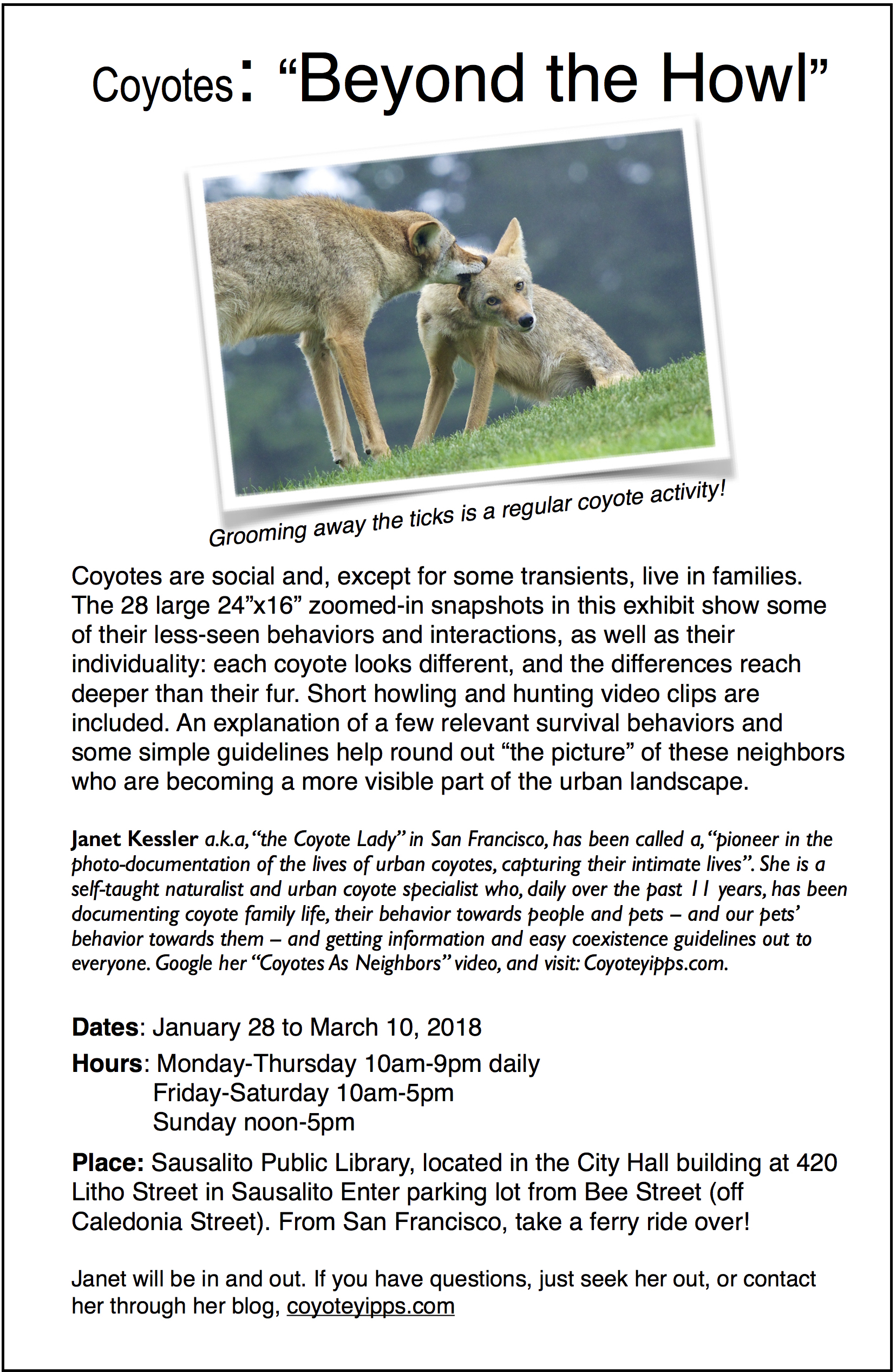
Coyotes are social and, except for some transients, live in families. The 28 large 24”x16” zoomed-in snapshots in this exhibit show some of their less-seen behaviors and interactions, as well as their individuality: each coyote looks different, and the differences reach deeper than their fur. Short howling and hunting video clips are included. An explanation of a few relevant survival behaviors and some simple guidelines help round out “the picture” of these neighbors who are becoming a more visible part of the urban landscape.

Janet Kessler a.k.a, “the Coyote Lady” in San Francisco, has been called a, “pioneer in the photo-documentation of the lives of urban coyotes, capturing their intimate lives”. She is a self-taught naturalist and urban coyote specialist who, daily over the past 11 years, has been documenting coyote family life, their behavior towards people and pets — and our pets’ behavior towards them — and getting information and easy coexistence guidelines out to everyone. Google her “Coyotes As Neighbors” video, and visit: Coyoteyipps.com.

Dates: January 28 to March 10, 2018

Hours:

  • Monday-Thursday 10am-9pm daily
  • Friday-Saturday 10am-5pm
  • Sunday noon-5pm

Place: Sausalito Public Library, located in the City Hall building at 420 Litho Street in Sausalito Enter parking lot from Bee Street (off Caledonia Street). From San Francisco, take a ferry ride over!

Janet will be in and out. If you have questions, just seek her out, or contact her through her blog, coyoteyipps.com

[Press Here for a printable Flyer]

On Installation Day: Our team of three had fun installing the exhibit in the very charming Sausalito Library: we had the layout mapped out beforehand, so only minor logistical adjustments to our plan were necessary. We were rewarded with “ooohs” and “aaahs” from the library staff and visitors from Connecticut, and then from the first official early-bird visitors. We finished a little after opening hours and went off for a reward meal overlooking the bay, which we suggest as something to add to your visit.

Previous Older Entries Next Newer Entries