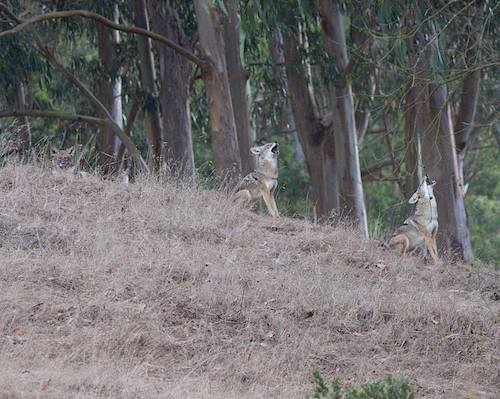
Three coyotes howling (#6) in response to a siren, with some bass in the background added by a dog — this is the first minute of the recording. The last 4 minutes turns into barking by one of the coyotes with a second one howling occasionally — it went on less intensely for a long time in response to dogs and onlookers on a path close by.
Buddies Still
15 Oct 2010 Leave a comment
in coyote behavior, family interactions, group activity


In spite of the bullying and shows of dominance by one coyote sibling towards another, I still see the two walking together at times. Maybe not as lovingly as before, but nonetheless, together.
Snapping: Growing Discord Between Coyote Siblings?
10 Oct 2010 Leave a comment
in communication, coyote behavior, dominant vs. submissive, family interactions, group activity
-

- less dominant coyote #2 sitting close to a path
-

- dominating coyote #1 to our right approaches coyote #2
-

- dominating coyote #1 sits as less dominant coyote #2 moves off
-

- less dominant coyote #2 moving off
-

- less dominant coyote #2 sniffs a spot, then urinates on it & moves on
-

- dominating coyote #1 comes to the same spot to mark it
-

- after marking, dominating coyote #1 looks in direction of coyote #2
-

- dominating coyote #1 approaches & attempts to mount coyote #2
-

- less dominant coyote #2 snaps at coyote #1 who has come over to him
-

- dominating coyote #1 retreats back
-

- less dominant coyote #2 moves off as dominating coyote #1 stands with hackles raised
-

- less dominant coyote #2 sits and looks away while dominating coyote #1 seems to accept the rebuff
-

- dominating coyote #1 turns around and marks a spot
-

- after marking, dominating coyote #1 moves away
-

- less dominant coyote #2 decides to move on
-

- dominating coyote #2 again follows, seemingly to take over
-

- less dominant coyote #2 moves off again and sits down
-

- dominating coyote #1 again walks towards less dominant coyote #2 who keeps his gaze diverted from the first one
Although these 18-month old male coyotes continue to spend time together, I’ve been noting a growing dissonance between them, and growing separation. The angry snapping in self-defence by the less dominant coyote #2, has become more routine. The dominant coyote #1 persists in attempting to dominate, while the less dominant #2 tends to move off or look away to avoid the first one. At this point I would not call coyote #2 submissive, after all, he snaps in self-defence. However, coyote #1 is definitely dominating in his behavior. Coyote #2 deals with the hounding by moving away and averting his gaze. His patience is wearing thin: “If you want to boss me around, go fly a kite.” I’ve labeled what went on today in the sequence of photos above.
A New Drama: Being More Evasive & Peripheral
04 Oct 2010 Leave a comment
in coyote behavior, family interactions, group activity


For many months now, the young coyotes I observe — they are 18 months old — appear to sleep separately from their parents, though at times the younger coyotes may hunker down together. So, in the morning, when a young coyote sees its parent, it always runs up to her, super-enthusiastically. There is an intense greeting with kisses, hugs and falling over each other. The affection is wonderful to see.
BUT, today it was different. It reminded me that young coyotes grow up and things do change. We will have to wait to see how temporary or permanent any new behaviors become.
Today, one of the younger coyotes was on a path when the mother coyote appeared about 100 feet away. I watched, baffled, as the younger coyote looked at the mother and then looked away, and continued walking away, almost disdainfully. After seeing him, the mother lay down next to the path — she seemed to have been expecting this response. She occasionally looked in the younger coyote’s direction. He remained far off, occasionally looking at her. Hmmm. I wondered what was going on.
Then, the second young coyote, his sibling, came up, and as I would have expected, ran up to his mother with kisses and hugs. At this point the “evasive” coyote slowly came forward, very tentatively, and joined in, but only for a moment, and always with his ears down or back. He seemed to want to join in, but was not in there whole-heartedly. He soon moved off to the side with ears down and watched. Why this new “off to the side” behavior? I wondered if there had been a fight with either his mother or sibling. Or, was a hierarchy establishing itself in a big way, or might there have been a severe disciplining from his mother. It was new behavior.
I have noticed that the other sibling, the one who has been showing signs of being the dominant of the two young pups, continually has gone after the more withdrawn coyote. The last five photos of this series shows this. No moves lately have been instigated by the meeker coyote towards the sibling, though he often approaches his mother for the affection he wants as he tries to get away from the more dominant sibling.
Ever since I made this observation, I’ve noticed this withdrawn coyote more off on its own, more separated from the mom and the other sibling — This is not always so, but more so than in the past. Is the hierarchy firming up? Will one of the coyotes soon move on? Or is this behavior just temporary, the result of a recent spat?
“Youngster Gets Bold”, by Charles Wood
30 Sep 2010 Leave a comment
in coyote behavior, group activity, reactions to a human
-

- TheThree
-

- Youngster
-

- YoungsterConfronts
At dusk Dad, Mom and a youngster showed at their usual gathering place. There may have been a fourth, another youngster. Mom and Dad, one youngster hanging with them, did seem to be watching for another. They were relaxed and didn’t seem to be on alert for intruder coyotes. Of course they were aware of me although neither Mom nor Dad seemed concerned enough to chase us off. The light soon became too dim to keep track of their positions. As I watched them my dog alerted. I noticed a coyote coming in our direction. It came towards us on a dirt road that runs up to the fence that runs along the riverbed where I stood. I moved closer to get a picture of the approaching coyote and thought that it had to be Dad. It wasn’t Dad. It wasn’t Mom. It was the youngster who for the first time took on the duty of challenging my dog and me. Bold as that behavior was, it came only half way down the road, perhaps stopping short because it knew it had been spotted. Nevertheless it didn’t immediately withdraw. It stood some, ambled around sniffing, stood some more and then trotted back towards its parents. Not a bad performance for its first attempt at confronting us.
Posting written by Charles Wood. Visit Charles Wood’s website for these and more coyote photos: Charles Wood. His work is copyrighted and may only be used with his explicit permission.
“Dad Sighted” by Charles Wood
25 Sep 2010 1 Comment
in coyote behavior, family interactions, group activity, mother/pup learning, reactions to a human
-

- Momfedup
-

- Momgetsspace
-

- DadMomPup
-

- Pup-1
-

- DadPup
-

- DadPup
-

- DadPup
-

- MomPup
Friday September 24 I saw three of my coyotes. I last saw Mom and a youngster September 13, and hadn’t seen Dad since August 31. I had been seeing them fairly often for about a month. I thought I understood their early evening rendezvous routine. I felt I could count on seeing them almost daily at a particular time and place. When I had come to that conclusion they stopped showing up.
In the 10 days since my last sighting I tried varying my visiting times. Once I went after dark, walking with my dog heading south along the east side of the river, starting at the north end of the nature sanctuary. About half way to their field, I heard some rustling in the dense wood and brush in the sanctuary. I couldn’t see an animal even with my flashlight. The rustling did morph into some obvious leaping, where brush and branches rattled for about two hundred feet at a lightening pace. It sure sounded like a bounding coyote, evidently spooked by our presence. A couple of times I went about an hour before sunset and wasn’t rewarded with a viewing.
Thursday September 23, impatient, I decided to enter their field. Their field has their den and is south of a nature sanctuary. I have observed them going in and out of that sanctuary and have also seen Dad and a youngster in an area to the north-west, across the river. Before entering their field I visited that north-west section. There I spotted some coyote scat on a dirt road. I took a stick to turn it over and the dust underneath the scat was still damp. It consisted of several fibrous palms seeds strung together with the usual brown material. I wondered if my coyotes get enough to eat. I then headed across the river and went south into their field.
Once in their field, I noticed more palm seed strewn scat on one of my coyotes’ roads. I kept my dog on leash and walked south along their main dirt road. I came to the area that has their den. A young coyote poked its head out of the dense brush, ears up and staring. It held still for a moment and backed into the brush. I left the field encouraged and waited on the river bank for an hour. I didn’t see a thing.
The next day, Friday the 24th, as the sun was setting I watched from the river bank. I hoped at least to see Dad who I hadn’t seen since the end of August. Instead I had been seeing Mom. There was a long period when the pups were first brought out that I would see them with Dad and never saw Mom. I don’t consider it unusual to see only one parent. I don’t have any certainty about why that should be so.
As soon as I arrived on the river bank Mom and a youngster showed up on the east-west dirt road. Mom was fed up with something the youngster did and gave herself some space. The two settled down for some waiting and watching. I noticed Dad was near them. I took a fairly clear shot of the youngster alone and recognize it as one of the two I saw in the rendezvous on August 31. I’m hoping these three’s watching and waiting Friday is a clue that the other or other youngsters are still alive. Friday’s youngster could not stay still. Mom and Dad were vigilant yet also at times were curled up, their eyes either closed, looking down the dirt roads or looking at my dog and me. The youngster was ignored by both Mom and Dad despite its attention seeking antics. Mom and Dad had jobs and attended to them.
I’m thoroughly impressed by the consistency with which Mom and Dad do their jobs. If their job is to sit still and wait, they sit still and wait. If their job is to chase my dog and me off, they do. I can’t imagine a coyote parent ever having to exhort “do as I say, not as I do!” The youngster, obviously with “ants in its pants”, simply could not do as its parents and just sit still. Yet it was not chided for ambling around. Mom did snap at the youngster when in its amblings it disturbed her with body contact. I read that as her saying “be a puppy, just don’t be one too close to me.” In contrast, tonight Dad seemed better able to simply tune the youngster out, even when body contact was involved.
Posting written by Charles Wood. Visit Charles Wood’s website for these and more coyote photos: Charles Wood. His work is copyrighted and may only be used with his explicit permission.
Sibling Belligerence
11 Sep 2010 Leave a comment
in coyote behavior, family interactions, group activity
-

- first coyote rushes at the other
-

- unwelcome mounting
-

- unwelcome mounting
-

- second coyote attempts to run off
-

- second coyote runs off with ears down
-

- nipping occurs
-

- second coyote tried to get away again
-

- first coyote persists
-

- second coyote seeks protection in bushes
-

- first coyote continues harassing
-

- second coyote runs off, head down & ears back as first coyote pursues
-

- second coyote gets far away and sits
I’ve been following these two young male siblings since they first appeared on the scene a few months after they were born. They now are about 18 months old. I see them often together, either playing, hunting, or wandering around. Today they were in a field hunting when one rushed at the other and attempted to mount it. This behavior was clearly not welcome by the second coyote. There was even nipping — seldom have I seen this between these two. Twice the underdog began to hurry off with its ears laid back and head down, a sign of anger and discontent. This coyote took refuge in some bushes. But the first coyote continued its harassment. Finally the underdog increased the distance between himself and the other, and sat down. At this point the first coyote gave up and wandered off in the opposite direction, and the second one continued walking further away from the first.
“Getting away” seems to be a need I am seeing more frequently these days by one of the coyotes, whereas in the past these two always ran off happily together. I wonder if this is a trend or a prologue to what will happen next. I wonder how it will play out. Last year a pup left at 20 months of age. Is this the normal age at which dispersing occurs, and is this the kind of behavior which spurs the dispersal? Maybe we will find out.
A Prize Engenders Some Jealousy & Possessiveness
10 Sep 2010 Leave a comment
in coyote behavior, family interactions, group activity, playing
-

- I found a stick
-

- I found a softball
-

- I like your softball better
-

- keep away from my softball
-

- finder of the softball snaps at sibling
-

- there is a second snap; the intruder avoids the snap
-

- finder keeps the ball; sibling looks on
-

- finder gives another warning to sibling to keep off
-

- sibling heeds the warning & moves off
-

- sibling looks back longingly
-

- finder enjoys his prize
-

- finder enjoys his prize
-

- sibling lies close by, but looks away
-

- sibling looks back longingly at the ball
-

- sibling resigned to not having the ball
-

- the winner is happy
“Look what I found!” “Ah, but I found something better!”
Coyotes like to play: they like to play with toys and they like to play with each other. These two coyotes stick together a lot of the time and keep tabs on what the other is doing, so of course, when one found something, he looked over to see what the other’s reaction might be.
Today, almost simultaneously, each found something exciting, and each deemed one of the finds superior to the other. The old softball became the item of attention and desire. The coyote who found the stick immediately dropped it and was drawn to the softball. Some finds are deemed more valuable than others. Coyotes can be possessive of their finds: here there was a need for the “finder of the prize” to guard his newly found treasure and not to share it. I watched this sequence unroll this morning. The ball was chewed and torn apart by the coyote who found it: that is what you do with softballs if you are a young coyote!
Mom Keeps Vigilant While Youngsters Play
08 Sep 2010 Leave a comment
in coyote behavior, family interactions, group activity, hierarchy

There appear to be very definite get-together times and maybe even several get-together places for the members of a coyote family. These get-togethers happen after a period of separation and lone activity, and appear to occur at least once in the morning and once in the evening. These sessions begin with intense affectionate greetings, including lots of kisses, body contact, jumping around and very often squeals of delight. During these group times, the coyotes play and just enjoy each other’s company. They may hang out together to watch or monitor activity in a park. The session then ends with one and then two coyotes going off in their own direction — either to hunt alone or rest alone. I have seen the entire group go off together to another location to monitor or hunt, but eventually the individuals end up going their own individual ways.
During these meetings, while the younger coyotes are playing, their mom normally watches them. She is in charge. Life for 18 month-old pups is still carefree. They surrender all vigilance and control to Mom, whereas life for her consists of knowing everything there is to know about coyote existence. She keeps watch for them and is prepared to defend them. How long will this go on? It is my thought that as long as she is there for them, they will continue in this mode: “It is not until you have to pay the bills that you pay them.” The younger coyotes still have a pup’s existence which is carefree, fun and happy, and it includes lots of displays of affection. They can take care of themselves by hunting and fleeing from dogs, but they don’t seem to have the whole picture yet. These observations are the same ones made by Charles Wood in his posting “Waiting” on September 4.
Mom very often seems to be gallivanting with the youngsters — she often is right in the middle of their activity. But upon closer examination, although she is there, she is not being rough and tumble or carefree at all. She soon tends to duck out from their activity and to sit off to the side to keep watch over their safety. They know this. Mom has her job to do, which involves being totally aware of the bigger picture. The younger ones are not there yet, even at 18 months of age.
Although the mother coyote normally just “watches” the younger ones, I have noticed her try to control the direction of their movements, attempting to lead them in a certain direction. Sometimes they respond right off, but sometimes she resigns herself to settling down until they are ready to come along with her. And sometimes she even abandons her effort and lets them handle themselves.
Chewing A Bush
07 Sep 2010 Leave a comment
in communication, coyote behavior, curiosity, family interactions, group activity


This coyote had just fled from a dog and walker when I took the first photo — it had run to this location where it stopped and sat down, I think it stopped here by pure chance. I thought to myself, “I’ll have to move, there is a branch in the way”. But then, the coyote started chewing on the branch, so I did not move. It chewed pretty intently and I watched. Then, it stopped and looked intently off to the side. A second coyote appeared slowly from where this coyote was now looking, intruding on whatever pleasure the first coyote had found. Maybe it was trying to figure out what was so much fun. As the first coyote watched, this second one went straight to the same branch and sniffed it.
This behavior may have revealed a hierarch. The first coyote watched intently at first, and then turned its gaze away. But when the second coyote finally moved between the first fella and his branch, the first guy flinched and snapped — I was able to see the bared teeth. The first coyote then continued moving forwards whereupon the second one followed, as if he had been cued to do so. But first, guy who came in later, the second fella, backed up a little in order to try biting the bush for himself before moving on: “I wonder what is so neat about this branch?” Mmmmm.
So the second coyote may have been either “herding” the first one to move on and then “trying” the branch as it did so. Or, it may have come over with the intention of taking over what the first coyote was doing. In both cases the second coyote seemed to be displaying some dominance. In both cases, the second coyote was calling the shots, unless, of course, the first coyote had engaged in the chewing with the intent of luring the other one over. It’s fun to speculate.
Perplexed And Fascinated By A Sibling’s Activity
31 Aug 2010 Leave a comment
in coyote behavior, curiosity, family interactions, group activity


I watched a pair of siblings actively descend a hill. But the similarity in energy and activity stopped there. The first to arrive on the trail stopped to wait for the other. When the second one arrived, he did not turn or wait for the first one at all. He ran straight for a bush area where he energetically sniffed, jumped about, pushed his way through. He remained in this spot engaged in this activity, while the first coyote watched, perplexed and fascinated by this siblings activity. The activity and the watching lasted for four full minutes.
“Pursued”, by Charles Wood
22 Aug 2010 Leave a comment
in care for the young, coyote behavior, family interactions, grooming, group activity, hierarchy
-

- Daddump
-

- DadgroomMom
-

- Dadchidepup
-

- Momreconnoiter
-

- PupjoinsMom
-

- Dadangrieratpup
-

- PupwithDad
-

- PupandDad
-

- PupandDad
-

- Dadmarks
-

- MomSouth
-

- Pupfollows
-

- Dadchecksrear
-

- MomandPup
-

- Mommarks
Saturday I waited on the river bank for half an hour looking east. I stood with my dog about 130 yards from the main north-south dirt road often used by my coyotes. I neither saw nor heard anything until 7:40 pm when three coyotes exited the underpass trotting south into their main field. Dad, in the rear, stopped several yards south of the underpass. The other two continued their trot south. Dad dropped scat and then hurriedly followed the other two coyotes. Apparently all three were hurriedly returning from the area to the north, an approximately 100 acre sanctuary for animal and plant life. Their main field is connected to the sanctuary by an underpass and I have previously observed both Mom and Dad in the sanctuary. In contrast, my coyotes’ main field approximates 25 acres, where all except around six acres were mowed a month ago for weed abatement. My coyotes numbered nine a week before the mowing: Mom, Dad and seven pups. Since then I’ve observed no more than four coyotes together at the same time in their field.
Dad caught up with the other two, having stopped to look behind him several times in the process. Together, they all stopped to look north from where they had come. I saw no pursuers. Dad took a break to groom his mate. A youngster was lying on the ground beneath them. Dad finished grooming Mom and then bared his teeth at the youngster. He stood over it, tongue out, as Mom went a bit to the north and stopped. She looked both north and east down flat dirt roads. Apparently pursuers could come from either north or east. The youngster followed her, and then returned to Dad. Dad put the returning youngster to the ground with seriously bared teeth. The youngster then remained near Dad as Dad again checked north. The youngster also stayed with Dad as he went to investigate some odors a few yards north of where Mom had stopped. This investigation lasted about a minute. It ended when the youngster headed south while Dad marked whatever they had discovered. Mom and the youngster headed south and Dad followed. While following, Dad frequently stopped and looked behind.
Mom and the youngster arrived at an entrance to what I assume is the area of dense brush that contains their den. She marked the road and then she and the youngster disappeared into dense brush. At that point I looked back down the dirt road for Dad and did not see him. I waited a bit, saw no pursuers and decided the show was over for the evening. I doubted that any vocalizations would follow because vocalizing didn’t seem wise in the circumstances.
What were the exact circumstances? From whom did they flee? Why was Mom groomed and the youngster instead chided? The second time the youngster was disciplined seemed clearly to tell the youngster to remain near Dad. What odor was important enough to give them pause to investigate and mark when obviously in flight? Did the three return to join other family members? How many of the other six children are still alive?
That the three were fleeing from one or more coyotes seems a safe bet. Perhaps the grooming behavior performed on Mom by Dad was to calm and reassure her. The youngster obviously had messed up earlier. I say obviously because it had prostrated itself by the time Dad had caught up with them. Had it handled an encounter with other coyotes poorly, or caused such an encounter? After being disciplined it chose to head towards Mom and apparently for that, was disciplined again.
It seems safe to say the odor marked was that of a coyote trespasser. The odor was important enough for both father and child to thoroughly absorb the information it contained.
The position Mom took, looking both north and east, suggests that no other of their family members were east. The area to the east, consisting of about four lightly covered acres, has its own north-south entry point and another entry point at the east most boundary, not particularly safe from intruding coyotes. The more southern area into which they ultimately disappeared is dense brush. I have seen Mom alone similarly seeming pursued as she headed south. She at that time also marked the point where she headed into that brush, nearly the same spot as this Saturday. This southern area is about two acres and I can’t take a step there without cracking dry twigs or rattling brush. Probably intruder coyotes would sound similar alarms. The high ground, banks to surrounding road beds and structures, are planted with rows of reeds that are green and supple for being irrigated. They are thick, high, and have tight yet navigable spaces for evasion and ambush. I’m hoping the other youngsters can be left there unsupervised while Mom or Dad or both reconnoiter before taking more family members out for their early evening hunt.
I’ve read and heard many times that feces and urine mark territory and thought it rather benign, perhaps even thoughtful or polite. I have rethought that. I have seen Dad drop scat a few yards from me to begin a confrontation. Dumping, scraping, mock charges and barking do drive me off, particularly with the way he looks so much larger with his fur buffed out. It isn’t simply that he can drop scat. He can do so and back it up with all his power. To mark while fleeing, and to mark the area they have the most interest in defending suggests to me: “Abandon hope all ye who enter here”.
Posting written by Charles Wood. Visit Charles Wood’s website for these and more coyote photos: Charles Wood. His work is copyrighted and may only be used with his explicit permission.
Get Off Of Me!
16 Aug 2010 Leave a comment
in coyote behavior, group activity


These male siblings are a year-and-a-half old. As usual, I spotted them playing and then hunting together. Only this time, one attempted mounting the other.
I have seen this behavior performed on the mother who sat down and patiently put up with it for a moment before snapping. Within the next few moments, the younger coyote repeated this a couple of times as I watched, and the mother always responded in the same way. The behavior ceased when the coyotes got up to leave.
And I have seen sporadic attempts of this behavior a couple of times between two male yearlings, but the attempts were not very insistent and appeared to be more part of the vocabulary of play — the attempts were abandoned quickly as other types of play took over.
This time, the behavior was clear and insistent and occurred three times within a matter of ten minutes during which I watched them. The underling did not like this, but was playful about it at first, and then annoyed, pulling back its lips in a display of “cool it” — the same as the mother had.
I wondered if the fun-loving and play in which these animals have engaged all their lives was beginning to turn in the direction of hierarchy and dominance. And I wondered if this would be the factor that will cause them to leave the family group and move on in the near future. The male from a brood born the previous year departed the area in November at the age of 20 months.
Of course, the young always, or almost always, leave and move on. But one wonders if leaving has to do with the urge to leave, or if they are “forced out” without cause, or if they might have been expelled due to a behavior — maybe a behavior which grows in intensity, such as dominance — which was not going to be tolerated by the rest of the group?