Information and stories about San Francisco coyotes: behavior & personality, coexistence & outreach, by Janet Kessler: Unveiling first-hand just how savvy, social, sentient and singular coyotes really are!
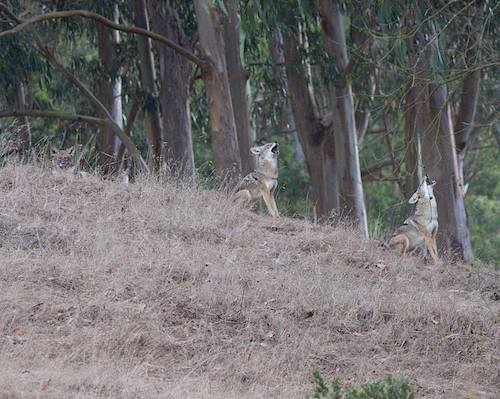
First there were sirens. Coyotes often respond to fire-engine or ambulance sirens. This older alpha male responded with howls as you hear here.
Then he stopped and listened. This is the part that’s most interesting to me: the listening. His family was responding to him. Notice him cocking and turning his head as he listens intently, trying to catch every meaningful sound in the reply howls of various family members — they are in the far distance, but you actually can hear them in the video.
His family consists of his mate and two of his mate’s yearling offspring. He himself joined the family only a year ago, shortly after the then-alpha-male died.
He was listening for WHO in his family was responding and where they were — each coyote has his own distinctive signature howl that includes a certain voice and pattern — I myself can distinguish some of these, and of course he would be able to discern their locations. Also, though, he was picking up on everything else being conveyed in their vocal responses conveyed by duration, tone, urgency or lack thereof, etc: there’s a lot of information there that we humans have not learned to decipher. Most of it, I believe, is emotional states. After discerning what he wanted to know, he then belted out his own long reply.
I have a whole page on vocalizations if you want to delve deeper: Coyote Voicings.
When he began kicking the dirt — a usually angry reaction — I turned around to see what had prompted him to do that. A walker and his dog had stopped close to me to listen, and the coyote appeared to be reacting negatively to that presence. Coyote often react to dogs and even intrusive photographers in this manner.
When the vocalizations stopped, the dog and owner walked on, and the coyote went in the direction of the howls he had solicited.
The previous day an unleashed dog had seen the coyote hunting in a field about 300 feet away. The dog took the opportunity to leave the beaten path where his owner was walking with him, and dashed after the coyote into the field, into what has been a safe-haven area for the coyote family. Most dogs are restrained to keep them from going after the coyotes here. Coyotes do not like being intruded upon or chased: they simply want to be left alone. The coyote fled, but stopped short. This intrusion was cause for the coyote to react. She turned around and paid that dog back in kind, pursuing him right at his heels. She may have tried to nip the dog’s heels, though the dog remained uninjured. The message from the coyote to the dog was clear: “leave me and my area alone.”
The very next day in the same area, another large dog, this time one that was leashed, caught sight of the same coyote an 8-year-old mother, and her 2-year-old son. The dog tugged hard on its leash and lunged as best as he could towards the two coyotes. The owner struggled to contain the unwieldy dog, but anyone watching could see that the more the owner remained in that spot, the more frenzied the dog became. The dog’s struggle to go after the coyotes went on for way too long when it could have been stopped immediately by the owner just by heading in the opposite direction and thus diverting the dog’s attention and containing his energy. The 2 coyotes reacted to the frenzied dog by going into a long, 13 minute BARKING and screeching session. They were proclaiming their anger, and proclaiming that this area was theirs, warning the dog away. The owner finally heeded the advice given to her: she turned around and left. I’ve seen often that dogs, even simply messaging their intent to go after coyotes in their territories create reactive coyotes — on-edge and readier to respond defensively — rather than coyotes who remain calm because they are left alone.
Here is a video-clip of the barking from that day. I videoed the whole 13 minutes, but have cut that down to about four minutes. Barking (as opposed to howling and yipping) is an angry response — a warning. For comparison, watch and listen to the smaller video below: that one involves two coyotes calling out to each other in upbeat yips and howls.
I want to address one specific coyote’s behavior towards one specific dog.
We all know that our domestic canine companions themselves can be very specific and particular about who and how they relate to regarding each and every other individual dog, and even individual people. For example, today I was approached by several dogs who knew me and were all hugs and kisses, wiggles and squiggles, towards me when I saw them. Cool!
Then there is another dog who barks at me ferociously — I keep away — the owner herself doesn’t understand it beyond what we’ve agreed on, that just like humans, likes and dislikes exist in animals, and some of these are strong. Maybe my camera equipment initially set off the dog, but now it’s an ingrained pattern. The owner of yet another dog told me that although his dog is outrageously friendly to almost everyone including me, there were two very specific dogs — only two — who raised his dog’s ire whenever he saw them. He didn’t know exactly why it was just these two dogs, but he told me that one of the dogs walks by his house every day, and so there may be a territorial issue involved in that case.
When chemistry is bad between certain dogs, the result is growling and lunging and worse. Fights can only be averted by tightening the leash and walking away. The behavior is first set off, no doubt, by communication that insinuates some kind of oneupmanship: a threatening or even a disdainful *look* from one dog to another, or maybe one dog reminds the reactive dog of another disliked dog in some way, which might explain why some dogs, I’ve been told by their owners, react to only a certain breed of dog. Dogs read each other well and they are constantly communicating, mostly in subtle, body-language ways, unbeknown to most of their owners.
Once a fight begins between dogs, it becomes difficult and even risky to separate them, so prevention in the first place is always best. Note that coyotes, unlike dogs, seldom actually engage on a fighting level with dogs. Any injury to them could spell death. So their strategy is to “message” through body postures. It’s best to heed their warning messages at a distance: just tighten your leash and walk away. As they get closer, they are more apt to engage in a charge-and-retreat messaging system that could involve a nip to your dog’s haunches. Small dogs could indeed be injured or worse, so please keep your distance in the first place!
1) So, the behavior of the coyote I want to describe — a behavior which for a while replayed almost daily — can be described like this:
Early in the morning, the coyote hangs out on a high knoll close to the entrance of a park, relaxing and taking in the view, watching dogs as they walk with their owners, or jumping up to watch any spurts of dog activity, such as barking or running after a ball: she’s curious about what’s happening on her territory and likes to know what is going on. In particular she keeps her eye out for one single dog who makes her feel very uneasy. That dog eventually appears with its owner and proceeds to walk into the park. (The owner is very aware of the coyote’s presence and behavior, and has learned how to deal with it by just walking on).
Hanging out on a little knoll
At this point, the coyote hops-to and starts to follow them. Today, unusually, the coyote was intent on getting closer to the dog, so the owner did the right thing, picking up a pebble and tossing it towards (not at) the coyote and walked on. The coyote distanced herself as expected. In the two years that I’ve been watching this behavior, there have been only a couple of instances when the owner has had to do this — her behavior is almost always at a safe distance.
1) coyote jumps with uneasy excitement when she first sees the dog; 2) sometimes her hackles go up, she lifts her lips and scrunches her nose, and she might kick the ground if the duo turn to look at her for any length of time; 3) she follows.
From the moment the coyote sees the dog-and-owner, the coyote could begin her screech/howling. Sometimes there’s no vocalization from the coyote as she follows, but most of the time there is a distressed, high-pitched, raspy grunt/scream, on the level of a “tongue-lashing” tirade. During these sessions, the 100-pound dog, to all appearances, calmly ignores the coyote — that she is leashed helps. And the dog owner with his dog just continues on his way in-spite of the coyote screaming her heart out in back of them.
After about 300 or so meters of this, at the crest of a hill where the coyote is able to keep an eye on the dog as it walks on, the coyote invariably stops following and stops screaming, and watches silently as the man and dog distance themselves around the bend and out of sight within the park. She usually then sits here for a few minutes, looking around, and finally gets up and walks about apparently a little aimlessly, but in fact there is purpose to this: she is waiting, biding her time, because that’s not the end of it.
The coyote eventually meanders over to a ledge where she can see the road below. She stations herself here and waits — about 10-15 minutes or so. She knows the dog and owner will be returning that way eventually, and eventually they do.
meandering over to the edge for a better view
waiting for dog and owner to reappear
They re-appear on the road where she expected them
When dog and owner re-appear into view, she keenly watches them again as they walk parallel to where she is, and then she hurries to a second location, still keeping an eye on them, where she can observe dog-and-owner making their last retreat out of the park for the day. And this is when the tongue-lashing can begin anew — with dog and owner again ignoring it and proceeding as though she were not there: this is their best option for handling the situation. Sometimes dog and owner look back at the coyote and smile. Soon the vocalizations stop, and the coyote simply watches as the two — dog and owner — disappear for good for the day into the distant mass of the city and away from her park, her territory. Occasionally she’ll run a little way after them from far in back to make sure they are gone. At this point, the ritual is over, until the next day or the day after that.
She watches, either in silence, or begins her vocalizations again until they descend into the neighborhood
Sometimes she travels a block further to make sure they have gone for the day
The behavior here is intense and specifically focused on this one dog and no other. It’s alarming for many people when they see or hear it for the first time until I can explain it to them.
I should point out that the dog involved has a past history of chasing this coyote, and even running to the coyote’s favorite hangout areas and peeing there, in a sort of “So, there…”, one-upmanship way. This kind of rather casual animosity — there is no barking or growling — is also conveyed through subtle eye twitches or the raising of a lip: these communications are chalk-full of meaning to canines, no matter how subtle and barely perceptible they might be to humans, and they are ever-present.
In addition though, in the past, this owner used to sit with his dog fairly close to the coyote and “chat” in an attempt to “break the ice”, he told me. The result was the opposite of what was intended. The intense focus may have actually conveyed to the coyote that she was “an object of special interest”, and may have caused her to become more suspicious and more wary of the dog than ever. If you focus on a coyote, they’ll focus back to figure out the reason for your interest: it’s part of their very inquisitive nature. In the wild, of course, there would probably be a sinister reason for another animal to focus on you, right? So the dog became something that the coyote watched out for. My advice is always to avoid focusing on coyotes when you have a dog — always just walk on.
So this particular dog became this particular coyote’s nemesis, and to a certain extent vice-versa. It is the only dog that gets this treatment from this coyote. We are fortunate that the owner is more amused — and maybe somewhat bemused — than anything else, with the coyote’s behavior. How different it might be if the owner had been fearful and intolerant, or had chosen not to flow with the situation: the situation would have been splashed, detrimentally for the coyote, all over the news, with the coyote’s reputation plummeting and fear levels stoked. Instead, a thorough explanation of the behavior and how to deal with it and even how to avoid it calmed everyone down. So we are lucky the owner of the dog is who he is. Thank you, Pete!
Until I’m able to explain the situation to any newcomers, they often come up to me with questions such as, “What is the coyote doing to the dog”, or the opposite, “What is the dog doing to the coyote?”, or they even come up with their own interesting interpretations, such as that, “The coyote was screaming ferociously for a mate.” But no, coyotes don’t scream for mates, and mating season is once a year, not in June, but in January/February. Once folks understand the situation, they are soothed, and become amused and even charmed. It’s much easier to embrace coyotes if you understand them. Certainly, it’s easier to coexist with them with the proper information.
2) I have seen this exact same behavior in another area of San Francisco: another coyote, another dog, and a different place. The setting was along a wide, paved, inner city park path taken regularly by dogs. The coyote’s behavior was reactive against one particular dog she felt threatened by and was worried about — even though that dog had never chased her in the past. This is self-protective and territorial behavior. The behavior might well have been initiated at some previous time through subtle negative communication or possibly even by a memory of a dog of similar breed, as previously explained.
Here is a video of that behavior. Or you may hear an audio below of this coyote’s upset and distressed deep guttural barking — so entirely different from a dog’s bark — as the coyote follows, with distressed bouncing steps and hackles up, within 30 feet of the dog and walker. This might be very upsetting to someone who does not understand the behavior and doesn’t know what to do. I advised the walker to just keep walking steadily away, and sure enough, as they continued to walk away from the coyote, the coyote soon turned away from them:
3) A somewhat related situation occurred years ago in a park where a group of off-leash dogs — always walking together at the exact same time every morning — were allowed, and even encouraged (unbelievably), to chase and harass the coyotes. It was only this one group of rowdy dogs that the coyotes always watched for and followed until they left the coyote’s critical areas. That group considered the coyotes bold, aggressive and antagonistic so they felt justified in letting their dogs pursue them.
They never did accept that it was their dogs’ behaviors which were causing the problem in the first place. The coyotes just wanted to be left alone. If the dogs had left the coyotes alone, the coyotes would no longer have felt a need to “push back”. This didn’t happen to dog groups that respected the coyotes by preventing harassment by chasing. By the way, the intense, agitated and distressed vocalization after being chased by dogs can go on for 20 minutes or longer.
TheGolden Rule for dealing with a dog/coyote encounteris always the same: Your safest option is AVOIDANCE: Whether you see a coyote in the distance, approaching you, or at-close range, leash your dog, shorten your leash, and walk away from it to minimize any potential dog/coyote confrontation or engagement. If you choose to shoo it away, follow the guidelines in this video, but know that what’s safest is complete avoidance. [This advice comes to you from over 11 years of keenly watching what works in this situation. This is the best option for preventing any kind of escalation. And here is a complete guide on “How to Handle Coyote Encounters: A Primer”]
I want to update the continuing story of the loner coyote I wrote about in: Coyote Speaks Her Mind to the Dog Who Chased Her Three Weeks Ago! The story through that posting evolved from a dog who repeatedly chased the coyote, to the coyote finally vocalizing her distress at being chased while remaining hidden in the bushes.
Soon thereafter, this coyote would follow that dog, which is now kept leashed, screaming out her anguish, now in plain view — no longer hidden in the bushes. For months this behavior continued, daily, and then the vocalizations stopped, but the following behavior still continued, always at a safe and great distance.
One might ask, “Why would a little coyote follow a dog — even a large 100 pound dog — if she were fearful of the dog? The answer appears to be that ‘following’ is used by coyotes both to escort out and to assure themselves that a threatening (or perceived as threatening) animal is leaving an area. It is a territorial behavior. Coyotes’ survival depends on their territoriality: they claim, and exclude other coyotes, from the land which will supply them with, and ensure them a supply of,food and protection from competitors. The screaming, which incorporates deep raspy sounds, is a brave warning, more bluff than anything else, but also a release of the coyote’s distressed feelings. The coyote appears totally aware that the dog is tethered: she has fled like a bullet when the dog got loose and turned towards her.
The little coyote’s behavior towards that dog is continuing to evolve. Yesterday, after seeing the dog in the far distance, she simply ran the other way and disappeared from view over the crest of the hill before the dog had a chance to see her!
Running off so as not to be seen
The dog doesn’t notice her
A few days ago, having seen the dog from a great distance, she ran off and hid rather than take a chance at being seen.
Crouching low the minute she saw the dog, in hopes of not being seen
watching dog walk away
coyote follows
watching the dog in the distance until it leaves
And today, the little coyote didn’t notice the dog — the dog is walked daily in the park — until the dog already was close by. Her evasive strategy this time involved crouching down into the grasses and ducking so as not to be seen. She was not seen by the dog, but she was seen by the owner. She remained in her crouched-down spot as the dog didn’t seem to notice her (the dog was leashed and couldn’t have moved towards the coyote even if she had wanted to).
The coyote got up and watched them walk away and disappear over the horizon and then took after them, but remaining out of sight. She spotted them at the crest of a hill where she sat and kept an eye on them from the distance until they left. This owner is doing as much as he can to avoid conflict by walking his dog on the leash and always walking away from the coyote. Fortunately, he is fascinated and amused by her behavior!
By the way, I have seen this same behavior in a number of females, and one male coyote — it’s not so unusual, so folks with dogs should be aware of it so they don’t freak out if it happens towards their dog. What to do? Simply shorten your leash and keep walking away from the coyote. Also, try to minimize visual communication between your dog and a coyote — the communication is most likely to be negative, so why even go there? Again, simply shorten your leash and walk on and away.
Summary: Coyote communication occurs mostly via eye contact, facial expressions and body language and it can be very subtle. Coyotes are not forever vocal as humans are; they tend to be on the quiet side — except when they aren’t! Here I explain their voice communications, based on my own daily dedicated observations over the past 11 years, and then I give about 20 examples, chosen from about a thousand that I’ve recorded.
Parent coyotes are especially edgy at this time of year — it’s pupping season.
As this mother coyote foraged behind some low bushes, dog owners with their mostly leashed dogs walked by on a path about 100 feet away: they stopped and looked at her, though it might have been better if they had just walked on. None of the dogs approached her, though they might have communicated some kind of negativity through their facial expressions and body language. The coyote apparently didn’t like them looking at her, or she didn’t like their negative communication. OR, the dogs may simply have been too close for comfort. I was concentrating on her, so I couldn’t see what the issue was.
Note that she begins her complaining with little grunts and heaves: it’s an emotional and distressed reaction. As she initially grunts and heaves, she hasn’t decided to go all out with her barking. But soon, she lets loose. All the dog walkers “got it” once I explained to them what was going on: that this was an edgy mother and coyotes don’t like dogs around them. The walkers and their dogs moved on, and she soon quit her howling and then retreated into the bushes.
Her own mother, too, engaged in this exact same type of barking: it is a distressful bark and only occurs when these coyotes feel harassed or intruded upon by dogs. This type of barking is both a complaining — letting everyone know how she feels — and a communication of standing up for herself, though you can be sure that if a dog went after her, she would skedaddle quickly. The barking session shown here lasted only about three minutes, but I’ve listened to one that lasted well over 20 minutes.
Being out at twilight in a park allowed me to glimpse an owl hunting — I don’t see this often. It was quiet and it seemed at first as though no one was around, but I was wrong. Soon a dog appeared, and the owl took off as it and its owner got nearer.
As I watched the owl fly away, I heard another man yell sharply at his dog. That was the tell-tale sign that alerted me to the possible presence of a coyote on a trail. As I headed in the direction of the voice, I began to hear two coyotes bellowing out their distress at having been chased. One coyote must have run off, because its barking receded into the distance.
However, the other coyote was very close by, in the bushes. I could not see the coyote at all — so, to begin with, I just took a photo of where the sound was coming from. It was in a hollow right next to the trail — not, as usual, up high and away. Although at first I had heard two coyotes barking together, the barking pattern changed when one ran off. The barking began alternating between them, one after the other, taking turns, seeming to answer each other, until the far coyote stopped altogether. The nearer one continued a little longer and then also stopped.
Within a short time, the closer coyote must have sensed that the danger had passed — the dog and walker were long gone — because it came out to inspect it’s surroundings, looking around carefully before trotting off to continue what it probably had been doing before the dog arrived: hunting for voles and gophers.
I’m including the recording in which you can hear the near and the far coyotes’ barking. Unfortunately the recorder picked up the sound of my walking as I was trying to visually spot the coyotes!
We noticed a lone coyote hurrying away, way down the path ahead of us. There were just a few of us on the path, but there was also a dog. The coyote obviously saw us as threats so it hurried up to a lookout, where, half-hidden, it proceeded to warn us off with its bark for about 20 minutes. A couple of people hung around to watch, as did their dog: they had never heard a coyote barking and were very excited and exhilarated by the experience.
I always suggest to people that it’s best to move on if you have a dog: this is the reason the coyote was barking. Having said that, I’ve noticed that coyotes will continue barking for a considerable time, whether the threat has departed or not! I took this video at the site of on den way back in April. Other people saw the pups, but I did not. On the video, you’ll hear lots of birds, a human voice and a San Franciscan fog horn in addition to the coyote’s barking!
He could have been belting out the Star Spangled Banner, holding the notes perfectly — after all, it happened to be the fourth of July!
I started taking the video as an Irish Setter spotted a coyote trotting down a hill. It was a chance encounter — a mere momentary brush-by — but a surprise for both. The dog turned to go after the coyote, but stopped in an instant response to his owner’s “no”. Nonetheless, adrenalin was already flowing, and the “I’ll get you” look had already been exchanged between the canines, so the coyote ran to an out-of-reach spot and began its distressed and upset barking. The owner and dog left immediately, which made no impact on the coyote who kept barking away for about 20 minutes to an audience of no one. However, as the minutes ticked away, the intensity of the initial barking subsided — I’ve posted a second video of the next part of this same barking session — to be continued on the next posting.
Friday I saw four of my Los Angeles area coyotes, all more or less together. Before twilight, Mom and Bold headed north from the nesting grounds to the rendezvous area. Then Mister showed up to bark as I followed them. I hadn’t seen Mom since June 13 and at that time she appeared to be traveling alone, as did Bold on June 30. I often see my coyotes either singly or paired.
Although two coyotes together aren’t unusual, three suggests my pack may be gathering for a rendezvous. At dusk a fourth coyote showed up, Shy. Eventually the three yearlings moved out of sight, like Mom who hadn’t showed herself since before twilight. The only adult I didn’t see was Dad. I reasoned he must have been with the new puppies and hoped they would head towards us. They didn’t. Perhaps Mom went to join Dad and the rendezvous was rescheduled. Or perhaps there is another rendezvous area and I delayed them moving there to join Dad and the puppies. In any case, I didn’t see Dad and the puppies.
My presence is definitely seen by my coyotes as involved and the behaviors I see are mostly of their interactions with an involved human who brings his dog. It was my dog who introduced us, and my interest in coyotes sprang from my interest in their field as a playground for my dog: not a good start, a start that won’t be overcome.
Once I attempted to break Dad’s misimpression by playing tag with my dog while Dad watched. I was thinking he would possibly be persuaded that we were cool. There was no sign of reappraisal, his unamused glare embarrassed me. Mom expresses Dad’s view, as do Mister, Shy and Bold. If they have a theory of my mind, it wrongly informs them that I share my dog’s desire for their food. Yet admittedly, given certain hypotheticals, I would eat their food though they could hardly know I wouldn’t relish it. Then again, with a flame, ketchup, mustard, vinegar and a dill pickle I can conceive of their food as enjoyable. I concede they know me in my essentials as well as they need to.
Mister
From time to time I’ve seen coyote life seemly unaffected by my presence. For example, some crows once buzzed Mom. She moved her gaze off me and onto the crows, sauntered from the road into wild mustard and returned to gazing at me as the crows moved on. I had expected a more energetic defense by Mom. Later I realized that crows can’t fly through wild mustard and that her defense was elegantly parsimonious. My imaginary defense against buzzing crows, flailing wildly as I thought she should have done, would have been untutored. It didn’t occur to me that Mom knows crows better than I do.
Posting written by Charles Wood. Visit Charles Wood’s website for these and more coyote photos: Charles Wood. His work is copyrighted and may only be used with his explicit permission.
All coyote barking that I have ever heard stems from incidents with dogs — an intrusion of some kind. This distressed barking should not be confused with the joyful howls that coyotes are prone to. Here I’m referring to distressed barking caused by the intrusion. But the intrusion doesn’t necessarily always involve an intentional intrusion. Today, for instance, this coyote, who obviously was caught off his guard, became surprised or spooked when two dogs and their owner appeared within the coyote’s safety range suddenly and without warning. The dogs had not chased the coyote at all, though there may have been canine communication of some sort — by eye contact and body language. Dog owners are seldom aware of this communication. The spooked coyote ran off to a high perch where he began a long, distressed, and drawn out barking session. He was “bitching” and “screaming” to let everyone know he was upset, and this continued for a good long time — until the “perpetrators” had walked on, far out of sight.
In this instance, when the coast had become clear, the coyote trotted off to another part of the path where he knew the dogs and walker would be returning, and waited vigilantly. I observed him watch them coming. He continued in this same spot until the dogs and owner were within about 150 feet, and then he stealthily slithered from view. There had been no barking the second time around — that part of the incident was over — this time the coyote just observed, to assure himself that the dogs and owner would be leaving in the same direction from which they had come, and maybe to let them know that he was still there!
the howling turns to barking when a hostile walker & dog appear in the distance
relaxing while hostile dog and walker are out of sight
moving further away and staying hidden when hostile dog & walker get too close
Today, from a distance in the park, I heard joyful coyote greetings and howling in response to fire engine sirens, a not unusual occurrence in urban areas. However, by the time I got to the scene, the howling and high-pitched squeals of delight had turned into a low-key distressed barking session due to the appearance of one of the few hostile dogs & walkers who could be seen about 500 feet away. The coyotes kept looking in that direction. The hostility of this particular pair comes from the unleashed dog continually chasing coyotes, and the owner who, even at large distances, throws stones at them.
The barking stopped when the walker and dog, still in the distance, disappeared behind some trees onto another path. The coyotes relaxed and waited: they knew the normal route of this walker and dog would be in their direction. When the walker could be heard imminently approaching, both coyotes silently slithered further away and up a cliff to behind a brushy area where they were partially hidden and less likely to be seen. After the walkers had passed on by, and after a few more walkers passed by, the coyotes, which had not been detected by any of them, slowly moved off and disappeared from view — they had waited there, watching and on alert, until all danger had passed.
While the coyotes had been relaxing before this dog and walker got close, another walker without a dog came by — she was thrilled to see the two resting coyotes. She told me that if I had not been there to point them out, she would have missed them because of their camouflage. The coyotes allowed us to admire them. Coyotes are very aware of individuals and dogs who frequent the park — they know what to expect from each individual dog and person and they act accordingly. Today these coyotes protectively increased the distance and hid themselves from a hostile dog and walker. If an antagonistic dog is not on a leash close to its owner, an alpha coyote could take the opportunity to repay previous antagonistic behavior towards itself, rushing close to the dog with a warning display. It is best to grab your dog and move on. Alpha coyotes have been known to nip the rears of dogs to make their message more forceful. Please beware that these are messages — it is the only method a coyote has of telling your dog not to get close or come after it.
#1 Mom sits up attentively at first sign of trouble
#1 Mom dashes down hill to the rescue
#1 Mom dashing to the rescue
#1 Mom dashing to the rescue
#1 Mom dashing to the rescue
#1 Mom arrives at the scene of trouble — dogs have gone
#2 Mom’s ears perk up at the first sign of trouble
#2 Mom darts off to the rescue
#2 Mom darts off to the rescue
#2 Mom darts off to the rescue
#2 Mom darts off to the rescue
#2 Distressed barking by Mom when she gets to the scene of trouble
Coyotes don’t appear to run much if they don’t have to. They tend to conserve their energy for when they need it, as far as I have seen. However, extreme joy or fear seem to prompt speed. During games of chase I’ve seen them whiz at top speed. Interestingly, the games are kept in a limited area by running in large circles: they never seem to get too far from where the game began. Another instance of joyful running is when they see Mom and decide to join her: Mom always has elicited ecstatic joy as pups run to greet her!
When I have seen coyotes run for other reasons than play, it has always been for more serious reasons. For example, when they are attempting to escape from a dog. Another example is when Mom, who is Alpha and pack leader, sees her pups approached or threatened by a dog: this is what I am depicting here: “Mom to the rescue”. This kind of run is bullet-fast and always in a bee line.
I show two examples of this. In both cases, Mom was resting when suddenly she became aware of a possible threat from a dog to one of her pups off in the far distance — as far as 500 feet away. A dog had either chased or come too close. The pups are now 20 months old — not infants at all, and larger in size than she is. However, they are not extremely savvy and she knows this. So far, I have never seen them put on a warning display — instead they simply flee from danger. So, when she is within view of them being threatened, she fills in the void.
In the first case she dashed down a hill from where she had been watching, sprinted across a field. By the time she got to her destination the dogs were gone, but the pup was still sitting on the hillside. She continued her lookout — standing guard — now from this much closer location.
The second example began in the same way: a relaxed Mom, and then, as her attention became riveted on the situation in the distance, her ears focused forward, and off she dashed, over 500 feet away. By the time she arrived, although the pup was no longer in sight, having retreated into the underbrush, she began a distressed barking session. Walkers have been leading their dogs away when this happens, and that is what went on this time.
Three coyotes howling (#6) in response to a siren, with some bass in the background added by a dog — this is the first minute of the recording. The last 4 minutes turns into barking by one of the coyotes with a second one howling occasionally — it went on less intensely for a long time in response to dogs and onlookers on a path close by.
Mom, sees something in the distance which puts her on alert
Mom, off like a bullet (blurred)
Mom, shooting across the park
encountering a youngster who follows her
Mom, barking and upset
young coyote watching as Mom barks nearby
Calmed down, Mom heads to another area
Mom gives a last lookout to make sure German Shepherd is gone
Mom spends the rest of the morning asleep and resting
This story hinges on human conduct, which is always the cause behind coyote “incidents”, and also the route through which misinformation is turned into nasty rumors. The only way we can control coyote behavior is through our own behavior. Leave them alone, and they will leave you alone.
So, the day began peacefully, as usual. Very often, when coyotes are out early resting on a hillside, a group of unleashed dogs will aggressively run up to their remote location and chase them. It is always the same group of dogs with the same set of owners who have never taken responsibility for keeping their dogs away from the coyotes — this group is one of the few who are not fond of having coyotes around. Ninety-nine percent of dog owners, however, are respectful and want to do what they can for the urban coyotes. They are totally responsible, keeping their dogs leashed or under voice control when coyotes are out. Repeated “incidents” always occur with the same few dogs. Fortunately, today the coyotes were not out when these dogs went by.
However, not long after they passed, a coyote did appear up on a hilltop, observing her surroundings. We know it was the mother coyote because of the behavior which followed. Several groups of walkers stopped to admire her presence in the park as she sat so calmly looking around: this was magical urban wildness. It was all so peaceful. Then the coyote jolted to a sitting up high position: her attention became riveted into the distance. She ignored the walkers below her. And then, as suddenly as she had sat up, she darted off like a bullet at full speed with hackles raised.
I’ve seen her do this before, so I knew what it was about. She sped to the spot which she had been so keenly observing. On the way she encountered one of her full-grown pups — but this is not the one she was worried about. She had the aim of heading-off a dog which was pursuing her other year-old pup. I didn’t even have to be there to know this. We then began hearing this mother coyote’s distressed and upset barking — barking she only engages in if she or one of her pups have been pursued by a dog. The barking is an indication of her distress, but also imparts a message: “Keep your distance.”
A few of us who just a few moments earlier had been watching her peacefulness, headed off to where the distressed barking sound was coming from. On the way we passed the angry owner of the dog which had chased the coyote — she now had her dog leashed. This huge dog continually chases the coyotes — it is a game for the dog who is about four times larger than any coyote. The owner wouldn’t even look at us: for her, the incident was the coyote’s fault for being there — not hers for not having leashed her dog.
We walked a little further until we spotted the mother coyote: she was rearing up on her hind legs and barking. The young coyote which had been pursued had taken cover in the bushes, but the second young coyote sat on the hillside nearby watching as its mother continued her barking for about 20 minutes.
The reactions to this incident were various: these are the reactions which get reported to our Animal Control Department. Some people were furious that a dog walker had allowed her dog to chase a coyote again — and that dogs are not kept leashed in this “leash-law” area. Some were just fascinated by the barking, and fascinated that a mother coyote would run such a long distance to defend one of her year-old pups from a dog. Some twisted the information to fit their own image of coyotes, saying the coyote had not been chased at all, that she was aggressive and bold and a danger to humanity. And finally there was the individual who points to observers or photographers so as not to have to address his own reasons for not leashing his dog.
It was nice having the witnesses who saw the young coyote chased by the German Shepherd. More and more people are willing to give their names to defend the coyotes and I want to thank them all. When a coyote defends itself or its pack members, it is not an act of aggression or an attack. In fact everyone needs to become more aware of nuances in terminology so that they may be able to describe what they see more accurately. Lynsey White and Stanley Gehrt of Ohio State University point out that the phrase “coyote attack” is sensationalistic and fear-mongering. We need a better choice of words and consistency to better understand how coyotes actually interact with humans. People often conflate words like “aggressive”, “assertive”, “bold”, “curious”, “defensive” and “investigating”. Details of the behavior of people, dogs and coyotes prior to and during any coyote incident are needed to really understand what is going on.
Our mother coyote finally calmed down. I watched her slowly head down a hill and into the bushes and finally up to one of her remote lookout posts, where she gave one last glance around to make sure the German Shepherd was gone. Then she lay down and napped. A couple of hours later I returned to the park to find her still in that same spot resting. Coyotes just want to be left alone. If you leave them alone, they will leave you alone. Please keep your dogs leashed around coyotes.
About My Site and Me: This website reflects my almost 20 years of intense, careful, and dedicated field-work — empirical observations — all photo-documented without interfering or changing coyotes’ behaviors. Be welcome here, enjoy, and learn! I am a self-taught naturalist and independent coyote researcher.
Coyotes reappeared in San Francisco in 2002 after many years of absence, and people are still in the dark about them. This site is to help bring light to their behavior and offer simple guidelines for easy coexistence.
My information comes from my own first-hand observations of our very own coyotes here in San Francisco. What I’m presenting to you is the reality of their everyday individual lives. They have not been studied or observed so thoroughly by anyone else. Mine is not generic information, nor second-hand.
Note that none of the coyotes I document and photograph is “anonymous” to me: I know (or knew) each one of them, and can tell you about their personalities, histories, and their family situations. There have been over 100 of them, distributed among over twenty families, all in San Francisco. Images and true stories have the power to raise awareness and change perspective.


 After about 300 or so meters of this, at the crest of a hill where the coyote is able to keep an eye on the dog as it walks on, the coyote invariably stops following and stops screaming, and watches silently as the man and dog distance themselves around the bend and out of sight within the park. She usually then sits here for a few minutes, looking around, and finally gets up and walks about apparently a little aimlessly, but in fact there is purpose to this: she is waiting, biding her time, because that’s not the end of it.