Rushed By A Dog

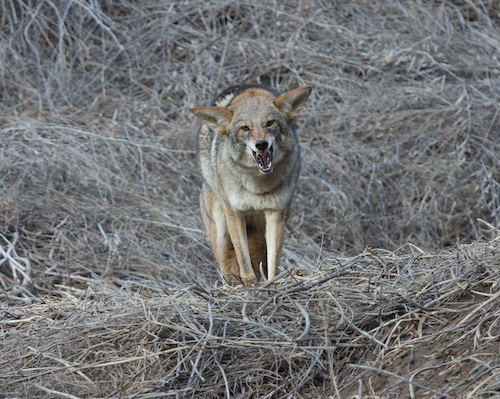
dog rushes a coyote who begins bouncing up & down in a display warning; it worked because the dog turns back here

Coyotes want to be left alone. They do not want to be approached and they do not want to be rushed or chased. Everyone knows how their particular dog will react to a coyote right after their very first encounter with one.

In this instance, a coyote was up on a hill relaxing and minding its own business — watching everything from the distance. It was off the beaten path and therefore out of the way. But as this unleashed dog came over the crest of a hill, he immediately spotted the coyote and rushed it. This is not a new activity for this dog, he has done it before. What is a game for a dog, is not so for a wild coyote. Without coming after the dog, the coyote made a few short feint rushes, bounced up and down, scratched the ground and had its hackles up. The coyote was doing all it could to communicate its needs: “don’t come after me, leave me alone.”

The dog understood, because it didn’t get any closer than what you see in the photo — the dog is actually turning to run to the safety of its master as I clicked this shot. The owner grabbed the dog and leashed it, and they walked on. This incident could have been easily prevented. If your dog has ever gone after a coyote, you need to keep your dog leashed — this is the only way to be responsible and fair to all involved: your dog, the coyote, yourself, other dogs and other walkers.

PCH Male, by Charles Wood

In north Orange County near Pacific Coast Highway I’ve found a male that’s active when I visit with my leashed dog.  In contrast, my river coyotes elude me.

Today near PCH a Northern Harrier was hunting a ridge and I was working on photographing it.  Out of the corner of my eye I saw a coyote descend the ridge into a cleared basin area below.  It is the third time I have seen him there.  The basin sits below a fenced walkway that provides an excellent view of a large field that ends at PCH and the beach.  The area close to the walkway contains the ridge, the basin clearing and brushy cover, cover the coyote quickly entered, knowing he had been seen.

I moved closer to the area he entered, being sure to stay away from brush.  I stood hoping to see him while my dog, close to me, lied down to groom.  In a while the coyote chose to leave the area in full view fewer than fifty feet distant.  There were many invisible points of exit he could have chosen and many visible exit points farther from me.

At first glance the photograph of him leaving may give the impression of a coyote simply walking by with a dog-like smile, unconcerned, headed to places unknown.  A closer look shows that although he isn’t bothering to look at us, his ear is telling him all he needs to know about my dog and me.  The picture with his tongue protruding also is a clue about his state of mind, as is the fact that he opted to pass close by.  My read of him is of a coyote engaged in a low intensity territorial confrontation.  Over a year ago, my river coyotes began their objections to my presence with the same behaviors, including the concluding tongue protrusion.  As I continued to encroach on my river coyotes’ space their confrontational behaviors incrementally increased in intensity.  Yet their objections began with behaviors much as displayed by the beach guy today.

Posting written by Charles Wood. Visit Charles Wood’s website for these and more coyote photos:Charles Wood. His work is copyrighted and may only be used with his explicit permission.

Acute Awareness of Who is Who

An alpha coyote was out doing her job: keeping an eye on the territory, casually watching dogs and walkers from in the far distance. Coyotes become particularly aware of dogs whose energy and awareness might indicate that they could be a threat to themselves. This coyote is especially aware of dogs which have been antagonistic. She has become acutely aware of the barks, paths and even owner voices associated with these dogs. She watches to assure herself that these dogs remain just “visitors” who will leave the park.

Today, when most of the “regular” dogs and walkers had already come and gone, the little coyote stretched big and yawned wide before trotting off to leave the area. And then we heard the loud braying voice of one of the regular walkers yelling at her dog in her usual manner. It was a woman who has shown lots of antagonism towards the coyotes, and whose dog chases the coyotes regularly.The minute we heard that voice from far in the distance, we saw this coyote stop dead in its tracks, turn around and dash right back to its previous lookout where it stood with its eyes glued to this woman and her dog. The coyote watched them until they left for good for the day — about 20 minutes. When they were finally gone, the coyote stretched and yawned again before slowly wandering off.

Transfixed By Dogs Before Fleeing From Them

Coyotes are fascinated by dogs. But watching isn’t all about entertainment. Coyotes are aware of every single dog that regularly passes through their territory. By watching them, coyotes get a good sense of which dogs might be dangerous to them. In addition to the several unleashed dogs which regularly have chased them, coyotes are aware of which dogs eye them antagonistically and of those leashed dogs that lunge towards them, conveying that they would like to give chase. As dogs and walkers get closer, coyotes will flee. I’ve noticed that the distance when coyotes will start to flee is related to how antagonistic the dog and owner have shown themselves to be in the past, as well as if the dog is an “unknown.”

Assessing A Passing Dog Group By Smell

After a dog group had gone by, this coyote approached the trail a little bit and tried assessing the group by smell — never actually stepping on the path itself.  I don’t know what kinds of smells the coyote was searching for, but smelling is a primary information gathering mechanism for them — could it be the equivalent of several sentences worth for us??

Spirited Dog Activity Upsets Coyotes


A dominant female coyote had been well hidden on a hillside when two active Vizlu’s began wrestling & nipping each other a couple of hundred feet from where she was resting: they looked as if they could have been fighting. The intense activity — something that bothers coyotes — caused the coyote to emerge on the hilltop with a strong warning display.  I call it a “halloween cat display” because that is what it looks like: arched back, fur on end, teeth showing with lips pulled back, scratching the ground. Coyotes do not like hyperactivity — it is important to keep our dogs calm when around coyotes. The coyote’s display is meant to make the dogs take note and leave. The dog’s didn’t take note, but their owner did when I suggested that it might be wise to restrain her dogs and calm them. She did so immediately AND walked her dogs away, saying to the coyote as she did so “Sorry Babe”.  The owner was superb in her reaction: willingly leashing and leaving so as not to upset things. As she left, the coyote calmed down immediately and went back to resting.

Unleashed dogs had caused a similar situation earlier, but the reaction from the owners was much more callous, with the dogs invading the coyote’s space. The coyote had been basking peacefully in the early morning sunshine on a distant hilltop, 200 feet from the trail. The coyote ended up running off for its own protection.

Later on, when a walker without a dog passed by the same spot, the walker made a wonderful effort to go around the coyotes — now there were more — giving them plenty of berth. Although the coyotes did flee to increase the distance, they did not leave. The walker was rewarded for her efforts: the coyotes remained for her to observe them.

The Case Of The Squeaky Ball

In this case, we wondered about a coyote’s extreme interest in a dog walking along with its owner. The dog was leashed and a coyote was following, at a safe distance, but definitely following them. When the owner stopped to talk to me, so did the coyote, coming in even closer and eyeing the dog intently but keeping safely off to the side.

The dog had a ball in its mouth which it put down and, puppy-like, assumed a rear-end-up and front-part-down playful position as it toyed with the ball. The ball squeaked which added to its appeal. All the while, the coyote kept eyeing the dog intently. We wondered about the coyote’s interest until the woman told me that the ball had been picked up by her dog in the park a few hundred feet back. Aha! Finally it made sense that the ball may have been a toy the coyote had used and considered as his own!

The coyote’s attention had probably been drawn to the dog’s squeaking the ball as the dog and owner walked along the pathway. Suddenly the coyote’s behavior made total sense — and it was very interesting! The coyote is a “teenager” and one who still enjoys “playing” with objects he finds in the park. I’ve seen coyotes play with objects and then “mark” them before leaving the toy behind.

The woman’s loyalty was to her dog, so she was not going to toss the ball out to the coyote. Instead she pocketed the ball and went on walking. The ball, no longer visible, disappeared from the consciousness of both dog and coyote! The dog went with its owner, and the coyote went now in a different direction.

I have seen coyotes often stop to observe another dog that is playing by itself with a stick or a pinecone — usually chewing these things with lots of gusto. This kind of situation — calm play — has lots of allure for young coyotes — they are curious and can relate to it — and I always get the impression that they would like to participate. They never do actually participate when the dog is there, but after the dog leaves, they often “try it out” for themselves!

Prescription For Disaster

All dog owners need to take responsibility for the safety of their pets. Leashing dogs protects both coyotes and pets: it is a win-win situation for everyone. Today there was an incident that could have ended in disaster because a little dog was not leashed.

The incident: A tiny (close to 4 pounds) white fluffy dog was grabbed by a coyote this morning in one of our parks. We found it about 200 feet away within about ten minutes after it was taken. He was lying in some undergrowth. The owner picked up the dog and ran him to a 24-hour pet hospital. The dog is being treated as I write this: the dog will be fine.

The details: We heard the owner yell at the top of his lungs “oh shit”, and then call for the dog — this is what notified us that something had occurred. Less than 30 seconds before, we had passed this man and talked to him about the elections. It was 7:00 in the morning and still dark — I was very surprised to see a dog walker with such little dogs in the dark in a wild park area. He had two dogs — both unleashed. The little dog was particularly small. This man was drinking his coffee as he walked, but most days when I see him as he walks his dogs through the park, he is working on his iPhone and concentrating on that. There have been no mishaps until today. When a woman walker found out what happened, she started screaming for the dog. The screaming and commotion might have served to scare the coyote even further off — but also to scare the dog — a dog is not going to respond to an unknown voice screaming at it. We heard the dog bark out twice and it is by following the sound that we found the dog.

What the owner said: The man told me he didn’t have his glasses on and so could not see very well. When he looked up, he saw two blobs which he assumed were coyotes, and suddenly his little white dog was no longer there. I asked him about a leash, but he did not want to discuss it — “I don’t want to know what I did wrong.” I offered to go with him to an emergency pet hospital, but he thought he could handle it.

People’s reactions: Most people are very responsible regarding their pets. But there is a handful of people who don’t want to take the small precautions needed to keep their pets safe: they are extremely antagonistic towards coyotes or anyone who likes them. From the distance I heard an angry man yell out: “I’m going to get you, coyote.”  Those people who are against coyotes will turn on them, using this incident as an excuse to malign coyotes rather than looking at their own contributing behaviors to the problem, or trying to solve the problem.

There is a lot that people can do to prevent coyote/dog interactions and incidents. The most important are to keep our pets safe by leashing them in a coyote area, keeping our pets calm in a coyote area, and preventing antagonistic dog/coyote communication through body language or eye contact. A coyote is going to follow its instincts — we can prevent our dogs from inciting those instincts in the first place. Scaring a coyote off with the loud noise from a shake-can serves when a coyote has come in too close.

The dog owner could have prevented the incident today by leashing his dog and by keeping his eyes open. In addition to endangering his pet, he has triggered another episode of human retribution. This is the scariest thing for me.

I spoke to two separate dog walkers afterwards to get a further sense of how people feel towards coyotes — neither had been aware of the incident. A French man and his girlfriend walking a dog didn’t even have a leash with them. “We have to walk our dog without a leash — the dog has to run,” is what he told me. He said that he just turns around and goes the other way when a coyote is out — that his dog would never chase a coyote. “The coyotes belong in the parks”, he told me — but he “cannot leash his dog.”  He didn’t seem to see that one of these tenets can’t be embraced without the other. The other was a woman with her dog well leashed: she felt sympathy for the coyotes who, she said, could not be blamed for following their own instincts.

Please keep your pets leashed in coyote areas. This will keep your dog from chasing a coyote, and therefore keep the coyote from returning to defend itself. Walk on rather than linger when coyotes are out. Leashing is the only method for keeping small dogs safe and close to you. Use a shake-can to scare a coyote off if it gets too close.

Rumors develop and spin out of control after such incidents, and it happened after this one. Friends let me know that they have since heard that the incident involved “a large labrador that had been totally mauled and nearly killed by a coyote.” The fact is that no dog has ever been mauled by a coyote in our San Francisco parks. The closest a coyote has come to this is nipping the haunches of dogs which have intruded upon it.

Messaging: Warning A Dog To Keep Away

Mom coyote and a year-and-a-half old pup were headed up a path when, up ahead, what came into view was that same enthusiastic dog from a previous posting, running after tossed pinecones. Note her extreme alertness in the first slide when she first sees what is going on. Although the dog owner stopped his activity immediately upon seeing her, the dog continued to bounce around enthusiastically in anticipation of the next pinecone being tossed. Coyotes often get upset around very active dogs. Neither the dog nor the coyote could have predicted that the other was going to suddenly appear where it did, so the situation could not have been prevented.

Because of the dog’s activity level, Mom coyote felt a need to warn the dog to keep away, so she went into her warning display mode. It lasted only a few seconds. Her messaging was very clear. When she saw that she was not going to be pursued, she stopped her display, calmed down, and walked on with her pup. Then, the owner and dog continued their fun. Note that the pup just stood and watched before moving on with his mother.

I have only seen an alpha coyote react in this manner. Younger coyotes would probably have just watched the dog activity out of curiosity and then run off. And note that no coyote in our San Francisco area parks has ever given this message to just a human. With just a human there, all coyotes are likely to run off the path or take a very wide berth around the human. Still, your best preventative recourse against your dog and a coyote engaging is to leash the minute you see a coyote and keep moving on, away from the coyote. Please keep your eyes open always in a coyote area — even if you don’t see one right off, know that they are around and could pop out any minute.

Contests & Winning

A friend relayed a story to me which I want to re-tell. He was walking in a park in the early evening. He had taken a little-used narrow path high above the beaten trail when he saw a large brown pit-bull dash across the path ahead of him. There was no owner around. Within seconds my friend could see that the dog was chasing a coyote. And within seconds of that, the pit-bull whizzed by him again in the other direction, this time followed by a second coyote: the dog was being warded off by the coyote pack leader which was protecting the chased coyote. It is important to know that this is how alpha coyote’s react: they are protective of their pack members.

But the story didn’t end here. My friend later descended to the path below where he saw the dog, now leashed, and its owner heading out of the park. And following them from 50 feet behind were the two coyotes: they were assuring themselves that the dog was leaving the park. After the dog was gone, the coyotes ran up to the hillside and cavorted playfully. My friend thought that the coyotes might as well have been celebrating and “thumbing their noses” at the departing dog which had disturbed them.

Amusing though it might seem, contests of this sort are the basis for future antagonistic relations between dogs and coyotes. We can prevent these from ever occurring in the first place by keeping our dogs restrained in the parks which we know have coyotes. Even if the dog is kept leashed and no longer chases, the coyotes have now become alerted to this particular dog: he has been tagged as a threat. And the dog has become alerted to the coyotes as something fun to chase — he will now continually look for them: each side will want to play out the contest.  Both the dog and the coyotes will feel tension if they see each other for some time to come.

“Rattle Snakes, Coyotes and Dogs”, by Charles Wood

On two occasions a few years ago my dog was off leash in two different locations where I suspected coyotes were present.  Both times we were in areas my dog hadn’t previously explored.  Both times a sole coyote approached my dog from behind.  Each got rather close and my dog didn’t seem to sense that he was being approached.  I was near enough to call off the coyote each time.  One of the coyotes was easy to call off.  The second one wasn’t as easy to call off, seemed more purposed and grumpier than the other.

A few nights ago I was glad I had my dog on leash.  I was on the riverbank and a coyote was fording the shallow, narrow river to come over onto our side.  My dog began to bark incessantly and pull on the leash.  Without that restraint, my dog would have chased the coyote.  My dog has an adversarial history with that particular coyote where neither much cares for the other.  The outcome of a chase wouldn’t have been predictable.

Coyote habitat is ideal for dogs to just be dogs.  Coyote habitat may also be home to rattle snakes.  Despite how we might assess our dog’s ability to emerge unscathed by contact with a coyote, the fact that rattlesnakes may also be present is a possibility I had not fully considered until yesterday.  Dogs like to chase and they also like to dig.  Off leash, my dog likes to dig out ground squirrel burrows.  I released him in a mesa where I can spot a coyote from a quarter mile away, farther than my dog can see.  I neither heard nor saw the rattlesnake my dog disturbed.  I did see my dog’s swollen and punctured back foot and soon discovered that the two vials of antivenin needed to treat him cost $485 each and aren’t necessarily stocked by an urban or suburban family veterinarian.  The total cost of his treatment could well approach $3,000.  Off leash, a dog may successfully chase away a coyote.  It may then proceed to investigate interests that prove more dangerous than coyotes.  There are more reasons than coyotes to leash a dog.

“Thoughts on Dogs and Coyotes” by Charles Wood

Over the last year the encounters between my dog and “my” coyotes have escalated into confrontations.  A year ago I could unleash my sixty pound dog in their field and successfully manage their infrequent interactions.  I’ve come to understand that my past success was influenced by chance and happenstance to a greater degree than I previously thought.  Today I consider my entering their field as potentially unsafe and provocative.  In contrast, other people use that field at times and have told me they have not seen coyotes there.  Young boys use a part of the field for bicycling, having built earthworks for that purpose.  Transients at times sleep there.  Groundskeepers make their appointed rounds.  Teenagers party.  Towards these other field users, the coyotes have remained a “ghost species”, perhaps because they don’t bring dogs with them.  My dog and I have caused the coyotes to single us out for increasingly confrontational treatment.  It took a year for those changes to develop, a testament to the coyotes’ natural tendency to avoid people.

By chance and happenstance I mean factors that influence coyote behavior.  At root their behavior is about food and reproduction.  Coyotes live mostly in family groups.  Consequently, if you see one coyote there is a good chance there is at least one more present nearby.  It doesn’t seem likely that one coyote and an equally or greater sized unleashed dog will seriously injure each other.  My opinion is that mature breeding coyote pairs together are smarter and stronger than one dog of their size or larger and that coyotes don’t play by the rules that a typical pet dog expects.  The encounters between a larger unleashed dog and such pairs seem to me to be advantaged to the coyotes.  The proximity of a human and the degree of human control exercised over the dog become critical to the outcome of such an encounter.

An unleashed larger dog appears to a coyote as an interloper, and intruder.  Coyotes are known to be intolerant of interloper coyotes.  Coyotes will defend their food sources and their young.  Their options in so doing are legion and their choice of tactics is perhaps situational.  My situation is that my dog foraged, he did not simply walk through the area and/or chase my coyotes.  Also, my dog interacted with a mated pair.  My observations of my coyotes and my interloper dog took place over the last year or so.  The contact with the coyotes began with them simply showing themselves.  They seemed to be saying, hey, you’ve smelled me and my markings, why are you still here?  After a time of being in view, they would withdraw into the brush.  At some point later Dad would attempt to sneak up behind my dog, presumably to deliver a nip to his haunches, nips I could prevent by yelling.  As time passed and I ignored these messages, Dad escalated to warning bark sessions after which he would return to the brush.  Barking sessions were later replaced by more aggressive displays of marking, scraping and mock charging followed by partial withdrawals where he remained in full view.  If we didn’t leave, he would begin those aggressive displays again.  Later, to those types of aggressive displays, Dad at times seemed purposed to separate me from my dog where I read his intent as to engage my dog in combat.  Mom recently temporarily separated me from my dog although we were on opposites sides of a chain link fence.

These behaviors developed over about a year, and about a month ago, Mom also began mock charges, marking and scraping without retreating from view.  I should mention that the zone of intolerance increased beyond their field and into other areas where my dog and I had never had problems with them.  My read of my dog is that he would not visit those coyotes of his own accord and that he has felt that way for some time.  Also, much of the time when we walk along the river bank or go to the bridge, we don’t see any coyotes.  When we do, many times my coyotes don’t behave aggressively.  I can’t predict when they will or when they won’t.  When I do see them, it is for an insignificant fraction of their day and I never know what kind of day they had.

Several years ago in a different area, at dusk, two coyotes followed my dog and me as we were leaving.  On the crest of a hill, one of the coyotes ran out in view of my dog while the other remained behind crouching.  My dog stupidly chased the moving coyote down the hill out of my sight.  The crouching coyote did not follow my dog, perhaps because I was present.  Perhaps the coyotes were practicing, but clearly my dog was at risk of being defeated in a frontal and rear attack.  I hadn’t visited that other area very often, yet those other coyotes engaged my dog at a level it has taken a year for my usual coyotes to approach.  Once, in that other area, my dog was off leash and out of my view.  I called him and he didn’t come.  I began to look for him and soon saw him running full speed towards the exit which is located about a mile from where we were.  I called him, he momentarily paused, missed one step in his galloping gate and looked me in the eye.  His look and body language said to me, “Forget it, I’m outta here buddy!”  It took me a while to catch up to him near the exit.  I believe he was responding to some wildness directed towards him by a coyote, again, one of my first visits to that other area.  Here again I am speaking to the unpredictability of coyote behavior, the reason the experts advise us, upon seeing a coyote, to go the other way.  We can choose to do so.  An unleashed dog may decide to chase the coyote and the outcome may or may not be consequential to the chasing dog.

Part of the unpredictability of coyote behavior could be attributable to the fact that the circumstances in which coyotes find themselves change over time.  Food may be plentiful one year and scarce the next.  A female may lack a mate one year and acquire one the next.  One year there may be no puppies and the next there may be several that survive for months or longer.  I have no idea why the coyote I call Mom recently became aggressive when for the longest time she was timid and obsequious.

I want to reiterate that the behaviors of escalating aggression I observed over a year were behaviors that I elicited by ignoring the messages the coyotes were giving me.  My behaviors caused the increasingly aggressive behaviors I observed.  From the point of view of the coyotes, my behavior was that of a perpetual repeat offender.  I continually brought my dog, whom they perceive as an intruding competitor, into their home.  I had decided to give my 60 pound dog a little space with coyotes in order to find out for myself what would happen.  I don’t like what happened.  My behavior was to repeatedly intrude into their home range and seek contact and take pictures.  My unwise dog used the space I gave him to seek food and to disturb the coyote family.  The coyotes’ home range contains their children and their food, the two things coyotes care most about.  They responded accordingly.  After all, coyote behavior is rooted in food and reproduction.

I’ve wondered, considering how little territory my coyotes occupy, how it was that rabbits were always present.  Why weren’t the rabbits depleted and why hadn’t the coyotes moved on?  One reason is rabbits reproduce rapidly.  Another is that other rabbits nearby come in and take over the space formerly occupied by rabbits that the coyotes ate.  The same kind of habitat seeking applies to coyotes.  Removal or extermination creates empty habitat for other coyotes to find and occupy.  The idea that “something must be done” about coyotes is simply an idea that is obsolete.  Coyote survival in urban and suburban areas doesn’t depend at all on how many are removed or killed.  Their ability to find and use habitat in urban and suburban areas depends on how we behave towards and think about coyotes.  Understanding the nature of coyotes helps us to manage our lives in ways that minimize unwanted contacts with them.  Coyote presence requires us to change a little.

Typical Encounter Between Mother Coyote and Dog Who Chased Her Pup

This behavior is so predictable, it has become a script. A dog is out with its owner for a walk. The owner spots a young coyote and is thrilled to see it, so stops to observe. The dog does not see anything. I mention to the owner that she might want to leash her dog if there is any possibility that dog might chase the coyote. “Oh no, my dog never chases dogs or coyotes.” I mention that dogs see coyotes more as squirrels than as dogs. I am ignored. The dog eventually sees the coyote, goes into his threatening stance and then goes after the coyote. The young coyote runs away.

The problem is that in one of our parks, the mother coyote is watching. In this case, from over 1000 feet away, the mother coyote had observed this dog and saw what was happening. The minute the dog threatened her pup, she dashed full speed to her pup’s defense. Her pup is 18 months old and full-sized, nonetheless, he is still her pup. She reached the dog and pursued him at a galloping speed. The dog’s owner had yelled repeatedly for the dog to come — but when a dog’s adrenalin is up, it never does come.

The dog ignored its owner until the coyote came full speed towards him with anger in her face. Then, when fear finally hit him, he came running towards his owner who grabbed him. At this point the mother coyote stopped her chase. The mother coyote’s job had been successful: she had kept the dog off of her pup. The dog could have been nipped in the haunches, but it did not happen this time. The owner grabbed the dog and leashed it, repeating out loud “Why didn’t I leash my dog.” The owner then retreated to a distant path and watched. The coyotes stopped all further activity and stood frozen, watching for any further intrusion from the dog. Not for ten minutes did the dog and walker depart, and not until then did the coyotes move into a more relaxed mode.

Grabbing a Dog’s Stick

This coyote watched, enthralled, as a dog chewed this big stick. Immediately after the dog left, the coyote carefully sniffed out the stick, grabbed it and attempted dragging it around a little. The coyote never actually settled down to chew it, though, as the dog had been doing. Notice that in the third slide the coyote is ready to take off — lickety-split . This is because the dog, which had not wandered too far, turned around and looked!  On departing — last slide — the coyote urinated on the stick (I was only able to capture the coyote finishing up this activity), marking it as belonging to itself!!

The Coyote “Wild Barrier” Is Breaking Down in Our Parks

Habituation — a certain familiarity — occurs when species are put into close contact with each other, as they are in our urban parks. Our aim should be to keep this familiarity at a minimum, so as to insure safety and to prevent conflict — to create a peaceful coexistence for everyone involved: for dogs, humans and coyotes. To achieve this requires a little effort on the part of everybody.

For the most part, coyotes in the city are considered to be more of a nuisance than actually a threat. Coyotes may be considered a nuisance simply by being seen, even without evidence of having done anything — this is not true of other urban wildlife. There are misconceptions and fears regarding coyotes because people are not familiar with their normal behavior: people don’t know what to expect from coyotes, and they don’t know what is expected of themselves. Education at all levels may aid coexistence.

First, it is important to know that coyote attacks are extremely rare, but they are possible. Like any wild animal, coyotes may behave unpredictably when cornered, sick or hurt. If a coyote appears threatening to you, you need to scare it off. Food left out or actual *feeding* of coyotes appears to draw coyotes to certain areas where they begin to tolerate human presence more and more. It’s important for us humans to make an effort to walk away from them.

The closest I’ve seen coyotes come to humans is when there is a dog problem.

This occurs when a dog chases a coyote, or when a dog comes in too close to a coyote or even when there is visual contact/communication between the two which is almost always of a threatening nature — this last occurs even with leashed dogs. The natural “wild barrier” between dogs and coyotes is broken down whenever there is “interaction” or “engagement” of this sort between the two. “Mutually engaged” means “mutually focused” on each other. A coyote remembers these incidents. The door has now been opened for future coyote/dog interactions — which bring the coyote into more frequent and closer proximity to humans.

Coyotes will adapt in the way they need to to survive and to feel safe. Coyotes will defend themselves against dogs, and they may eventually take the initiative to prevent future threats towards themselves from particular dogs. Coyote/dog interactions always bring coyotes close to humans.

By the way, since coyotes carry diseases and parasites, if your pet is bitten, please follow an intense cleansing procedure and contact a veterinarian.

Previous Older Entries Next Newer Entries