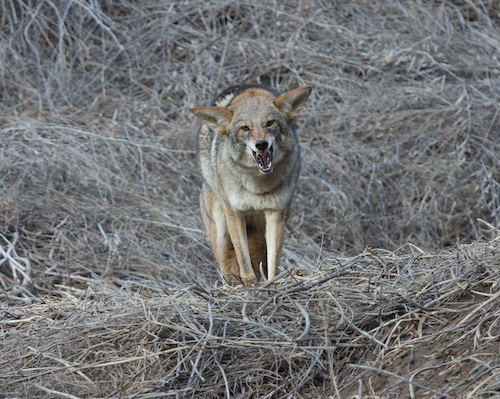
When “Mouthing” Was Still Play Only A Short Time Ago

Here are some photos from September that I did not post. Posting them now actually works well, because the behavior they depict is in contrast to what is occurring now. Now a hierarchy seems to have been established between these two sibling males. The dominant one tends to bully the other, and the other one tends to run off to avoid it: this happens now always.

But before this, at the end of September, there was more equality and lots of playing and affection between these two siblings. These photos show the coyote which has become less dominant — to our left — playfully putting his snout around the one who now has become more dominant in a bullying sort of way. It is almost a role reversal, except that back then, these behaviors were just being toyed with and didn’t seem to carry much weight at all as far as I could see.  The mouthing in these photos was part of the play involved with chewing a stick together and dealing with some bugs which were flying around their faces. But now I see it used to confirm dominance, this along with mounting behavior. Again, in a reversal of behaviors, the coyote who is less dominant now used to mount his sibling excessively — always in play: it didn’t seem to carry any weight because the other coyote did not react to it. So, the excessive mounting behavior, along with the mouthing I show here, may have driven the dominant to become so in order to squelch this behavior — maybe he got tired of it. Note that this behavior is what is occuring between 20-month old male siblings. Mom is still very clearly pack leader and has never been challenged in her position.

A thought about dominance and alphas occurred to me.  A friend recently told me that Alpha animals tend to have lower resting heart rate than the rest of the pack — they are calm and in control. After being told this, I remember how an Alpha dog was able to calm and control my dog who had a bout of “oneupmanship” when they met. My dog approached the other dog with hackles up, standing upright and ready to do battle to show the other dog where the relationship stood. However, the other dog, the same size as my dog, was the calmer and the one in control — the true Alpha. He gently pushed my dog, in a playful manner to begin play: “hey, knock it off” he seemed to be saying. They immediately became best friends, with seemingly equal status, but the other dog was in control. The point of this story is that the animal who needs to be a bully very often is not the one in control, not really the dominant one. Maybe such an animal is dominant only in a very superficial way, and in relationships below the Alpha.

Today I was able to see the coyote who has been exhibiting less dominance, the one with less “fight” in him, lead the others in a play session. Both the mother and the current “bullying” sibling were being “led” by the sibling which shows less dominance! I don’t know if this short play session has significance.  Maybe there are more nuances that the rest of us need to pick up on!

“Playing Pine Cone”

I am writing about this activity again because I’ve seen it yet again, in almost the exact pattern as before. My friend who tosses pine cones for his dog to fetch calls it “playing pine cone.” He plays this regularly, just he and the dog and the pine cones.  However, if a particular coyote passes close by at the time, the coyote has been responding in what now has become his own predictable way. It is always the same coyote.

The coyote stops and watches — he seems to want to join in the play. Pine cones are tossed, and occasionally a pine cone rolls too far, so the dog just picks up one that is lying closer and brings that one back to its owner. This is the chance the coyote takes to dart in and grab the pine cone that had rolled too far! He runs off with it — not too far — to where I’ve seen him attempt to toss it up or play with it very briefly, but then, instead of continuing his own game, he stands back and watches the dog-owner activity some more until the game he happened upon is over and the dog and owner depart! The coyote then slowly continues to where he had been headed before his attention had been diverted.

Spirited Dog Activity Upsets Coyotes


A dominant female coyote had been well hidden on a hillside when two active Vizlu’s began wrestling & nipping each other a couple of hundred feet from where she was resting: they looked as if they could have been fighting. The intense activity — something that bothers coyotes — caused the coyote to emerge on the hilltop with a strong warning display.  I call it a “halloween cat display” because that is what it looks like: arched back, fur on end, teeth showing with lips pulled back, scratching the ground. Coyotes do not like hyperactivity — it is important to keep our dogs calm when around coyotes. The coyote’s display is meant to make the dogs take note and leave. The dog’s didn’t take note, but their owner did when I suggested that it might be wise to restrain her dogs and calm them. She did so immediately AND walked her dogs away, saying to the coyote as she did so “Sorry Babe”.  The owner was superb in her reaction: willingly leashing and leaving so as not to upset things. As she left, the coyote calmed down immediately and went back to resting.

Unleashed dogs had caused a similar situation earlier, but the reaction from the owners was much more callous, with the dogs invading the coyote’s space. The coyote had been basking peacefully in the early morning sunshine on a distant hilltop, 200 feet from the trail. The coyote ended up running off for its own protection.

Later on, when a walker without a dog passed by the same spot, the walker made a wonderful effort to go around the coyotes — now there were more — giving them plenty of berth. Although the coyotes did flee to increase the distance, they did not leave. The walker was rewarded for her efforts: the coyotes remained for her to observe them.

The Case Of The Squeaky Ball

In this case, we wondered about a coyote’s extreme interest in a dog walking along with its owner. The dog was leashed and a coyote was following, at a safe distance, but definitely following them. When the owner stopped to talk to me, so did the coyote, coming in even closer and eyeing the dog intently but keeping safely off to the side.

The dog had a ball in its mouth which it put down and, puppy-like, assumed a rear-end-up and front-part-down playful position as it toyed with the ball. The ball squeaked which added to its appeal. All the while, the coyote kept eyeing the dog intently. We wondered about the coyote’s interest until the woman told me that the ball had been picked up by her dog in the park a few hundred feet back. Aha! Finally it made sense that the ball may have been a toy the coyote had used and considered as his own!

The coyote’s attention had probably been drawn to the dog’s squeaking the ball as the dog and owner walked along the pathway. Suddenly the coyote’s behavior made total sense — and it was very interesting! The coyote is a “teenager” and one who still enjoys “playing” with objects he finds in the park. I’ve seen coyotes play with objects and then “mark” them before leaving the toy behind.

The woman’s loyalty was to her dog, so she was not going to toss the ball out to the coyote. Instead she pocketed the ball and went on walking. The ball, no longer visible, disappeared from the consciousness of both dog and coyote! The dog went with its owner, and the coyote went now in a different direction.

I have seen coyotes often stop to observe another dog that is playing by itself with a stick or a pinecone — usually chewing these things with lots of gusto. This kind of situation — calm play — has lots of allure for young coyotes — they are curious and can relate to it — and I always get the impression that they would like to participate. They never do actually participate when the dog is there, but after the dog leaves, they often “try it out” for themselves!

Watering Holes

It took a coyote lapping up water on a rock to make me notice how much water is retained in rock crevices, not only after a heavy rain, but also after a mere misty drizzle. These photos were taken in the morning after a very light drizzle. Everything else was totally dry. There were two different rock puddles which the coyote sprang to, one right after the other, lapping delectably, looking up and then lapping again, first from one rock and then from the other. For me, water always tastes best when I’m really thirsty, and that may have been the case with this coyote.

Young Coyotes Coming Of Age

Today an incident was described to me — I was not there to see it. A walker was coming down a path next to a wooded area with his fairly small unleashed dog. Until today, the dog had never noticed any coyotes so there has never been a problem: the dog always went about minding his own business, and the owner was free to take in the scenery and wildlife.

But today, out of the wooded area appeared a coyote which ran after the dog. Coyotes have only chased dogs that have intruded upon them, so inadvertently this dog and walker may have come too close to the coyote — they may have startled the coyote. This startle and pursuit behavior has happened various times in the past with other dogs. The owner was quite upset that the coyote hadn’t just fled away from them. Instead, the coyote chased the dog right back to its owner and the owner had to scare the coyote off. The owner felt that this particular coyote was displaying a new boldness in doing so.

We discussed things that might have been going on. First, had the dog been leashed, the incident could have been halted before getting going: an owner’s close proximity to a leashed dog along with scaring the coyote off, by yelling, could easily have kept the coyote away. The coyote’s initial response to the startle might have been to stand up to the dog and give it a clear message: “leave me alone, go away.”  However, once the dog ran off in fleeing mode, the coyote’s natural reaction was to pursue it. The dog, then, of course, came back to its owner with the coyote on its tail, fairly oblivious to the owner standing there. The owner felt this behavior showed a new boldness in the coyote. At this point he was able to interrupt the chasing behavior and scare the coyote off. However, the incident left him feeling uneasy: he will have to be more vigilant now. Coyotes which have been startled in this manner tend to react this way — I have seen it often: it is another reason to keep dogs leashed as a precaution to insure safety for both dogs and coyotes.

Another possibility to keep in mind is that running after the fleeing dog may also have been a “play” response. This particular coyote is one who has always loved playing chase with his sibling until pretty recently when the sibling — dominant sibling —  decided that bullying was more fun than chasing games. The invitations to play are no longer responded to positively by the dominant sibling. “Playing” was pointed out to me as a highly likely explanation for the short chase because it fits in so well with the individual character of this particular coyote. Ultimately, we won’t know — but restraining our pets with leashes is a good idea in coyote territory.

The coyote involved in the incident is one of two young 20-month olds. It might be of interest that that these are young males who are now dealing with their own maleness and testosterone and coming of age.  At this time of year last year the one male pup from a previous litter — at the time also a 20-month old — left for good. This is dispersion time, when young coyotes go off on their own to seek their own fortunes and fates elsewhere — it’s time for them to leave the nest. Already the sibling rivalry between the two siblings keeps them much more distant from each other than they ever have been in the past. The coyote situation is a constantly evolving one. But not all coyotes do move on: sometimes some remain as part of the original family pack. I’m watching to see how things develop.  I don’t know if this might be relevant to the incident or not, but it is information to bear mind, especially about young coyote males.

Streets And Cars

Even the smallest streets with minimal traffic pose a risk to wildlife: possums, skunks, raccoons, but also cats and dogs. In this instance a coyote was able to dash onto the grassy area beside a road as the car came by. The car stopped and both car driver and coyote fixated on each other after the near accident. And then, the coyote proceeded to walk down the street again! This was a tiny little roadway in a residential neighborhood.

However, two years ago, in July, I observed a coyote whose incapacitating limp I tracked for a full month. I did not know what had caused the limp, but I found out six months later when I was talking to someone about the dangers of life in an urban area for coyotes. She told me that six months earlier, on one of the busiest thoroughfares during peak rush hour traffic, as cars slammed on brakes to avoid it, a coyote meandered its way across the traffic and was struck by a car: she had observed this herself.  The coyote dragged itself out of sight before anyone could get to it, so no one could have helped it after the accident. This was one of only a few coyotes in the area, so it had to have been one and the same as the one with the bad limp that I had observed during that same time frame. The injury healed and the coyote is still kicking around, so I suppose it was lucky. Only a year before this, as another coyote was crossing that same street, it was hit, with a less happy outcome — that one did not survive.

A Day Away From “The Dog Show”

Today I was able to follow a couple of the coyotes for a couple of hours. Each day is totally different from the last, and the sum of them all gives a more rounded picture of what an urban coyote’s daily routine is like. Yesterday I watched these same coyotes remain distant from the crowds of dog walkers, but on a hill overlooking them. The walkers and dogs were very aware of the coyotes, and the coyotes were very aware of the dogs, each observing the other from the safety of the distance: maybe 500 feet away instead of the more usual 200. That was yesterday.

Over time, several of us have noticed that it is often the earliest walker in the parks who “wakes up” the coyotes. Coyotes appear not to be around, and then suddenly, shortly after the first walker goes by where they are, the coyotes appear. Today it was I who created the first stirrings. Suddenly there was one coyote sitting and then lying on a hill, and as it got lighter I saw that actually there were two “piles” of coyotes: a onesome and a twosome. There were no greetings that occurred while I was there, so I got the impression that they had been there a long time — maybe they had slept there. Unusually, I heard one of the coyotes sneeze loudly a couple of times. By the time I could see them fairly clearly — though it was still too dark for the camera to work — first one, then all headed down the hill and onto the main trail in the  park towards the front of the park. No one else was there.

I went in their direction and found them “setting up” to watch for when the dogs and walkers would arrive.  One coyote perched on a hill and sat facing the main path, while the other two meandered close by. However, today, unlike yesterday, there were very few dog walkers who came to the park early on! It must have been boring!! Watching dogs is one of the coyotes’ favorite entertainments. But other things did happen.

While still sitting at this front part of the park, a lone walker with his leashed dog headed up the grassy hill, off the trail, towards the coyotes, both dog and owner eyeing the coyotes intently. We could not figure out why the dog owner was doing this. He got halfway up the hill, saw us, and decided to turn back. Mmmm. The coyotes watched them intently as they headed away and we did not see them again.

Before my friend decided to head home, one of the coyotes came towards his dog which was walking on a path away from the coyotes. The owner was surprised: “I’ll be darn.”  The dog was called and came right away, so the coyote was left on the path looking at both the dog and owner. It was one of the teenage coyotes and its intentions were obviously friendly. Still it is best not to let dogs and coyotes interact. My friend left, so I too, headed away, but in the opposite direction.

When I next looked up, the coyotes, too, had dispersed from the area, but I was able to watch them in a number of other areas and get a feeling for the kind of morning it was for them. I soon spotted one on a rocky cliff as another dog and walker came by me. He leashed his dog, and both coyote and dog eyed each other with interest until the dog walker and dog went on.

Soon I spotted two of the coyotes close to a curb beside the park. They were keeping track of each other’s hunting activities.  One hunted without results and peed — in disgust? —  on the useless hunting spot before looking up to find the other which had disappeared from view. Oh well, it went on alone.

It is at this time that this coyote headed into the street, crossing it and jaunting along — and barely getting missed by a car. It then ventured into the street, walking along its edge for the length of a block. Fortunately, not other cars came by while it was on the street.

Coyotes cover some ground during their day, and today was no exception. The coyote which was not hit by the car began meandering along some of its routine pathways, when it came across its sibling sitting calmly in the middle of a path. Both coyotes froze and stared at each other for over a minute. These two teenagers have been working out their hierarchy, so bullying is something I’ve been seeing a lot of. I was wondering if something of this nature was going to ensue, but it did not. The dominating guy then walked towards the guy sitting down, but he then just went right by him — no greeting or joy at all: something which was standard in the past. They both started walking in the same direction, but not really together. But the less dominant one became diverted and walked into an overgrown brushy area off to the side of the path. There was loud rustling. The dominating one remained and curiously watched, but then walked calmly on. I went on with the dominating fellow.

When this coyote had reached the other end of the park, he became alert, ears up, and perfectly still and tall. I knew he had become transfixed by a squirrel — a squirrel he has seen often. Experience with this particular squirrel, which I have seen before, caused the coyote to give up pretty quickly.

The coyote was headed towards one of its hideouts when a walker appeared. “Wow, a coyote” you could feel him think from his stance. The coyote was not so thrilled, but stood perfectly still as did the observer. After a few moments, the observer was very careful to go way around the coyote, taking some photos on the way. The minute he was gone a woman and large unleashed dog came sauntering along — the coyote was still on the edge of the path. The other coyote had re-appeared close by. I suggested that she leash her dog. It was fascinating that she would not do so until she spotted the coyotes, which took her some time to do. These coyotes are very well camouflaged. She had never seen coyotes before and was fascinated. I told her a little about them. By this point the coyotes had had enough input and disappeared into the bushes. That was the end of my observing for the day.

Love & Rigid Social Order

A coyote social order is maintained by rituals which constantly confirm who fits where in a group. Here, Mom goes through the ritual of enclosing the snouts of both of her offspring, 19 months old, in her snout and the confirmation seems to be appreciated by everyone — they seem to have interjected their snouts into hers for this confirmation. The two siblings often battle — the battles are only a few seconds long, but they definitely are there. Here, sibling #2 begins to dominate, but Mom walks off at one point and shows her teeth in another. Sibling #2 keeps peace by walking under his dominating sibling’s chin. In the end, the two siblings banter amicably.

A Story About Marking

Here is an interesting story which I found in a charming book by Brad Kessler entitled Goat Song.

The book chronicles the raising of goats on a small farm in Vermont. Coyotes came down from the hills to try their luck at grabbing some of the baby goats. The coyotes were elusive, and the owner was told by others in the area that the only way was to “get rid of them”. As he was a “pastoralist”, coyotes were supposed to be his foes, and he would have to “lose the luxury of appreciating all forms of life — especially those who might devalue his livestock.” But he could not accept that killing was the only way to control coyotes.

He noticed some coyote scat in his yard and that his dog urinated on it. He decided to do the same. Then the two, dog and owner, headed up to the hills, led by the dog, where again they found some more scat and proceeded as before: dog marking it and then owner marking it. They were leaving a message: “We’re here, too.”

They continued this for several days, finding less and less scat each time, until after a week they found no more. They apparently had scared the coyotes off, because no more scat appeared by the barn or on the hill which they had been patrolling, although coyotes continued to bother some of the other farmers in the area.

This is a story about coyotes’ and humans’ territoriality, and an understanding that was reached by using coyote methods. I am not sure it could ever be duplicated, but it is very interesting.

More Play and Dominance

In this sequence a coyote plays with both the core and the shell of a golfball. The core is more highly prized because it has a better consistency: it is rubbery and therefore more fun to chew and some of the rubber bands which make it up actually “flick” the coyote back, making it appear to be alive. I’ve described this in a previous posting.

So here you have a coyote playing contentedly with the inner core of a golfball, the shell is nearby — until the coyote’s dominating sibling appears. The dominating sibling shows his dominance by standing over this fellow with his hackles raised and tail up — he demands a show of submission. The dominated coyote complies by exposing his vulnerable parts.  A distraction in the distance gives this dominated fellow a window to slip away, which he does. But the dominating sibling then grabs the core of the golf ball which the first fellow had been playing with — along with a mouthful of grass. The dominated fellow then settles for second best: the outer shell of the ball — you can see him eyeing it and moving in, but he is afraid to actually grab it. So instead he moves in and watches enviously as the dominating fellow chews the core — one might almost think from the photos that the dominated guy is actually asking for the core.

Then the dominating fellow walks off with the core ball still in his mouth, and the dominated guy, keeping his eyes on the dominant one, grabs the shell, lies down and chews on this for a little while. But soon he turns to a piece of cork which is close by. The dominating fellow comes back for the abandoned shell, but instead simply marks it, and then leaves passing the other coyote almost with a snarl, as the less dominant fellow ignores him and works on his piece of cork.

Rain

Some of us love the rain, and some of us don’t so much. It boils down to individual differences and preferences. I myself love donning my slicker and boots and venturing out into the elements. Animals, too, have their individual preferences: some love the rain, and some do not. For instance, when I would open the front door on a rainy day, my own dog used to get up, just to take a look. The minute he saw the rain he would shake himself out before even venturing out into it — just the thought of getting wet made him shake off the water: no, he always preferred to stay indoors and dry. Yet I’ve met dogs who aren’t affected one bit by being wet: today a large lab was walking alongside its owner in the pouring rain — tail wagging. I asked the owner about it and was told that the dog has never shown any aversion at all towards rain!

So, I suppose these individual differences also apply to wild animals. In the rain I’ve been seeing hawks flying around and screeching and I’ve seen lots of song birds out — they seemed to be out because of the rain. As for coyotes, I have seen them relaxing on a rock in light rain, and I’ve seen them hunting in heavy rain. Whether they really happen to be enjoying the rain I couldn’t tell, but they were out.

The reason I’m adding this posting is because recently a dog walker brought four dogs to one of the area parks which is known to have coyotes — all the dogs were unleashed. The walker told me that since it was raining, she thought there would be no coyotes out. This is not correct. The photos above depict a coyote meandering on a path in fairly heavy rain, and then lifting itself on a rock to get a better view through the rain. It might be true that some, or even most, coyotes might not be out in the rain, but this is not true all the time for all of them.

Bugs and Grubs?

I watched this coyote work here for fifteen full minutes. It was digging and eating something — somethings. They were small and didn’t require much chewing. After the coyote left I checked it out, but could only find some small bugs and white larvae. Coyotes do eat bugs and grubs.

I’m wondering if this also might have been a squirrel’s cache of winter food? It is only a thought — I could not confirm it. I didn’t see a squirrel, but the coyote did look up frequently.  I found out what squirrels eat and cache. This includes seeds, nuts, fruits, lichens, buds, roots, pine cones, leaves, twigs and bark. They have been known to also eat bird eggs, snakes and insects, snails, baby birds and even rats. Coyotes also eat all of these things.

Whatever the coyote had been working on, it was not a gopher or a vole. It was probably bugs and grubs — maybe a colony of them?

And Again, Sibling Squabbles

These wranglings are always rather short, ending with the less dominant guy running away from the dominating sibling. A hierarchy is establishing itself between these two sibling coyotes, as it must, and this is the way they work it out.

Gnawing A Gardener’s Glove

Coyotes have a knack for finding fun things to play with. A gardening glove may have been left behind by one of the many volunteers in the park. It is the first time I’ve actually seen gnawing — as if it had been a bone. The leather part of the glove must have been a little like a dog’s rawhide toy. The activity engaged the coyote happily for about ten minutes.

Previous Older Entries Next Newer Entries