Lost Alpha Status?

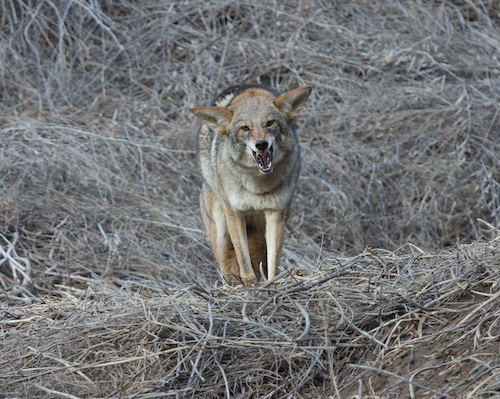
I’ve followed a female coyote for several years now — I’ll call her “mom”.  She had puppies the first year and the second year — they all grew up and eventually dispersed. But the third year and this year there were no puppies. Why? We are told that only “alpha” coyotes reproduce. So, might no puppies be due to her having lost her “alpha” status and might this also have something to do with the possibility that a new family group of coyotes might now be using this same territory?

Coyotes form nuclear family groups which exclude other coyotes from their groups and from their territories. I’ve watched this mother coyote raise her various families. Never have we seen other coyote faces within her family group, or other coyotes in her territory.

The theory of lost status occurred to me due to a rumor — unsubstantiated at this point — that a new coyote group, including juveniles, might have been spotted recently, passing through what has been her territory. I have not seen a new group at all. Coyote rumors are rampant in this area: they often spin into a life of their own. So my theory is speculative, at the moment, and will have to remain that way until we verify what we have heard through the grapevine. But I wanted to explore this possibility of loss of alpha status, even if it exists only as a theoretical possibility. I have noticed changes in behavior that might be explained by a loss of alpha status.

Coyote groups are always family groups: genetically-related individuals with the same parents. They are not like dog packs, where unrelated individual dogs form groups for survival purposes. If a new group of coyotes was seen that included juveniles, the young ones would have had to have been born last year, when our mother had no pups. They would have been born to another alpha since only alphas breed.

The presence of another family might also explain why our mom coyote’s forays into the larger part of a park have dwindled, if not totally ceased — she has been limiting her outings to a smaller area now, and I’ve seen her eyeing the adjacent area where the new coyotes were purportedly spotted.

Why might she have lost her alpha status? Could this have happened when her mate was killed? We are assuming it was her mate who was found poisoned two years ago, right at about the time her second set of puppies was born. We assumed this because we never saw a male in her territory after that event. We only saw her and her growing pups. Was her status tied to his status, and then lost when he died?  Or could she have lost her status because there was no male, whatever his status? Or might she have lost it by another means — for instance, she was badly injured by a car two years ago, which might have compromised her ability to remain an alpha?

Then again, she might be too old now for pups, or she might have sustained internal injuries from that car accident that prevent her from having more puppies. One theory brought up in the literature is that coyotes self-regulate their population sizes. If an area has all the coyotes it can support, coyotes will have very tiny litters, or none at all.

So, no puppies, and the possible sighting of another family group including juveniles makes me think of the possibility of lost alpha status. In addition, the previous bolder behavior which suggested an alpha is no longer what I am seeing in our mom. We will never know the answer to the “whys”. But we do know that this very proud, aware and responsible mother coyote has stopped having pups altogether for the past couple of years and she has retreated to a smaller territorial area where she has been less visible than she used to be. Time will tell how long this situation will last — it might be very temporary, or it could be long-term.

Habitat destruction could be driving coyotes out of their previous homes and into new areas.

Habitat Destruction. Habitat destruction is the single most harmful human activity to wild animals. Many of us are upset at the very short-sighted policies causing this habitat destruction which lead to displacement of our wild animals. The “native plant programs” is a case in point: dense animal habitat is being removed in order to plant native plants which offer little if any habitat value — these are mostly dune-type plants. Animal habitat consists of dense areas of growth, brambles and underbrush which are impenetrable to humans and dogs — this is what makes it a safe habitat for animals. In San Francisco we have vast areas of our Presidio which are now being cleared of their forested areas for the benefit of native plants — this means lost habitat. In addition, the remodeling of Doyle Drive, and its attendant habitat destruction, may be driving coyotes out of their original homes close to the periphery of the city, and causing them to move deeper into the heart of the city to find new places to live. If new groups of coyotes are being seen in some areas, this is the strongest explanation.

Not A Pup: Baby Coyotes Are Not Out Now

Several people have told me that they have seen baby coyotes wandering around — about “yea high” — half the height of a full-grown coyote. They all were adamant about what they had seen — “positive” beyond any doubt that they had seen a baby coyote, or several of them.

But coyotes only come into heat once a year, always in January or February. They are just being born right now. No small coyotes will be seen wandering about at this time of year. Baby coyotes spend the first month of their lives in dens — they do not emerge until they are 4-6 weeks old. I wondered if there was some kind of anomaly occurring, caused by a global warming problem or something like that maybe?

So I asked a gal who said she had seen them to please show me where this was. We went. Sure enough, we found a coyote jumping and hiding behind some bushes and then peering at us from its hiding place with wide open eyes and big ears. My friend said “yep, that’s it”. It sure acted like a little puppy, but it was a full-grown two-year old — one which I have been observing over the last two years. I actually thought it was interesting that some people see coyotes as shy little pups, and some see them as dangerous and large. Maybe it depends on how one WANTS to see them!

The Interpretation

The “spooked” posting continues with an “interpretation”. These photos here show the same thing going on as in that posting: a spooked or surprised coyote hurries away from a dog and its owner, up to a ledge where it begins a distressed barking session until the dog and owner are far gone, and then follows them for a short distance or waits to make sure they are gone.

Dog owners who understand the situation are always amused at this behavior. They seem to comprehend coyote behavior especially when their own dogs are involved. However, I remember various instances of when a dog owner, after this exact same behavior, announced far and wide that there was an “aggressive” coyote out stalking him and his dog. It’s so sad when someone spreads fear and maliciousness about a coyote who basically just wants to be left alone.

Yes, there was the distressed barking, and the coyote did spend some moments watching the dogs that had spooked it. Those of us who have come to know various of our local coyotes can attest to what was going on. But anyone who doesn’t know coyotes or understand their behavior, anyone with the tiniest bit of fear, will spin a tale, and, as the story spreads, it grows, until you have a sensational story all ready for the press.

Coyotes will defend themselves and their territories against dogs. This is why it is best to leash dogs in coyote areas: dogs and coyotes need to be kept apart. But a spooked coyote is just that, not an aggressor.

Pursued Against One’s Will

Here you have a young coyote using a trail in a park. He had been avoiding and walking away from dog-walking groups all morning. His walk is obviously a casual one on a trail which appeared to have no one on it. The coyote left the trail long enough for an attempt at hunting in some brushes but then returned to the path. Suddenly, from over 200 feet ahead, a dog on the trail spotted this coyote and came after him furiously. The dog was right on the coyote’s tail — and it is this extreme closeness which is so disturbing. The coyote got away. But the story could have been different, with the dog hurting the coyote, and the coyote hurting the dog in self-defense. For the dog, chasing is game, but for the coyote it involved running for its life: coyotes live in a much more real world than our dogs do. I have avoided putting photos of dogs in the blog, but this one needs to be put in to bring home to everyone that wildlife and dogs need to be kept apart. This type of scenario can be avoided by restraining our dogs in parks that have coyotes.

A woman nearby who watched the event was able to grab her unleashed dog to prevent it, too, from going after the coyote — something it has done frequently and I could tell from the way the dog was pulling on the owner’s hold that the dog desperately wanted to do so again. The dog probably would not have pulled this way if it had been prevented from chasing the coyotes so many times before. I was pleased that she put in this effort this time.

Spirited Dog Activity Upsets Coyotes


A dominant female coyote had been well hidden on a hillside when two active Vizlu’s began wrestling & nipping each other a couple of hundred feet from where she was resting: they looked as if they could have been fighting. The intense activity — something that bothers coyotes — caused the coyote to emerge on the hilltop with a strong warning display.  I call it a “halloween cat display” because that is what it looks like: arched back, fur on end, teeth showing with lips pulled back, scratching the ground. Coyotes do not like hyperactivity — it is important to keep our dogs calm when around coyotes. The coyote’s display is meant to make the dogs take note and leave. The dog’s didn’t take note, but their owner did when I suggested that it might be wise to restrain her dogs and calm them. She did so immediately AND walked her dogs away, saying to the coyote as she did so “Sorry Babe”.  The owner was superb in her reaction: willingly leashing and leaving so as not to upset things. As she left, the coyote calmed down immediately and went back to resting.

Unleashed dogs had caused a similar situation earlier, but the reaction from the owners was much more callous, with the dogs invading the coyote’s space. The coyote had been basking peacefully in the early morning sunshine on a distant hilltop, 200 feet from the trail. The coyote ended up running off for its own protection.

Later on, when a walker without a dog passed by the same spot, the walker made a wonderful effort to go around the coyotes — now there were more — giving them plenty of berth. Although the coyotes did flee to increase the distance, they did not leave. The walker was rewarded for her efforts: the coyotes remained for her to observe them.

A Story About Marking

Here is an interesting story which I found in a charming book by Brad Kessler entitled Goat Song.

The book chronicles the raising of goats on a small farm in Vermont. Coyotes came down from the hills to try their luck at grabbing some of the baby goats. The coyotes were elusive, and the owner was told by others in the area that the only way was to “get rid of them”. As he was a “pastoralist”, coyotes were supposed to be his foes, and he would have to “lose the luxury of appreciating all forms of life — especially those who might devalue his livestock.” But he could not accept that killing was the only way to control coyotes.

He noticed some coyote scat in his yard and that his dog urinated on it. He decided to do the same. Then the two, dog and owner, headed up to the hills, led by the dog, where again they found some more scat and proceeded as before: dog marking it and then owner marking it. They were leaving a message: “We’re here, too.”

They continued this for several days, finding less and less scat each time, until after a week they found no more. They apparently had scared the coyotes off, because no more scat appeared by the barn or on the hill which they had been patrolling, although coyotes continued to bother some of the other farmers in the area.

This is a story about coyotes’ and humans’ territoriality, and an understanding that was reached by using coyote methods. I am not sure it could ever be duplicated, but it is very interesting.

Prescription For Disaster

All dog owners need to take responsibility for the safety of their pets. Leashing dogs protects both coyotes and pets: it is a win-win situation for everyone. Today there was an incident that could have ended in disaster because a little dog was not leashed.

The incident: A tiny (close to 4 pounds) white fluffy dog was grabbed by a coyote this morning in one of our parks. We found it about 200 feet away within about ten minutes after it was taken. He was lying in some undergrowth. The owner picked up the dog and ran him to a 24-hour pet hospital. The dog is being treated as I write this: the dog will be fine.

The details: We heard the owner yell at the top of his lungs “oh shit”, and then call for the dog — this is what notified us that something had occurred. Less than 30 seconds before, we had passed this man and talked to him about the elections. It was 7:00 in the morning and still dark — I was very surprised to see a dog walker with such little dogs in the dark in a wild park area. He had two dogs — both unleashed. The little dog was particularly small. This man was drinking his coffee as he walked, but most days when I see him as he walks his dogs through the park, he is working on his iPhone and concentrating on that. There have been no mishaps until today. When a woman walker found out what happened, she started screaming for the dog. The screaming and commotion might have served to scare the coyote even further off — but also to scare the dog — a dog is not going to respond to an unknown voice screaming at it. We heard the dog bark out twice and it is by following the sound that we found the dog.

What the owner said: The man told me he didn’t have his glasses on and so could not see very well. When he looked up, he saw two blobs which he assumed were coyotes, and suddenly his little white dog was no longer there. I asked him about a leash, but he did not want to discuss it — “I don’t want to know what I did wrong.” I offered to go with him to an emergency pet hospital, but he thought he could handle it.

People’s reactions: Most people are very responsible regarding their pets. But there is a handful of people who don’t want to take the small precautions needed to keep their pets safe: they are extremely antagonistic towards coyotes or anyone who likes them. From the distance I heard an angry man yell out: “I’m going to get you, coyote.”  Those people who are against coyotes will turn on them, using this incident as an excuse to malign coyotes rather than looking at their own contributing behaviors to the problem, or trying to solve the problem.

There is a lot that people can do to prevent coyote/dog interactions and incidents. The most important are to keep our pets safe by leashing them in a coyote area, keeping our pets calm in a coyote area, and preventing antagonistic dog/coyote communication through body language or eye contact. A coyote is going to follow its instincts — we can prevent our dogs from inciting those instincts in the first place. Scaring a coyote off with the loud noise from a shake-can serves when a coyote has come in too close.

The dog owner could have prevented the incident today by leashing his dog and by keeping his eyes open. In addition to endangering his pet, he has triggered another episode of human retribution. This is the scariest thing for me.

I spoke to two separate dog walkers afterwards to get a further sense of how people feel towards coyotes — neither had been aware of the incident. A French man and his girlfriend walking a dog didn’t even have a leash with them. “We have to walk our dog without a leash — the dog has to run,” is what he told me. He said that he just turns around and goes the other way when a coyote is out — that his dog would never chase a coyote. “The coyotes belong in the parks”, he told me — but he “cannot leash his dog.”  He didn’t seem to see that one of these tenets can’t be embraced without the other. The other was a woman with her dog well leashed: she felt sympathy for the coyotes who, she said, could not be blamed for following their own instincts.

Please keep your pets leashed in coyote areas. This will keep your dog from chasing a coyote, and therefore keep the coyote from returning to defend itself. Walk on rather than linger when coyotes are out. Leashing is the only method for keeping small dogs safe and close to you. Use a shake-can to scare a coyote off if it gets too close.

Rumors develop and spin out of control after such incidents, and it happened after this one. Friends let me know that they have since heard that the incident involved “a large labrador that had been totally mauled and nearly killed by a coyote.” The fact is that no dog has ever been mauled by a coyote in our San Francisco parks. The closest a coyote has come to this is nipping the haunches of dogs which have intruded upon it.

“Rattle Snakes, Coyotes and Dogs”, by Charles Wood

On two occasions a few years ago my dog was off leash in two different locations where I suspected coyotes were present.  Both times we were in areas my dog hadn’t previously explored.  Both times a sole coyote approached my dog from behind.  Each got rather close and my dog didn’t seem to sense that he was being approached.  I was near enough to call off the coyote each time.  One of the coyotes was easy to call off.  The second one wasn’t as easy to call off, seemed more purposed and grumpier than the other.

A few nights ago I was glad I had my dog on leash.  I was on the riverbank and a coyote was fording the shallow, narrow river to come over onto our side.  My dog began to bark incessantly and pull on the leash.  Without that restraint, my dog would have chased the coyote.  My dog has an adversarial history with that particular coyote where neither much cares for the other.  The outcome of a chase wouldn’t have been predictable.

Coyote habitat is ideal for dogs to just be dogs.  Coyote habitat may also be home to rattle snakes.  Despite how we might assess our dog’s ability to emerge unscathed by contact with a coyote, the fact that rattlesnakes may also be present is a possibility I had not fully considered until yesterday.  Dogs like to chase and they also like to dig.  Off leash, my dog likes to dig out ground squirrel burrows.  I released him in a mesa where I can spot a coyote from a quarter mile away, farther than my dog can see.  I neither heard nor saw the rattlesnake my dog disturbed.  I did see my dog’s swollen and punctured back foot and soon discovered that the two vials of antivenin needed to treat him cost $485 each and aren’t necessarily stocked by an urban or suburban family veterinarian.  The total cost of his treatment could well approach $3,000.  Off leash, a dog may successfully chase away a coyote.  It may then proceed to investigate interests that prove more dangerous than coyotes.  There are more reasons than coyotes to leash a dog.

Feeding Coyotes Could Lead To Their Death Sentence

Today I saw a scrawny juvenile coyote attempting to hunt in the intense sun and heat at noon. He was not full grown, which means he is from a litter born this year. He was terribly scruffy looking and scrawny. The temptation to want to help was tremendous.

The problem with feeding them is a huge one: it is illegal, but what about the moral question of helping an animal in distress? These animals will not remain wild unless they learn to survive on their own. If you spoil a child, you are not helping the child, rather you are ruining his chances to become self-sufficient and productive. Spoiling is usually done for selfish reasons, not for the child. With coyotes, we want them to remain wild. Please don’t feed coyotes — it could lead to their death.

The biggest problem of all with a fed coyote is that they know where the food comes from. It might seem like benign feeding at first, but the coyote will eventually “ask” for more food, and then “demand” it aggressively — “biting the hand that feeds it.” This is the only explanation some experts have for why some coyotes — shy animals who are wary of humans — have become aggressive around humans. If you feed a coyote, you might be setting him up for future problems with humans, and possibly even eventual death by firing squad at human hands.

A Chicken??

Today I watched a coyote eating something way in the distance. The more I photographed, the more worried I became, because what was being pulled apart and eaten was rusty in color and about the size of a cat. Once I got home, by zooming into the photos I would be able to tell what this rusty thing was, but I could not tell from looking at the digital screen on the camera. Finally, I decided to check this thing out for myself directly. Yes, I would be intruding on the coyote, but I needed to find out. It was a long trek, but I got to the open field and the coyote was still working on its meal. As I came up, the coyote walked off: he wasn’t guarded or protective at all about his prey and allowed me to look at it.

I was surprised that the pile of rust was feathers! I thought to myself, “Wow, how did this coyote get a hawk? It must have been an injured hawk.” I took photos of the feathers and began to leave, when it struck me that these feathers were much too red for a hawk and there were no large feathers. It is then that the thought occurred to me that it might be a chicken. I went back, and, yes, it had to be a chicken, a fully feathered chicken. This is not a place where chickens hang out naturally.

However, I’ve been told that more and more people are keeping chicken coops in their backyards. Could this particular chicken have escaped from its coop? The other sad possibility is that this was a dead victim of a cock-fight. This illegal and cruel activity continues in our area; carcasses are tossed into wilderness areas in the hopes that the remains will be disposed of by the wildlife. This possibility was suggested to me by the director of one of our wildlife museums. She said that two years ago two roosters had been found in her park area — they had been disposed of there after having engaged in cock fighting. The last possibility is that a human tossed the chicken, either dead or alive, into the area on purpose to feed our coyotes: this also is an illegal activity. Whatever the reason, I’m hoping this was an isolated incident.

As I left I looked back to see the coyote taking the chicken to a safer place — a place where I would not find it.

Evasion and Curiosity: A “Trickster”

Coyotes have a knack for “evading” or “loosing” those of us who have been watching them. I’ve walked by a coyote which I thought had moved forward along a trail, only to find that it had moved only a few paces, an almost imperceptible movement, partly behind a tree or a bit further up a hillside, or its stillness had caused it to blend into the landscape: the color of a coyote’s coat and it’s slow, smooth movements allow this. Spotting a coyote where you thought you had not seen it a second before is a bit disconcerting! At the same time, coyotes also can run a considerable distance before you know it: I’ve watched a coyote who, again, suddenly is nowhere to be seen — until I look way into the distance: how did it get there so quickly? This is why coyotes have been known in Native American mythology as tricksters — and it is why the term still has meaning for some people.

In addition, coyotes are very curious creatures. If you catch their interest, they might follow you or look back at you as you walk along — always very quietly and sometimes imperceptibly, until you “catch” them doing so. Again, the idea of “trickster” comes to the minds of many.

“A View From The Bridge”, by Charles Wood


Tuesday at 8:15 pm my view from the bridge was two young coyotes passing through the underpass headed south.  Of course they spotted me.  They stopped to look.  Looking, they moved from side to side and at angles that moved them further away.   Soon they took to the brush and my flashlight’s reflection from their eyes gave me their positions.  After several minutes they were gone.

Wednesday I returned to perhaps catch young coyotes heading towards the underpass from the north side.  None showed up.  I arrived earlier than on the previous evening.  I walked towards the bridge on the north side of the street.  At about 7 pm Mom, in her field on the south side, spotted me.  There wasn’t much of me to see given her angle of view.  Yet still, she followed me as I walked east towards the bridge.  When I arrived at the bridge she had approached it to get a better look at me.  After a couple of minutes she left.  At 9 pm I left having not seen any other coyotes.

Posting written by Charles Wood. Visit Charles Wood’s website for these and more coyote photos: Charles Wood. His work is copyrighted and may only be used with his explicit permission.

Some more from Charles Wood

It wasn’t until eight o’clock that one of my coyotes showed up as I looked east from the river bed.  It was trotting south along its usual road and I took its picture, titled “Who”.  That its ears are both fully erect suggests it isn’t Mom.  However it does appear to be a female coyote.  In the dim light I saw its progress down the road.  It trotted, stopped, marked, trotted, observed me and trotted out of sight.  I believe it went into the brushy area Mom and Dad probably used for their den this year.

My supposition is that other family members are in that brushy area at dusk.  Perhaps they meet there after solitary hunting earlier in the afternoon.  Perhaps some spend most of the day there.  The majority of their field was mowed for weed abatement a couple of weeks ago.  Currently three areas of good cover remain.  Those areas are connected by brushy corridors.  Should the coyotes want to travel unobserved between the three areas during daytime they certainly could.  Recently I spoke with a man who, as he walked along the river bed at dusk, observed several coyotes vocalizing in the den area.  I’ve yet to see that event.

I waited a quarter hour and then went to observe from the north for another quarter hour.  I then returned to my original vantage point.  My dog alerted and my flashlight revealed our escort, Mom.  She was closer to us than is usual for her.  I scanned the field with my flashlight and saw no other pairs of eyes.  I was disappointed.  I had hoped to witness a family gathering.  I left to return to my car, about a fifteen minute walk.  As I neared my car, from my coyotes’ field, I heard a chorus of happy yips.  Happy to be together and perhaps happy to have their space.

Posting written by Charles Wood. Visit Charles Wood’s website for these and more coyote photos: Charles Wood. His work is copyrighted and may only be used with his explicit permission.

“Mom, Dad, and Two Pups” by Charles Wood

Wednesday I returned to the river bank to look east for my coyotes.  I was pleased to see four show up.  Dad and two pups are pictured and Mom was a little too far to the right of the frame to include.  Aware of being watched, they stopped traveling.  Dad stared at me.  Several times Dad gazed in the direction they had been headed.  The two pups headed back in the direction from where they had come.  I was not able to see if Dad continued forward or if he went back south with the two pups.  Perhaps other pups had been traveling ahead of the four I saw and Dad went forward to be with them.  Mom did stay to sit and watch me.  Eventually she left to join her group to the south.

I waited a bit longer and went to the bridge to look south.  By then it was dark.  Soon they returned and my flashlight caused them to retreat south.  I followed them along the river bank.  I stopped to watch.  Two coyotes approached about 30 yards in my direction and began to bark and yip at me.  The voices did not sound like Dad’s.  One appeared to be dropping scat.  Still, they were at least 75 yards from me and I could not identify those two individuals.  My flashlight again caused them to retreat and hide in the brush.  After several more minutes it became clear that they were not to show themselves again.  They may have used cover and darkness to move past me and on to their destination.  I walked along the fence leading to the bridge hoping to provoke a display by Dad.  It did not so I went home.

Looking at Tuesday’s picture “DadMom” it is clear that one of the coyotes is indeed Mom, but the other is not Dad.

Posting written by Charles Wood. Visit Charles Wood’s website for these and more coyote photos: Charles Wood. His work is copyrighted and may only be used with his explicit permission.

“Vocalizing”, by Charles Wood

Tuesday I watched for my coyotes from the riverbed near dusk.  The alpha male and his female were together when they spotted me.  Yet Dad did not challenge me and soon left.  I did not see where he went.  Mom stayed behind to watch me for a few moments.  She soon headed east and hid in the brush on the south side.  I didn’t see her again and I did not see their pups.  I had also checked on them after dusk on Sunday.  Sunday I didn’t see the coyotes although I did hear them in the distance on the south side.  They were yipping, but I couldn’t tell how many were vocalizing.

After Mom hid Tuesday I tried to better hide myself to perhaps trick her out into the open again.  I tired of waiting and went instead to the bridge on the major street that is the northern border of their field.  To the north is a bountiful natural area I’ve confirmed they enter.  I stood looking down at the north exit of the underpass.  I hoped to see Mom, Dad or both pass through to the north.  I didn’t see either go through the underpass.  However, from the northeast, perhaps several hundred feet into the nature area, I heard the loud barks of one coyote.  The barks were mixed with high pitched yowls.  Such are the vocalizations I’ve heard from Dad as part of his territorial displays.  I did not hear other coyotes reply to the barks and yowls.  I suspect, of course, that Dad was the coyote that vocalized.  I also assume he was messaging his own kind.  The vocalizations stopped after several minutes.

I waited on the bridge to see if Dad would come trotting back south.  I did not see him do so.  Perhaps he commanded the right to remain north.  Perhaps he had stood his ground until the time was right for him to withdraw to the south.

Posting written by Charles Wood. Visit Charles Wood’s website for these and more coyote photos: Charles Wood. His work is copyrighted and may only be used with his explicit permission.

Previous Older Entries Next Newer Entries